
The Air Jordan 15 asks a different historical question from the championship shoes immediately before it: how does a signature line continue when its athlete has stepped away again? Its angular profile, woven upper and projecting tongue offer a conspicuous answer. This is a model worth examining on its own terms, without turning personal taste into a supposedly universal verdict about the best or worst Jordan.
A 1999 launch with an original season spanning 2000
Tinker Hatfield’s Air Jordan 15 debuted in 1999, during Jordan’s second retirement. The original collection continued into 2000.
What the X-15 reference actually means
The shoe’s inspiration is the North American X-15. Some sneaker histories casually call it a fighter jet, but NASA classifies the X-15 as a rocket-powered hypersonic research aircraft. The more accurate description strengthens the design story: the reference concerns experimental speed and flight, rather than an operational combat aircraft.
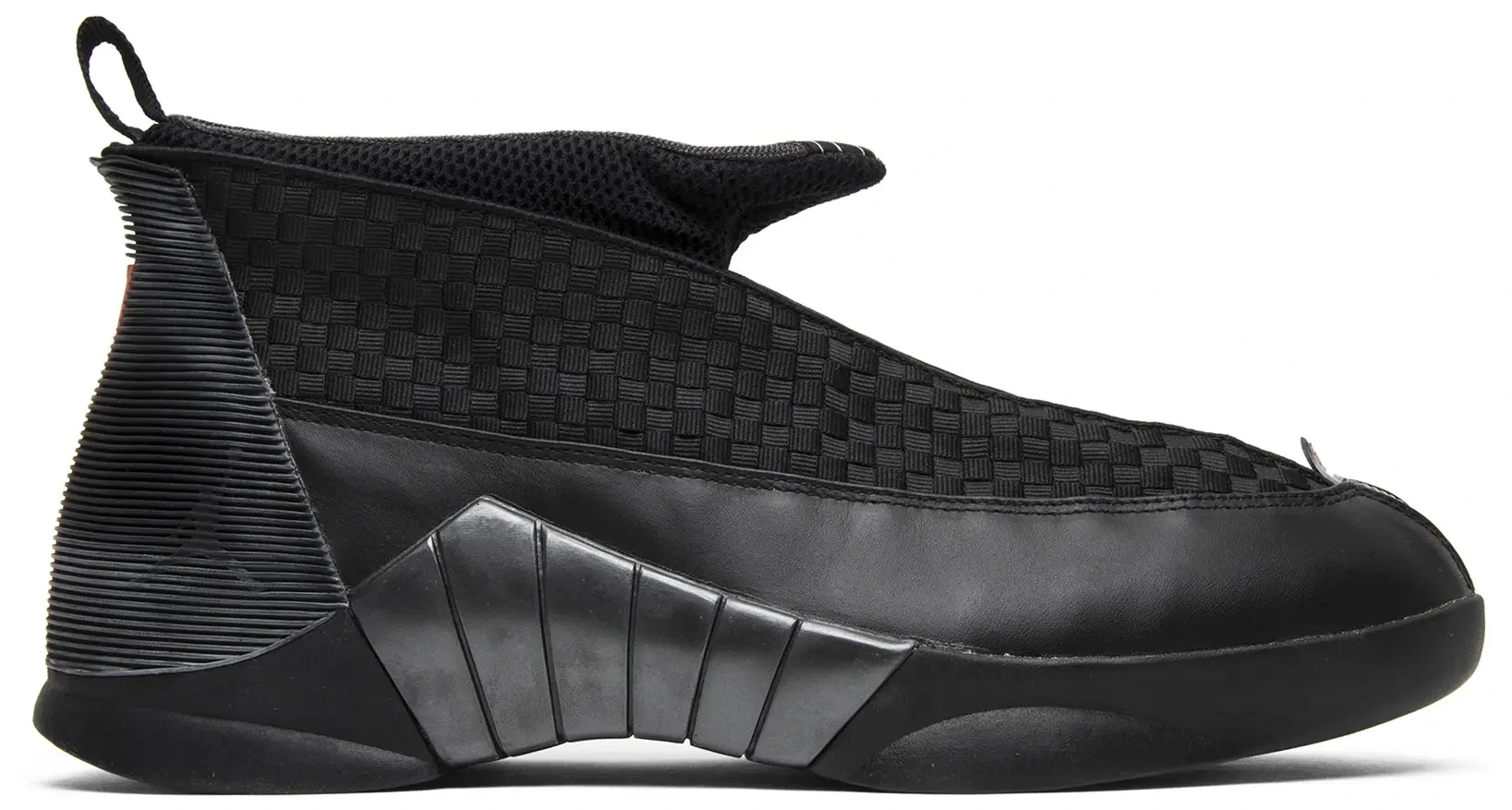
A woven surface and a projecting tongue
The upper’s woven treatment, internal sleeve, hidden quick-lacing arrangement and Zoom Air distinguish the original concept. The protruding tongue echoes Jordan’s habit of sticking out his tongue during play. For a model-wide description, ‘woven upper’ is safer than assuming every later version uses the same fiber or original construction.
Three original colorways
Black/Red, 1999. Black/Varsity Red belongs to the model’s opening release period. Its dark body makes the woven texture and projecting lines central to the appearance. It also shows how the familiar Bulls-associated palette could continue in a signature product even when Jordan was not playing for Chicago.
Columbia Blue, 2000. White/Columbia Blue–Black is an original release from the following calendar year. The lighter palette makes the transition between woven sections and structural areas easier to read. It should not be mislabeled a later retro simply because the model’s headline date is 1999.

Flint Grey, 2000. Flint Grey/White is another original-season color. The restrained palette brings the silhouette and surface construction forward. Its 2000 release shows why the original collection is best understood as a 1999–2000 season.

A broader original family
Other original offerings included Obsidian/White–Metallic Silver. The catalog also includes Lows and Moc versions. Those names describe construction differences, not just extra color choices. They should be separated when counting original releases or comparing the model’s proportions.

Later reinterpretation: Billie Eilish
Nike’s Billie Eilish edition gives the 15 a later cultural chapter. The official launch material identifies it as one of her favorite silhouettes and describes recycled material content for that particular collaboration. Those sustainability details belong to that release; they cannot be projected backward onto every original 1999 pair.
Why the absence of an MJ game matters
Many histories organize the line around a single famous performance. The 15 resists that structure. Its significance must be explained through the product, its release context and the ways later wearers interpret it. That is not an absence of history; it is a different kind of history.
The visual tension comes from the relationship between texture and outline. The woven area encourages a close look at the surface, while the projecting tongue changes the silhouette even from a distance. That combination can divide personal taste, but it gives the 15 a clear identity among the smoother leather-based models around it.
How to compare originals and later editions
Check the cut, material specification, tongue shape, heel details and exact year before comparing two pairs. A monochromatic collaboration may emphasize the silhouette differently from an OG with contrasting areas. That does not make one a replacement for the other in a chronological account.
The most productive searches are specific: ‘Air Jordan 15 Black Red original 1999,’ ‘Columbia Blue 2000’ or ‘Air Jordan 15 Low versus original high.’ These phrases establish the question before bringing in resale listings or photographs. A historical model guide cannot guarantee fit, comfort or the condition of a decades-old pair.
The place of the 15 in the series
The 15 broadens the story of the Air Jordan line beyond the recurring championship image. Its shape is unusually assertive, and its later reinterpretations show that an established design can be encountered by a new audience for different reasons. Understanding the original years and original palette gives that later cultural life a solid starting point.
Mid and Low: first releases and colors
The standard-height 15 debuted in Black/Varsity Red in 1999. Its Low followed in 2000, with White/Deep Red and White/Midnight Navy documented early that year. The available records support this opening pair of palettes rather than one securely ordered first color. The Low relocates the woven treatment toward the rear of the ankle.
Frequently asked questions
When was the Air Jordan 15 released?
The Air Jordan 15 was released in 1999. The original collection continued into 2000.
Who designed the Air Jordan 15?
Tinker Hatfield designed the Air Jordan 15.
Did Michael Jordan wear the 15 in an NBA game?
No. Its original release belongs to his second-retirement period.
Was the X-15 a fighter jet?
No. NASA describes it as a rocket-powered hypersonic research aircraft.
Are Columbia Blue and Flint Grey original colors?
Yes. Both belong to the original 2000 portion of the release cycle.
Sources
Nike Air Jordan 15 archive · Sneaker Files Air Jordan XV history · Original Air Jordan XV: Black/Red · Original Air Jordan XV: Columbia Blue · Original Air Jordan XV: Flint Grey · NASA: X-15 research program · Sneaker Bar Detroit: original Deep Red Low · Sole Retriever: original Midnight Navy Low.
For the wider context, explore Air Jordan History: From the 1984 Nike Deal to the XXXIII.