

The Air Jordan 13 tells its story through shape as much as through color. Rounded sections underfoot, a small holographic detail and a heavily textured upper make it different from the more linear 12. The result offers several ways into the model’s history: the designer’s concept, Jordan’s final Bulls season, the original retail collection and a memorable connection to cinema.
The 1997 debut and the design before it
The Air Jordan 13 reached stores in November 1997. Tinker Hatfield’s concept developed earlier: a sketch dated August 8, 1996 is part of the design history discussed by the Smithsonian. That gap is a reminder that a sketch date and a release date describe different stages of the same product.
Black Cat as a design idea
The panther-inspired outsole and holographic eye connect with Jordan’s Black Cat nickname. Zoom Air and a carbon-fiber plate complete the original performance package.
Three original-season colorways
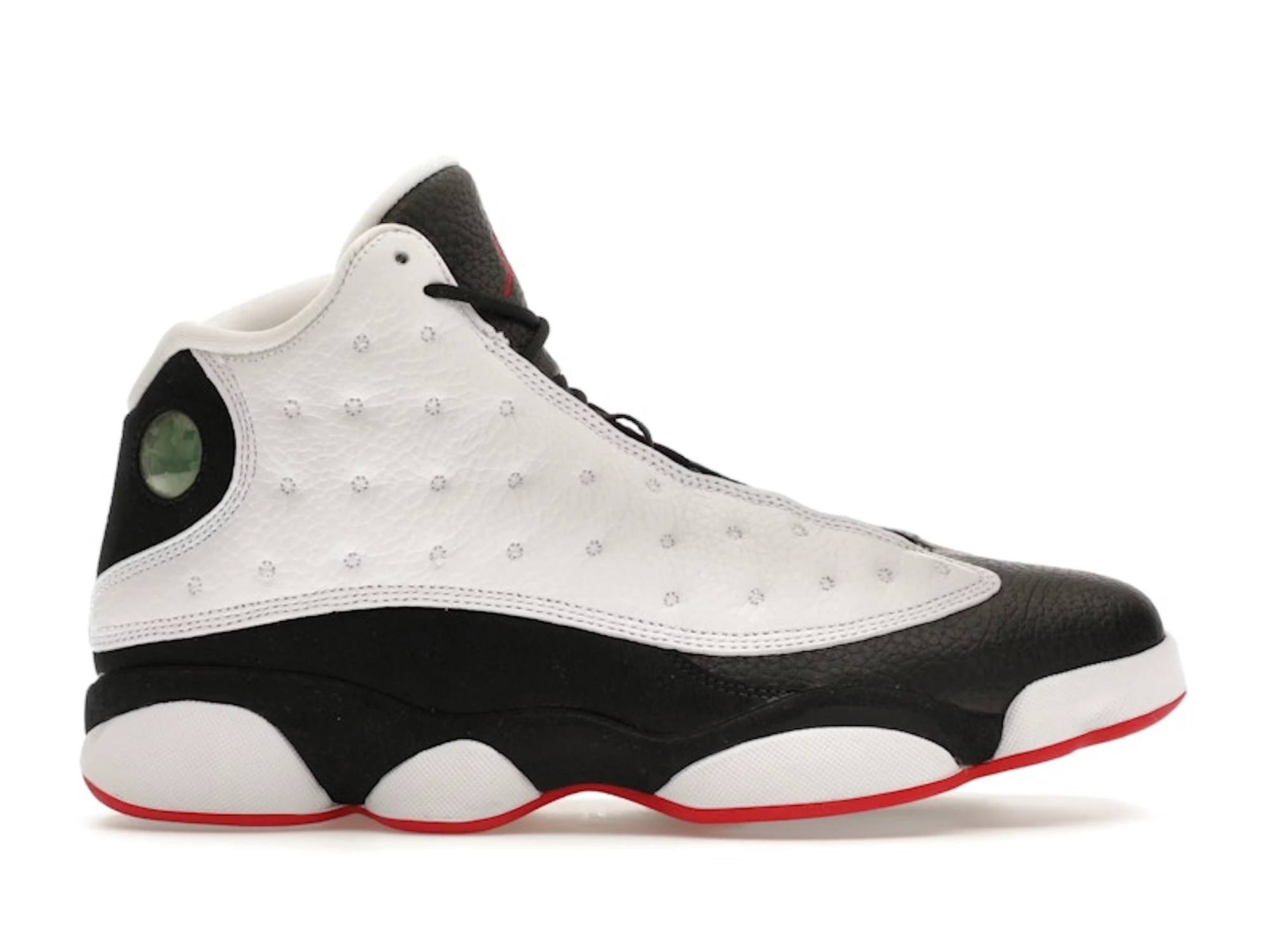
White/Black, 1997–98, widely called He Got Game. The White/Black–True Red–Pearl Grey combination belongs to the initial retail cycle. Its white side panels and black toe create a sharply divided appearance. The movie nickname is useful today, but it should not replace the underlying color description when identifying an original release.
Flint, 1998. Navy/Carolina Blue–Flint Grey–White offers an original alternative to the Bulls palette. The navy reflective side panel and gray lower section are key identifiers. Flint shows why a model-wide history cannot be limited to the colors Jordan wore with Chicago: retail identity and an athlete’s game wardrobe are related, but separate subjects.

Black/Red, 1998. Black/Varsity Red is another original-season release. The dark upper and red lower areas give the panther concept a more concentrated team-color reading. It arrived in 1998, during the model’s original season, and complements the white-and-black and blue-based options.

A shoe with a screen identity
The white-and-black 13 appears on Denzel Washington’s character Jake Shuttlesworth in Spike Lee’s 1998 film He Got Game. That association gives the colorway a cultural reference beyond basketball footage. A later nickname can preserve an original-era connection without having been the formal name printed on every box at the time.
How many original versions were there?
The original catalog comprised five mid-cut colorways and two Lows. White/red and Playoffs complete the mid-cut group beyond the three selected here; the Low versions include navy and Chutney. Counting seven original releases without explaining those different cuts can mislead readers into looking for seven original mids.
The final Bulls season is a broader story
The 13 is closely associated with Jordan’s 1997–98 season, but the final championship-clinching appearance also belongs to the next model, the 14. Keeping the two models separate prevents an evocative phrase such as ‘the last championship shoe’ from obscuring what was actually worn.
A season can contain more than one signature shoe, and the release schedule can cross a calendar year. For the 13, that means a 1997 model debut and several original colors sold in 1998. Neither observation cancels the other. This is especially useful when organizing a chronological collection or writing captions for game photographs.
What to examine in a retro
Nike records a retro return in 2004. Later versions should be studied as editions rather than assumed to reproduce every original detail. Upper materials, reflective treatment, hologram execution and the precise color description are useful comparison points. The presence of a familiar name such as Flint does not answer all of those questions.
Why the design remains legible
The 13 is unusually easy to discuss from more than one angle. A side view emphasizes the large textured panels. An underside view reveals the segmented footprint. A close-up isolates the small jewel. Together those views explain the design more effectively than a single dramatic photograph.
The strongest historical reading preserves that relationship between detail and whole. The shoe is neither just a hologram nor just a film reference. It is a complete silhouette whose original color range and sporting context help explain why different versions can carry distinct memories while remaining immediately recognizable as the same model.
Mid and Low: first releases and colors
The Mid opened in November 1997 with White/True Red–Black. The Low followed in 1998: Black/Chutney is documented for June, ahead of the Navy/Metallic Silver–Black–Carolina Blue release in July. A small Jumpman replaces the Mid’s ankle hologram, giving the lower silhouette its own identifying detail.
Frequently asked questions
When was the Air Jordan 13 released?
It reached stores in November 1997; the 1996 sketch belongs to its development, not its retail launch.
Who designed the Air Jordan 13?
Tinker Hatfield designed the Air Jordan 13.
Why is the design associated with Black Cat?
Its panther-inspired outsole and holographic detail connect with Jordan’s Black Cat nickname.
Are Flint and He Got Game original colors?
Yes. Both belong to the original 1997–98 release cycle; Flint dates to 1998. References disagree on the exact debut year of the White/Black colorway known as He Got Game.
Did Jordan wear the 13 for the final shot of the 1998 Finals?
No. That famous final Bulls shot is associated with the Air Jordan 14.
Sources
Nike Air Jordan 13 archive · Sneaker Files Air Jordan XIII history · Original Air Jordan XIII: He Got Game · Original Air Jordan XIII: Flint · Original Air Jordan XIII: Black/Red · Smithsonian: Air Jordan design · Sneaker News: original Chutney Low · Sneaker Files: original Navy Low.
For the wider context, explore Air Jordan History: From the 1984 Nike Deal to the XXXIII.