
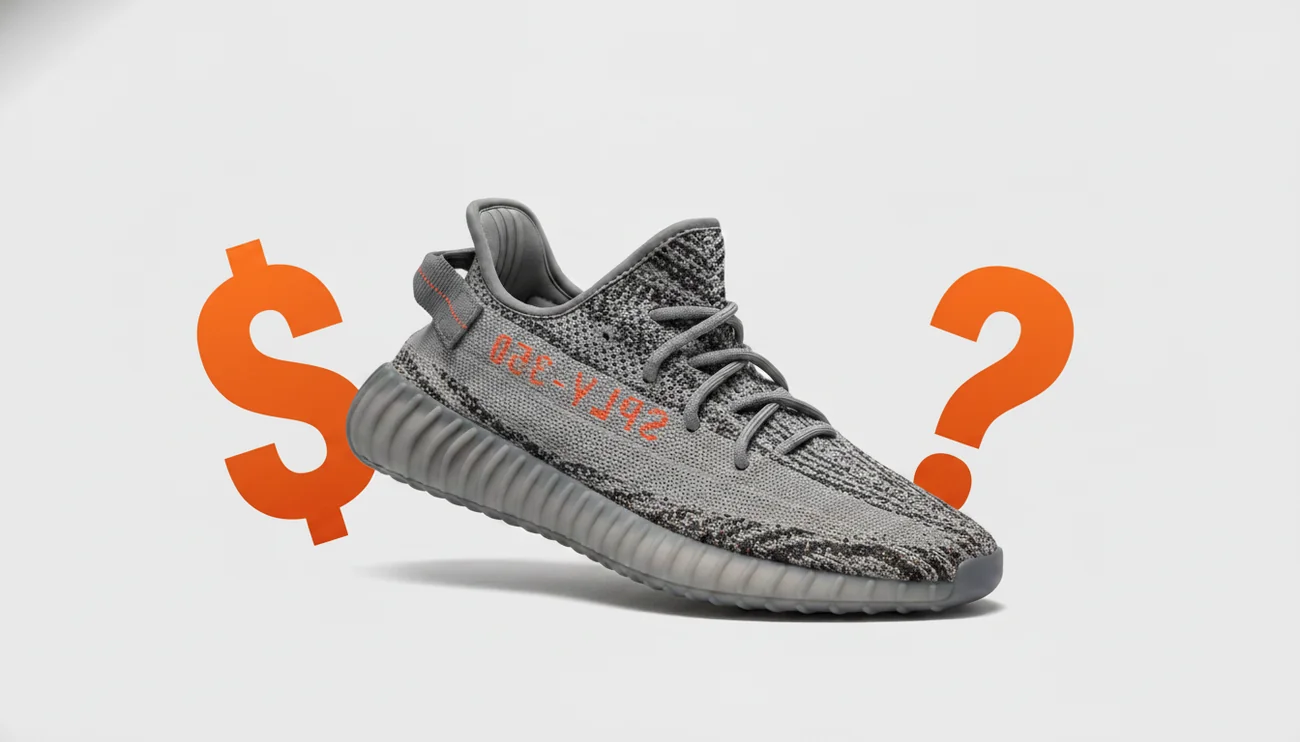
A sneaker price check is an estimate of what a pair may be worth in a specific market at a specific time. The most responsible result is usually a defensible price range—not one “correct” number—built from truly comparable sales, current asks, buyer offers, condition, size, and transaction costs.
The estimate can change with model, colorway, style code or SKU, release year, size, condition, box, accessories, platform, seller and buyer location, fees, shipping, sales tax, supply, demand, and the date of the research. Two sneakers that look almost identical can therefore trade at very different prices.
Price check is part of secondary-market vocabulary. For more resale terms, see the Sneakerhead Dictionary.
What Does “Price Check” Mean in Sneaker Culture?
A price check is the process of gathering market references to estimate the range in which a sneaker could realistically be bought or sold on the secondary market.
Price check is not the same as retail price. Retail is the original authorized selling price; resale is a later secondary-market transaction that can happen above, near, or below retail. See our guide to sneaker resale.
There is also no single authority that decides what every sneaker is “worth.” Marketplaces observe their own listings, offers, and transactions; stores have different margins; and direct sales reflect local conditions. A price check organizes those signals but does not guarantee a sale at the estimated range.
Does a Price Check Show the “Real Value” of a Sneaker?
Usually, there is no single permanent “real value.” It is more accurate to talk about an estimated market range, observed selling prices, or current market references.
A price check is a snapshot. Restocks can add supply, re-releases can change interest in older editions, demand can move, and one size can behave differently from another. Always attach a date and context to the estimate.
Retail, Ask, Offer, and Sold Price: What Is the Difference?
Retail
Retail is the original authorized selling price from the brand or an authorized retailer. It is useful historical context, but it does not create a permanent floor or ceiling for secondary-market pricing.
Lowest Ask
An Ask is a seller’s requested price. On StockX, the Lowest Ask is the lowest active Ask available for the relevant variant, and Buy Now lets a buyer purchase at the applicable lowest Ask. The Lowest Ask is an active seller expectation, not proof of a completed sale; it can remain above what buyers are willing to pay, and StockX regional or all-in pricing can make visible Ask figures differ by location.
Highest Offer
An Offer is a buyer’s proposed price. On StockX, sellers can use Sell Now to accept the current highest compatible Offer. The Highest Offer is not automatically a fair or final market value: Offers can expire or be changed before a sale is confirmed. Older sneaker discussions may use the word Bid; StockX currently emphasizes Offer in its Verified Marketplace.
Last Sale and Sales History
When a platform shows Last Sale, it generally refers to the most recent recorded transaction for the selected product or variant. Sales history gives you additional completed transactions.
One sale does not define the market. It may be old, size-specific, region-specific, or unusually high or low. The older and more isolated the transaction, the less weight it should usually carry in a current estimate.
Asking Price Is Not Sold Price
A seller can list a sneaker at almost any price allowed by the platform. That number records what the seller wants, not what a buyer has actually agreed to pay.
Completed sales generally deserve more weight than isolated active listings. Asks are still useful because they show current supply, but an Ask alone does not prove demand exists at that level.
Spread, Liquidity, Volume, and Recency
What Is the Spread Between Ask and Offer?
The spread is the gap between the lowest active Ask and the highest active Offer. A wide spread can show disagreement between buyers and sellers or a less active market; a narrow spread can indicate that expectations are closer together. It is a signal, not a formula.
What Is Liquidity?
Liquidity describes how easily or frequently a pair finds a buyer. A sneaker can have a very high Ask and almost no sales. In that case, the listing may say more about seller expectations than about how quickly the pair can realistically be converted into cash.
Why Do Volume and Recency Matter?
Several recent transactions for the same release, size, and condition usually create a stronger reference than one old sale. Look at frequency, dates, and dispersion instead of relying on a single headline number.
An unusually high or low sale can be an outlier caused by condition, rare size, incorrect identification, region, or timing. Averages can help, but they should not hide changes in trend or obvious extremes.
How to Price Check Sneakers Step by Step
1. Identify the Exact Product
Confirm the brand, model, colorway, style code or SKU, and edition. Similar names and nearly identical colorways can lead to the wrong comparison. The SKU is useful for identifying the release, but it does not authenticate the physical pair by itself.
2. Confirm the Release Year and Generation
The same colorway can have an original release and several retros. Each edition can have its own SKU, materials, shape, branding, box, supply, and market. Do not treat two release years as the same product just because the colorway name matches.
3. Use the Correct Size
Check the exact size. Supply and demand can vary significantly by size, so a general average across all sizes may be poor evidence for one specific pair.
Also confirm sizing category and conversion. Men’s, women’s, GS, PS, and TD versions should not be treated as interchangeable comparables simply because they share a colorway name.
4. Define the Condition
Separate new or unworn pairs from used pairs. Record the original box, replacement box, box damage, missing box, extra laces, hangtags, special inserts, dust bags, and release-specific accessories.
Do not apply a universal percentage discount for every flaw. The impact of a missing box, stain, repair, or accessory depends on the specific product and the availability of comparable pairs.
5. Analyze Recent Completed Sales
Look for completed transactions involving the same release, size, and closest possible condition. Compare multiple sales and dates, and give less weight to isolated or clearly stale transactions.
6. Compare Ask and Offer
Use the Lowest Ask to understand current seller expectations and the Highest Offer to understand active buyer demand. Study the gap between them, but do not confuse either figure with a completed transaction.
7. Check More Than One Source
Compare sold data, active listings, and condition information across more than one marketplace when possible. For used and vintage pairs, marketplaces that preserve detailed photos and condition descriptions may provide better comparables than markets centered on new items.
8. Adjust for U.S. Market Costs
For U.S. buyers, compare the actual checkout total: item price, shipping, sales tax, buyer fees, optional verification charges, and any other platform-specific costs. For sellers, estimate net proceeds after commissions, processing, shipping, promoted-listing costs, or other applicable charges.
A buyer’s total and a seller’s payout can be very different even when both refer to the same transaction. “Sold for $300” does not automatically mean the seller received $300 or that the buyer paid exactly $300 all-in.
9. Build a Range, Not a Magic Number
Finish with a range supported by recent comparable evidence. If only a few comparable sales exist, widen the uncertainty and say so. A low-liquidity vintage pair should not be presented with the same confidence as a current sneaker with dozens of recent sales.
Why Do Size, Release, and SKU Change the Result So Much?
A popular model name can hide many separate products: men’s and women’s versions, GS sizes, High, Mid, Low, original releases, later retros, and regional editions. Small differences in identifiers can represent completely different markets.
Size has its own supply and demand too. One size may be easy to find while another has very little active inventory, so the “average price” of a model is only broad context.
How Do You Price Check Used Sneakers?
For a used sneaker, compare the same release, size, and the closest condition available. Photos and description matter because two “used” pairs can be dramatically different.
- outsole wear, heel drag, and loss of traction;
- creases, stains, scuffs, tears, and repairs;
- yellowing, oxidation, and discoloration;
- sole separation, glue issues, and midsole integrity;
- odor and condition of the insole and lining;
- original box, replacement box, or no box;
- extra laces, tags, and release-specific accessories;
- customization, replacement parts, or restoration.
Deadstock or DS usually describes a new, unworn pair in sneaker culture, but the exact marketplace criteria vary. Even an unworn sneaker can have box damage, missing accessories, manufacturing variation, or age-related deterioration.
Condition helps determine price; it does not replace market evidence.
How Do You Price Check Vintage or Older Sneakers?
Older pairs often have low liquidity and very few true comparables. Structural condition, originality of components, provenance, size, box, and rarity can matter more, but those characteristics still need actual buyer demand.
A collectible sneaker may have market value and still be unsafe to wear. Foams, adhesives, rubber, and other materials age even when the sneaker was never worn. See our guide to sneaker crumbling and hydrolysis.
Where Can You Check Sneaker Prices?
StockX
StockX is useful for size-specific active Offers and Asks, recent transaction history, and pricing guidance. In 2026, U.S. Verified Marketplace sellers also have tools such as Sell Now, Sell Faster, and Earn More. Sell Now reflects the highest current Offer; Earn More uses recent global sales to suggest a more ambitious competitive price; and Sell Faster is built around competitive current pricing.
StockX also uses regional and all-in pricing logic, so visible Ask and sales-history figures should be interpreted in context. One StockX screen is not a universal market price. See our StockX buying guide.
GOAT
GOAT can provide useful current asking-price references across new, used, and new-with-defects inventory. Approved sellers identify the SKU, condition, and price, and used or defective listings require photos. GOAT also uses Offers in some transactions. A displayed asking price or accepted Offer on one platform still should not be treated as a universal cross-platform valuation. See our GOAT guide.
Flight Club
Flight Club is useful as a consignment-market reference, particularly for rare or collectible sneakers, but the visible price reflects that retail/consignment environment. It is not directly equivalent to a peer-to-peer sold price or StockX Highest Offer.
When using Flight Club, compare the exact size and condition and remember that store economics, inventory, and service model can produce different pricing. See our Flight Club guide.
eBay and Completed Sales
eBay can be especially useful for used, vintage, uncommon, and condition-sensitive sneakers. Basic completed/sold-item search can show recent transactions, while eBay Product Research gives eligible Seller Hub users up to three years of sales data, including actual sold prices from accepted Best Offers, average sold price, sold range, shipping costs, trends, and sell-through rate for recent windows.
Still filter carefully by model, SKU, size, condition, buyer or seller location, and category. Broad searches can mix different releases or unrelated products.
How to Price Check Sneakers in the U.S. Using Global References
A global sale is useful context, but it is not automatically the same as U.S. market value. Regional inventory, buyer demand, platform rules, shipping, duties embedded in international prices, and currency effects can all change what a comparable means.
- compare U.S.-based sold data when available;
- check whether the displayed price includes duties or regional adjustments;
- separate item price from shipping, tax, and buyer fees;
- use the same size and condition;
- check whether the sale came from the same release year and market;
- for sellers, compare expected payout rather than only buyer-facing price;
- for buyers, compare final checkout cost rather than only the headline price;
- treat global data as supporting evidence when the local U.S. sample is thin.
Platforms change fee and tax handling over time. For an evergreen price check, it is better to describe the cost categories and check the current checkout than to hard-code one tax rate or fee percentage.
For U.S. transactions, sales tax generally depends on the destination and marketplace collection rules. The useful number for a buyer is the real final checkout total, while the useful number for a seller is expected net proceeds.
Which Factors Actually Influence Sneaker Price?
- Supply and demand: low supply matters only when buyers are willing to pay.
- Size: each size can have its own inventory and demand.
- Condition: wear, damage, aging, box, and accessories change comparability.
- Release: OG releases and later retros can trade in different markets.
- Location: regional inventory, platform pricing, shipping, and taxes affect totals.
- Liquidity: a high Ask with few sales may not be achievable quickly.
- Recency: restocks, re-releases, and changing demand can make old data less representative.
Rarity, hype, history, and collaborations can influence demand, but none guarantees a high price. A collab can trade above, near, or below retail, and a rare pair can still have very few interested buyers.
Hypothetical Sneaker Price Check Example
Imagine the same release, size, and new condition has three recent completed sales at $230, $240, and $250. The Lowest Ask is $280 and the Highest Offer is $220. The sales cluster around $230–$250, while the $60 spread shows that the cheapest seller and highest active buyer are still apart.
That does not make $240 the automatic “correct value.” Check the sale dates, number of transactions, U.S. versus global pricing context, and whether fees or regional adjustments change what the buyer paid or seller received.
If your pair is used, missing its box, repaired, or missing accessories, do not apply the new-pair range directly. Find condition-matched comparables or widen the uncertainty.
Common Sneaker Price Check Mistakes
- looking only at the Lowest Ask;
- treating one Last Sale as the definitive value;
- using an active listing as if it were a completed sale;
- ignoring size or mixing men’s, women’s, GS, PS, or TD products;
- confusing similar colorways or different release years;
- failing to confirm the style code or SKU;
- comparing used sneakers with new or DS pairs;
- ignoring box, accessories, defects, or restoration;
- using only one marketplace;
- ignoring shipping, sales tax, platform fees, or verification costs;
- confusing sale price with seller profit or payout;
- using stale data or one extreme outlier without context;
- assuming rarity, hype, or collaboration guarantees appreciation.
Does a Price Check Confirm Authenticity?
No. A price far below the normal range can be a warning sign, but it does not prove a sneaker is counterfeit. A high price does not prove authenticity either.
Price check estimates market references; Legit Check evaluates authenticity. Provenance, product details, photos, seller reliability, marketplace protections, and authentication evidence remain separate questions.
Can a Price Check Predict Appreciation or Investment Returns?
No. A price check describes present and recent market evidence; it does not reliably predict future demand. Sneakers can restock, be re-released, fall out of fashion, deteriorate physically, or become harder to sell.
Use a price check to reduce the chance of paying far outside current comparables or to create a more realistic listing range. Do not treat it as a promise of profit, future appreciation, or fast liquidity.
Sneaker Price Check FAQ
What Does Price Check Mean in Sneakers?
It means estimating a sneaker’s current market range using comparable release, size, condition, platform, and location data.
How Do I Know How Much My Sneakers Are Worth?
Identify the exact model, colorway, SKU, release year, size, and condition; compare several recent completed sales; review current Ask and Offer data; check another marketplace; then adjust for box, accessories, fees, and U.S. market conditions.
Is the Lowest Ask the Value of a Sneaker?
No. Lowest Ask is the lowest current seller request in that marketplace context. It is not a completed transaction until a buyer actually accepts or matches the price.
Is Last Sale the Correct Price?
Not necessarily. It is one recent transaction reference and may be stale, size-specific, region-specific, or an outlier. Compare multiple recent sales.
What Is the Difference Between Ask and Offer?
Ask is what the seller wants. Offer is what a buyer is willing to pay. The difference between the lowest Ask and highest Offer is the spread.
Does Sneaker Size Change the Price?
It can. Each size has its own supply, demand, and transaction history. Do not mix adult sizing with GS, PS, or TD versions.
Can You Price Check Used Sneakers?
Yes. Use condition-matched comparables and account for outsole wear, damage, aging, repairs, box, accessories, and structural condition.
Does the Original Box Affect Value?
It can, especially with collectible releases or special packaging, but there is no universal percentage. The effect depends on the release and available comparables.
Is StockX Enough for a Price Check?
No single source is ideal in every case. StockX offers strong signals for many products, but eBay sold data, GOAT inventory, consignment pricing, and local or direct-sale evidence can improve the estimate, especially for used and vintage sneakers.
Should I Treat a Global Sale Price as U.S. Market Value?
Not automatically. Global sales can be useful evidence, but regional inventory, taxes, shipping, duties, and platform pricing can change what the comparable means for a U.S. buyer or seller.
Does Every Limited, Rare, or Collaborative Sneaker Cost More?
No. Scarcity without demand does not guarantee a high price, and a collaboration or hyped release can trade below retail.
How Long Is a Sneaker Price Check Valid?
There is no fixed expiration period. Fast-moving releases, restocks, news, and changing demand can move the range quickly. Record the date and refresh the data before an important transaction.
Conclusion
A useful sneaker price check combines exact product identification, correct size, comparable condition, recent completed sales, current Ask and Offer data, liquidity, more than one marketplace, and realistic U.S. transaction costs.
It does not discover one universal price. It builds a defensible market range for a specific pair at a specific moment. For more secondary-market terminology and cultural context, explore the Sneakerhead Dictionary and Sneaker History & Culture.