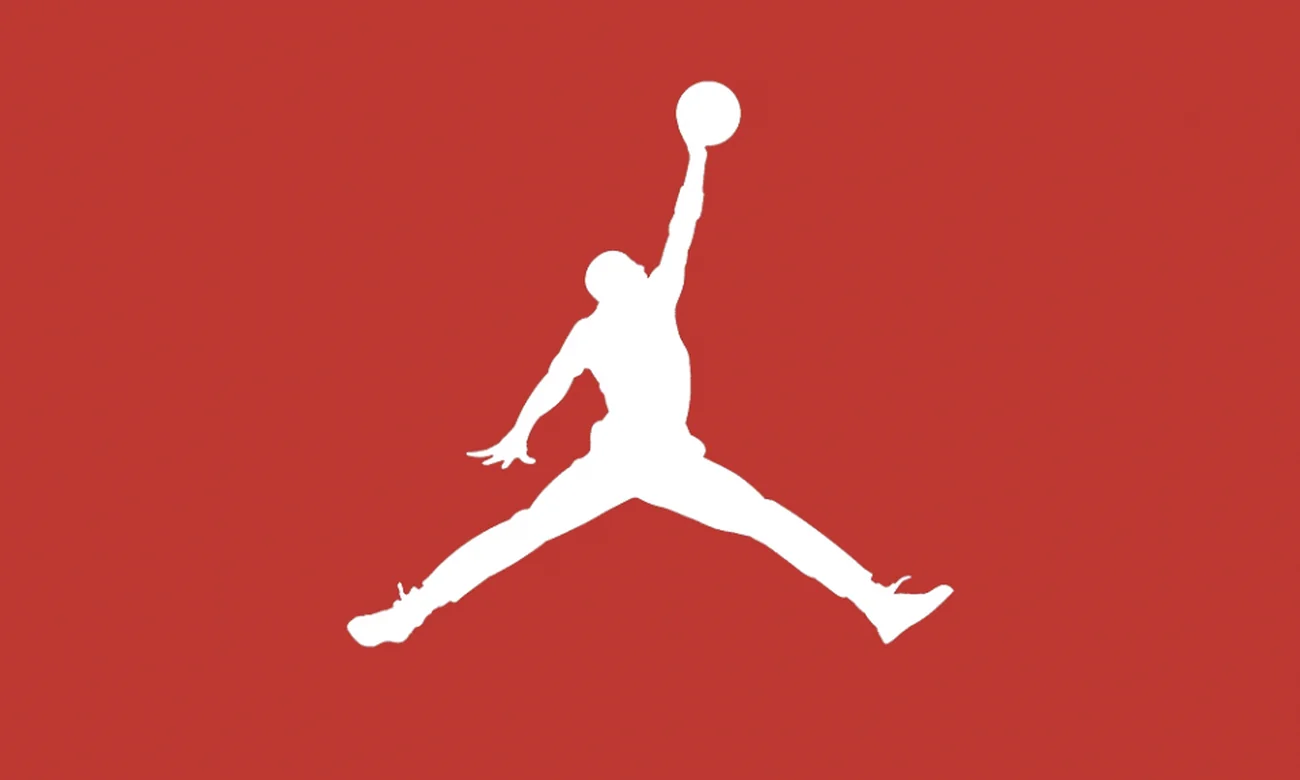
Jumpman is the name commonly used for the silhouette of Michael Jordan suspended in the air with a basketball in one hand. It became the most recognizable visual symbol associated with Jordan Brand, which is part of NIKE, Inc. Its origin, however, cannot be reduced to one photograph or to Michael Jordan’s 1988 Slam Dunk Contest victory.
The story involves a 1984 photograph created by Jacobus “Co” Rentmeester for LIFE, a later photo shoot commissioned for Nike, graphic identity work credited to Peter Moore, and the decisive use of the logo on the Air Jordan 3 designed by Tinker Hatfield. “Jumpman” is also part of the language of sneaker culture, but first and foremost it identifies a symbol built around Michael Jordan and the Jordan universe.
What Does Jumpman Mean?
The name combines jump and man. In Nike and Jordan Brand usage, Jumpman identifies the stylized silhouette of Michael Jordan in an airborne pose. Publicly available historical sources do not conclusively establish who coined the name or the exact date when it first became official terminology.
Its historical meaning is more precise than a list of marketing attributes: the logo turns Jordan’s body in motion into a visual mark. Over time, Jordan Brand connected that image with his athletic legacy, the idea of flight, and the intersection of sport and culture. Words such as “performance,” “luxury,” or “innovation” may describe products or campaigns, but they are not literal definitions of Jumpman.
Who Is the Player in the Jumpman Logo?
The player is Michael Jordan. The silhouette preserves his recognizable body position and connection to basketball, but it is not a candid image captured during a game. The pose was created during controlled photo sessions.
It is also inaccurate to say the logo is simply a cutout of Jordan’s famous free-throw-line dunk from the 1988 Slam Dunk Contest. The photographic story behind the Jumpman began several years earlier.
Where Did the Jumpman Pose Come From?
To understand the logo’s origin, it helps to separate three stages: Co Rentmeester’s photograph, the later photograph commissioned for Nike, and the transformation of Jordan’s figure into a simplified silhouette.
Co Rentmeester’s 1984 Photograph
In 1984, photographer Jacobus “Co” Rentmeester photographed Michael Jordan for a LIFE magazine feature on U.S. athletes preparing for the Los Angeles Olympic Games. Jordan was still a student at the University of North Carolina.
The scene was staged rather than photographed during competition. Rentmeester placed Jordan on a grassy rise, used a basketball hoop as part of the composition, and directed him into a pose inspired by a ballet grand jeté, with the legs extended in opposite directions and the ball raised in one hand.
The later federal court record describes the photograph as a carefully composed image involving choices of pose, camera angle, timing, lighting, and shutter speed. Nike obtained limited access to transparencies of the photo before commissioning its own image.
The Later Photograph Commissioned for Nike
In late 1984 or early 1985, Nike commissioned another photograph of Michael Jordan in a broadly similar airborne pose. The second image was created outdoors with the Chicago skyline in the background, Bulls-related colors, and Nike footwear. Nike used the image in posters and billboards connected to the early Air Jordan campaign.
The two photographs share the idea of Jordan suspended in the air, but they are not the same image. The background, framing, lighting, limb positions, scale of the figure, clothing, and relationship to the basket differ.
How the Nike Photograph Became a Silhouette
The federal appellate record in Rentmeester v. Nike states that Nike created the Jumpman logo in 1987. The logo follows the outline of Jordan’s body as it appears in Nike’s own photograph, simplified into a solid graphic form.
That sequence matters: Rentmeester’s image is an important earlier reference in the history; Nike then commissioned a separate photograph; and the Jumpman silhouette was derived from Jordan’s figure in Nike’s later image. Calling either photo alone “the original Jumpman photo” hides important differences.
Who Created the Jumpman Logo?
The most consistent graphic-design credit is Peter Moore, Nike’s creative director during the early Air Jordan years. The Peter Moore Created archive credits him with both the original Wings logo and the Jumpman, along with the Air Jordan 1 and Air Jordan 2.
The contributions still need to be separated carefully. Rentmeester conceived and directed the 1984 photograph. Nike commissioned another session with Jordan. Moore is credited with developing the graphic identity and silhouette. Public documentation does not describe every internal production step behind the final artwork.
Tinker Hatfield should not be described as the creator of the Jumpman simply because he designed the Air Jordan 3. His documented role was designing the AJ3 and giving the logo one of its most important early placements on the shoe.
The Jumpman Timeline in a Few Steps
- 1984: Co Rentmeester photographs Jordan for LIFE in a directed airborne pose.
- Late 1984 or early 1985: Nike commissions its own photograph of Jordan in a related but visually different pose.
- 1987: according to the federal court record, Nike creates the Jumpman silhouette from Jordan’s figure in its photograph.
- 1988: the Air Jordan 3 places the Jumpman prominently on the tongue and becomes the logo’s defining early sneaker moment.
- 1997: the business officially becomes Jordan Brand within NIKE, Inc., giving the Jumpman a broader portfolio to represent.
- 2016 and beyond: Jumpman branding expands visibly into sports outside basketball, including college football and other global partnerships.
When Did the Jumpman First Appear on Air Jordans?
The Air Jordan 3, released in 1988, is the clearest landmark. Nike’s official Air Jordan 3 archive identifies the model as a 1988 Tinker Hatfield design and connects it directly with the birth of the Jumpman icon.
That does not mean 1988 was the first time the underlying image had appeared anywhere. Nike had already used its photograph in advertising, and the federal court record places creation of the graphic logo in 1987. It is useful to distinguish the photograph, the graphic mark, and the logo’s prominent use on a sneaker.
Why Was the Air Jordan 3 So Important to the Jumpman?
Nike’s official archive dates the Air Jordan 3 to 1988 and identifies Tinker Hatfield as its designer. The embroidered Jumpman on the tongue gave Jordan’s silhouette a highly visible, front-facing position on one of the most important models in the franchise.
Original 1988 versions used Nike Air branding at the heel. Later retros have varied between Nike Air and Jumpman treatments depending on the release, so the branding on a modern retro should not automatically be projected backward onto the original AJ3.
Jordan also won the 1988 Slam Dunk Contest wearing the White/Cement Air Jordan 3. That moment strengthened the cultural association between the shoe, flight, and the Jumpman. But the logo was not designed from a photograph of that dunk; its visual history predates the contest.
Wings, Jumpman, and Swoosh: What Is the Difference?
Wings
The Wings logo—the basketball with wings—is part of the original Air Jordan identity and is strongly associated with the Air Jordan 1. Peter Moore is credited with creating the logo as well as designing the AJ1. Wings did not disappear when Jumpman became prominent; it remains visible on retros, apparel, and Jordan projects.
Jumpman
Jumpman represents Michael Jordan’s airborne silhouette and became the broader visual mark of the Jordan universe. It appears across numbered Air Jordans, performance and lifestyle footwear, apparel, accessories, uniforms, and products connected to athletes and sports beyond Jordan’s original signature line.
Swoosh
The Swoosh is Nike’s primary corporate and product mark. Because Jordan Brand is part of NIKE, Inc., the identities are historically and corporately connected, but they are not interchangeable. Depending on the model and release, Swoosh, Wings, Jumpman, and Nike Air branding can appear separately or together.
Are Air Jordan and Jordan Brand the Same Thing?
Not exactly. Air Jordan is the footwear franchise that began around Michael Jordan’s signature product in the 1980s. Jordan Brand is the broader brand structure that developed later.
Official NIKE, Inc. material states that the business officially became Jordan Brand in 1997. Air Jordan products and the Jumpman therefore existed before the organization had the corporate identity we now call Jordan Brand. That is why it is historically imprecise to write that “Jordan Brand launched the Air Jordan 3 in 1988” without explaining the timeline.
Today, Jordan Brand remains part of NIKE, Inc. while operating with its own identity, leadership, products, athletes, and partnerships. Its portfolio extends beyond numbered Air Jordans to athlete signature lines, team footwear, lifestyle products, apparel, and accessories.
Does Every Jordan Product Have a Jumpman?
No universal rule works here. Logo placement changes by model, year, edition, sport, and purpose. Some products emphasize Jumpman; others highlight Wings, Nike Air, Swoosh, an athlete’s personal mark, or another design identity.
The reverse is also important: seeing a Jumpman does not mean the product is necessarily a numbered Air Jordan retro. The symbol represents the broader Jordan Brand ecosystem.
Why Did the Jumpman Become a Global Symbol?
The Jumpman’s power does not depend on every Jordan product being rare or expensive. Its recognition was built through several historical factors:
- the direct association with Michael Jordan and his basketball career;
- the long-running success of the Air Jordan franchise;
- the prominent visual role the logo gained on the Air Jordan 3;
- decades of exposure across footwear, apparel, advertising, and popular culture;
- Jordan Brand’s expansion to new athletes, product categories, and sports;
- the simplicity of a silhouette that remains recognizable across different sizes and applications.
Some Jordans are limited and highly contested; many others receive wide distribution or eventually go on sale. Resale price and exclusivity do not define the Jumpman or explain its cultural significance by themselves.
Is the Jumpman Used Only in Basketball?
No. Basketball remains the historical core of the symbol, but Jordan Brand has expanded into other sports and lifestyle categories. A particularly U.S.-relevant example came in 2016, when the University of Michigan football program became the first college football team in the country with an exclusive Jordan Brand partnership and wore Jumpman-branded uniforms.
Jordan Brand has also built partnerships with Howard University and expanded into global football through Paris Saint-Germain and other programs. These examples show that Jumpman now identifies a sports-and-culture ecosystem much larger than the numbered Air Jordan series alone.
The Co Rentmeester vs. Nike Copyright Case
In 2015, Rentmeester sued Nike, alleging that Nike’s commissioned photograph and the Jumpman logo infringed the copyright in his 1984 image. The case concerned photographic copyright, not a dispute over who owned a trademark registration for the Jumpman name or symbol.
In 2018, the U.S. Court of Appeals for the Ninth Circuit affirmed dismissal of the case. The court accepted that Rentmeester owned a valid copyright and held that Nike’s access to his photo plus the conceptual similarities were enough to support a presumption that Nike’s photograph was inspired by or copied from the earlier image rather than created wholly independently.
That did not end the legal analysis. Copyright protects the particular expression of an idea, not the general idea of a pose. The court found that differences in framing, body position, setting, lighting, and visual arrangement meant the works were not substantially similar in the legally required sense. The Jumpman logo, as a stylized silhouette derived from Nike’s photograph, was even less similar to Rentmeester’s photo.
One judge agreed with the result regarding the logo but believed the similarity between the two photographs should not have been resolved so early in the case. The panel’s final judgment nevertheless favored Nike. The balanced conclusion is that the conceptual influence was recognized, but the court did not find unlawful appropriation of protected expression.
Jumpman FAQ
What Does Jumpman Mean?
Jumpman is the name used for the silhouette of Michael Jordan suspended in the air with a basketball. The public sources reviewed do not establish who originally coined the name.
Is the Jumpman Michael Jordan?
Yes. The figure represents Michael Jordan in a staged airborne pose that was later converted into a silhouette.
Was the Jumpman Photo Taken During a Game?
No. Both Rentmeester’s 1984 image and Nike’s later photograph were planned photo shoots rather than spontaneous game photographs.
Did the Jumpman Come From the 1988 Slam Dunk Contest?
No. The photographic history begins in 1984, and the federal court record states that Nike created the silhouette in 1987. Jordan’s 1988 dunk-contest victory helped strengthen the association between the icon, flight, and the Air Jordan 3.
Who Created the Jumpman Logo?
Peter Moore is the designer most consistently credited with the graphic creation of the Jumpman. Co Rentmeester created the earlier influential photograph, and Tinker Hatfield designed the Air Jordan 3, but those roles are not the same.
What Was the First Air Jordan With the Jumpman?
The Air Jordan 3 from 1988 is the first numbered Air Jordan most clearly associated with a prominent Jumpman application on the shoe, especially the embroidered logo on the tongue. The graphic mark itself existed before the AJ3 release.
Did Jumpman Replace the Wings Logo?
Not completely. Jumpman became the broader Jordan identity, but Wings remains strongly associated with the Air Jordan 1 and still appears on current Jordan products.
Does Jordan Brand Belong to Nike?
Yes. Jordan Brand is part of NIKE, Inc. The dedicated business officially became Jordan Brand in 1997, after the Air Jordan line and Jumpman already existed.
Does Every Jordan Shoe Have a Jumpman?
Not necessarily. Branding varies by model and edition, and some products emphasize Wings, Nike Air, Swoosh, or athlete-specific marks. Not every product carrying Jumpman is a numbered Air Jordan either.
Is Jumpman Used Outside Basketball?
Yes. Jordan Brand has used Jumpman across college football, global football, lifestyle products, and other sports. The University of Michigan became the first U.S. college football program with an exclusive Jordan Brand partnership in 2016.
Conclusion
Jumpman is Michael Jordan’s silhouette and the defining visual symbol of the Jordan universe, but its history begins before the Air Jordan 3. It runs through Co Rentmeester’s directed 1984 photograph, a separate photo commissioned for Nike, graphic development credited to Peter Moore, and the highly visible use of the logo on Tinker Hatfield’s Air Jordan 3 in 1988.
Keeping that sequence straight avoids three common mistakes: treating the two photographs as the same image, crediting Tinker Hatfield with creating the Jumpman, and describing 1980s Air Jordan history as if Jordan Brand already existed in its current organizational form. For more context, read the history of the Air Jordan 1 and explore Sneaker History & Culture.
Sources Consulted
- U.S. Court of Appeals for the Ninth Circuit — Rentmeester v. Nike, Inc. (2018)
- Nike / Department of Nike Archives — Air Jordan 3
- Nike / Department of Nike Archives — Air Jordan 1
- NIKE, Inc. — Howard “H” White profile and Jordan Brand timeline
- University of Michigan — 2016 athletics report and Jordan Brand football partnership
- Peter Moore Created — design archive and biography
- NIKE, Inc. — Jordan Brand x Howard University