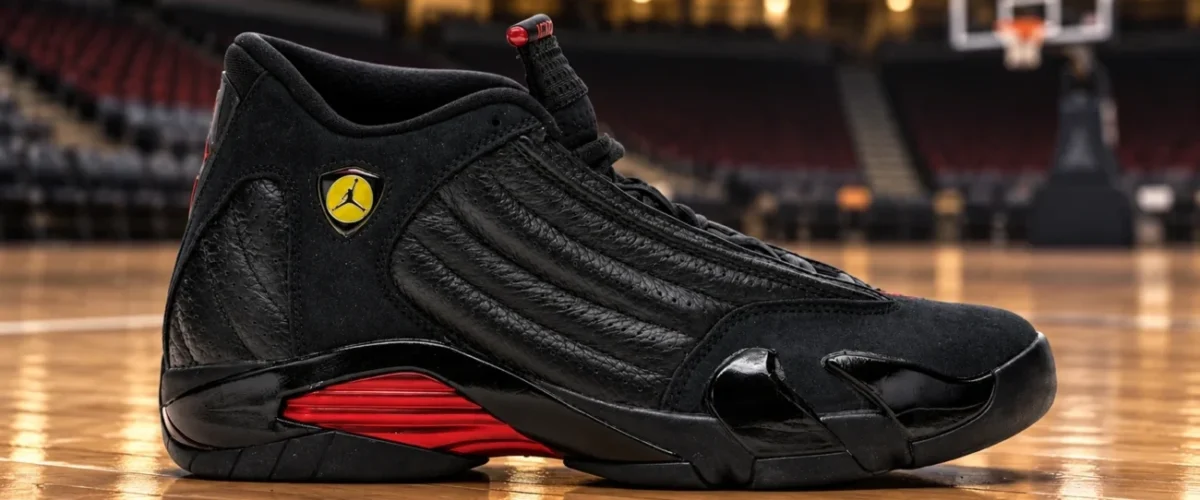
The Air Jordan 14 entered history before it reached stores through a normal release. Michael Jordan wore an early black-and-red version during the 1998 Finals, closing his playing career with the Bulls in that shoe. His jumper over Bryon Russell made “Last Shot” a permanent basketball image. On his feet, a low-profile sneaker with aggressive lines and a small side shield looked suited to that idea of controlled speed.
The XIV launched at retail in 1998. Its design, associated with Tinker Hatfield, translated Jordan’s passion for sports cars into the line’s visual language. But two different stories hide inside the word Ferrari: the model’s inspiration and later colorways that received that nickname. Understanding the distinction helps explain both the Finals pair and versions that explored the theme more explicitly.
An early version in the Finals before retail release
According to Nike’s archive, Hatfield gave Jordan an early version of the XIV and asked him not to wear it yet. The player liked the shoe and took it onto the court anyway. The important detail is the sequence: MJ’s use preceded the model’s regular retail arrival.
That sequence prevents a common confusion. The “Last Shot” worn in 1998 was neither a modern retro nor the red XIV later known as Ferrari. It was the black version with red details that came to carry the moment’s nickname. The Air Jordan 13 accompanied the 1997–98 season, but the XIV appears on Jordan’s feet for the decisive jumper. Both belong to the same end of an era through different paths.
For collectors, that makes the XIV a special entry in the Air Jordan timeline. Many models gain significance over an entire season. This one received an enormous association before the public had the usual opportunity to buy it. Its life as a memory object began almost alongside its introduction to the wider public.
Last Shot: what the nickname actually means
On June 14, 1998, Chicago beat Utah 87–86 in Game 6 of the Finals. Jordan’s basket left 5.2 seconds on the clock and helped decide the Bulls’ sixth championship. It is that Chicago ending that the name “Last Shot” preserves.
The nickname does not mean the last shot of Michael Jordan’s entire career. He would return to the NBA with the Washington Wizards. Its proper scope is his final shot as a Bull, in a game that ended both the series and that group’s dynasty. Nor was it a basket with the clock at zero: playing time remained.
Those distinctions make the memory more interesting. The photograph of the suspended follow-through can suggest an instantaneous ending, but the play belonged to a sequence of decisions, defense, and a final possession. The shoe sits within that moment rather than a legend disconnected from events. For a fan, recognizing its silhouette in the footage adds a layer to an already unforgettable scene.
Ferrari: an inspiration built into the design
A Nike-published franchise history links the XIV to Jordan’s Ferrari 550 M. The connection is visible in the shield containing the Jumpman, lines suggesting air intakes, and elongated profile. The automotive reference organizes the design rather than appearing only as a themed graphic.
The small side emblem is particularly effective. Placing the Jumpman inside a shield outline creates an identity different from a large logo laid across a flat panel. The eye finds the symbol almost as it would find a badge on a car’s bodywork. That does not make the original XIV an official Ferrari collaboration. Design inspiration and a jointly branded product are different things.
It is also worth examining the relationship between sides and sole. Sculpted lower components appear to support a low body. At the back, vertical lines and the number 23 concentrate information in a narrow area. The composition is more angular than the XIII and less monumental than the XII. Tinker Hatfield’s story helps place that shift between organic references and engineered objects.
Air Jordan 14 construction and technology
Nike’s archive describes the original design with two Zoom units and ventilated mesh areas. Its franchise history also mentions leather and ventilation on the medial side. The proposal fits the image of speed: the car theme shapes the appearance while the sneaker retains basketball-specific solutions.
The silhouette has a relatively low collar compared with several earlier Jordans. That should not be confused with calling every edition an “Air Jordan 14 Low,” a name used for specific variants. A description of proportion and an official variant name are not the same information.
Materials deserve particular attention on the Last Shot. In a retrospective published for its twentieth-anniversary return, Nike distinguishes the suede toe area of the 1998 original, the use of nubuck on the 2005 retro, and the return of suede in 2011. That is a concrete example of changes between reissues. The same black-and-red combination can contain real differences when examined closely. Our guide to sneaker parts helps locate the toe area, panels, and midsole during that comparison.
Last Shot, Black Toe, and Ferrari: three readings of the XIV
On the Last Shot, the black surface concentrates the design and allows red details to work as accents. It is a composition that suits the low profile: the shoe appears compact, and small elements become important. Its connection to Jordan in the Finals is direct, but the colorway also works visually for someone unfamiliar with the game.
Black Toe emphasizes the separation between the black front section and white areas of the upper. The change makes the cuts easier to follow and produces a more graphic reading. Compared with the Last Shot, the same model seems to open up. It is a useful reminder that the XIV’s identity comes from its proportions and components, not just one color-blocking arrangement.
The red Ferrari explores the automotive reference more obviously. An Extra Butter launch record documents that concept’s return in 2025, under style IF5015-600. This belongs to the model’s later life. The fact that the XIV began with a car-inspired design does not make that red edition the pair worn in 1998. For someone seeking the Last Shot, the distinction prevents buying a different story from the one they wanted.
Retros keep the moment in circulation
The Last Shot’s returns in 2005, 2011, and 2018 created new opportunities to approach the design. The 2018 edition carried the context of its twentieth anniversary. A reissue lets people wear the silhouette without depending on a decades-old original, although it does not eliminate differences in materials, proportions, and finish.
In the sneakerhead vocabulary, “retro” describes a return to the archive rather than an automatic promise of a perfect replica. The XIV makes that especially clear because the brand itself records material changes. The richer comparison asks what was preserved and what changed instead of treating every black-and-red pair as one product.
A basketball ending that opened another chapter
The Air Jordan 14 holds an appealing contradiction: it feels like a definitive farewell, yet the line continued. The Air Jordan 15 arrived in a retirement setting, needing to carry the brand’s identity without another MJ season in Chicago. The XIV, meanwhile, remained permanently close to that final gesture in a Bulls jersey.
From the Air Jordan 1’s debut to the XIV’s automotive shield, the signature changed materials, proportions, and references. The Last Shot shows how a single game can fix a colorway in collective memory. The rest of the family shows that a strong design still has room for other colors and interpretations after the game ends.