From the contract to the release
The Air Jordan 1 debuted in 1985, after Michael Jordan signed with Nike in 1984. Designed by Peter Moore, the player’s first signature sneaker attached his name to a dedicated product line and gained attention through a campaign built around the conflict between the shoe’s colors and NBA rules.
Parts of that story, however, were simplified over the decades. The famous account of the “Jordan 1 banned by the NBA,” for example, combines an actual 1984 episode involving the Nike Air Ship with the later advertising campaign for the Air Jordan 1.
Contents
- From the contract to the release
- How Michael Jordan joined Nike
- Did Jordan really not want to sign with Nike?
- Deloris Jordan’s role
- Who negotiated the contract, and how much did Nike offer?
- How the Air Jordan 1 was created
- Where did the Air Jordan name and Wings logo come from?
- Was the Air Jordan 1 really banned by the NBA?
- When did Jordan Brand launch?
- How the AJ1 moved beyond basketball
- Air Jordan 1, music, and street culture
- Air Jordan 1, skateboarding, and sneaker culture
- Air Jordan 1 in film and media
- OG colorways, High, Low, Mid, and KO
- Air Jordan 1 collaborations
- Jordan Brand and social impact
- Frequently asked questions
How Michael Jordan joined Nike in 1984
Michael Jordan entered the NBA in 1984 after three seasons at the University of North Carolina. He had hit the game-winning shot in the 1982 college championship game, earned national recognition, and played on the U.S. team that won Olympic gold in Los Angeles.
The Chicago Bulls selected Jordan with the third pick in the 1984 NBA Draft.
Sneaker brands were competing for player contracts, but Jordan was hardly an unknown prospect. He was already one of the most promising young athletes in American basketball.
Nike was not entering basketball for the first time, either. The company had produced models such as the Bruin and Blazer since the early 1970s and had launched the Air Force 1, its first basketball shoe with Nike Air, in 1982.
The Jordan partnership would change the scale of Nike Basketball and the way an athlete could become the centerpiece of a product line, rather than establish the category from scratch.
Did Jordan really not want to sign with Nike?
Yes. Historical accounts consistently describe Michael Jordan’s preference for adidas and his initial lack of enthusiasm for Nike.
He also had a prior connection to Converse, the brand he wore at North Carolina, which already sponsored major NBA stars.
It was not that Converse or adidas saw no potential in Jordan. Nike’s advantage was a proposal that would give him a far more individual product identity.
David Falk, Jordan’s agent, already had a good relationship with Nike executive Rob Strasser. Falk believed Michael should be treated more like the biggest tennis stars: as the center of his own line, rather than simply an athlete paid to wear an existing product.
Deloris Jordan’s role
Michael’s mother, Deloris Jordan, played an important part in the story, though her involvement is often dramatized.
When Michael showed little interest in traveling to meet with Nike, David Falk approached his parents. Deloris and James Jordan Sr. insisted that their son at least hear the company’s pitch in Beaverton, Oregon.
That was crucial to getting Jordan into the room with Nike.
Deloris helped ensure Michael heard the offer. David Falk and Nike executives, including Rob Strasser, handled the professional negotiations; later accounts differ on the relative influence of each participant.
Who negotiated the contract, and how much did Nike offer?
Signing Michael Jordan was not the work of a single person.
Sonny Vaccaro was an important advocate for signing him within Nike’s basketball operation. Rob Strasser played a central role in the negotiations and commercial strategy. Peter Moore contributed to the presentation and development of the visual identity. Howard White became one of the key personal connections between Nike and Jordan. And David Falk, as Jordan’s agent, negotiated on the athlete’s behalf.
Michael Jordan himself also credited George Raveling, a member of the 1984 Olympic coaching staff, with encouraging him to consider Nike.
An ESPN retrospective puts the initial offer at approximately $500,000 a year for five years. That figure gives a sense of Nike’s bet on a rookie, without accounting for every clause, royalty, and incentive in the contract.
The deal also included commercial performance targets that could allow Nike to end the relationship if the line failed. That quickly stopped being a concern: early Air Jordan sales far exceeded projections.
How the Air Jordan 1 was created
The Air Jordan 1 was developed under the creative leadership of Peter Moore and released to the public in 1985.
It used a construction typical of mid-1980s basketball shoes: a paneled leather upper, a high collar, a rubber cupsole, and encapsulated Nike Air cushioning.
Its visual impact came largely from pairing the new Air Jordan identity with colors much bolder than those typically associated with professional teams’ uniform requirements at the time.
It is important not to assume the retail Air Jordan 1 was already finished when Jordan negotiated with Nike in 1984. During the preseason and the beginning of his professional career, he wore Nike Air Ships while his own line was still in development.
By the time the AJ1 reached retail in 1985, Jordan was already one of the NBA season’s breakout rookies.
Where did the “Air Jordan” name and Wings logo come from?
The name Air Jordan is generally credited to David Falk during discussions about Michael’s first line.
“Air” worked on two levels: it referred to Nike Air technology and naturally fit Jordan’s image as a player known for his ability to play above the rim.
Peter Moore developed the initial visual identity and created the famous Wings logo: a basketball flanked by wings and the Air Jordan name.
According to Moore’s later accounts, the idea for the wings came during a flight, when he noticed the kind of pilot-wing pin given to children. He then drew a winged basketball, creating a symbol that still appears on the Air Jordan 1 decades later.
The Jumpman would become the main symbol on Air Jordan footwear later, especially beginning with the Air Jordan 3.
Was the Air Jordan 1 really banned by the NBA?
This is the most famous part of the story, and the one most often oversimplified.
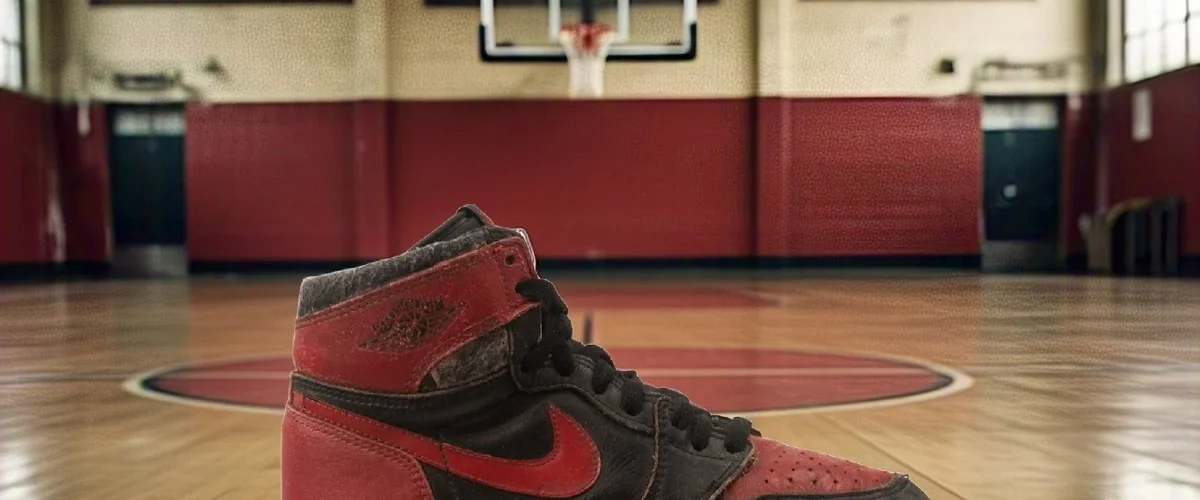
In 1984, the NBA had rules governing the uniformity of players’ footwear. During the preseason, Michael Jordan appeared in a predominantly black-and-red Nike shoe that did not meet the league’s interpretation of the permitted colors.
NBA documentation specifically mentions a black-and-red shoe Jordan wore on or around October 18, 1984.
The important detail is that the available historical evidence points to the black-and-red Nike Air Ship, rather than the retail Air Jordan 1, as the shoe directly involved in that episode.
The AJ1 was still being finalized.
Nike, however, turned the controversy into a compelling marketing story. Its advertising suggested that the NBA had tried to stop Jordan from wearing the product but could not stop the public from buying it.
Over time, the 1984 Air Ship, the Air Jordan 1 Black/Red, and the “Banned” campaign merged in popular memory.
Simply saying “the Air Jordan 1 Bred was banned by the NBA” therefore erases an important historical distinction.
What about the $5,000 fines?
The story that Jordan was fined $5,000 per game and Nike paid every fine has become inseparable from Air Jordan lore.
Later accounts repeat that amount, but the best-known primary documentation establishes the NBA’s warning about the footwear more clearly than a verifiable series of fines paid game after game.
The historically sound conclusion is this: the NBA challenged Jordan’s black-and-red footwear, and Nike used that controversy in the campaign that helped sell the Air Jordan 1.
When did Jordan Brand launch?
The Air Jordan line began in 1985, but Jordan Brand officially launched as its own division of NIKE, Inc. in 1997.
The sneaker line came before the broader brand organization.
- 1985: Air Jordan exists as Michael Jordan’s signature line.
- 1997: Jordan Brand formally debuts as a Nike division.
Over time, Jordan Brand expanded beyond products directly tied to Michael Jordan, sponsoring other athletes and creating its own performance and lifestyle lines.
How the Air Jordan 1 moved beyond basketball
The Air Jordan 1 began as a basketball shoe, but its longevity owes much to what happened after it stopped representing the latest on-court technology.
Its design remained instantly recognizable, and the same elements that worked with a Chicago Bulls uniform also paired with jeans, casual clothing, and the styles of different urban subcultures.
That does not mean the AJ1 created streetwear or sneaker culture by itself. The Air Force 1, adidas Superstar, Converse, running shoes, and many other silhouettes also played essential roles.
What distinguished the AJ1 was its unusually strong connection between athletic performance, an athlete’s personality, brand storytelling, and visual identity.
Air Jordan 1, music, and street culture
Basketball and hip-hop grew alongside each other in many American cities during the 1980s and 1990s. Sneakers worn by star players naturally began appearing off the court as well.
The AJ1 became part of that exchange between sports and street style, but hip-hop’s relationship with sneakers spanned many brands and models.
Run-D.M.C., for example, is historically much more closely associated with the adidas Superstar. That is one reason sneaker culture’s history should not be reduced to a single silhouette or brand.
Decades later, artists such as Travis Scott helped introduce the Jordan 1 to new generations through official Jordan Brand collaborations.
Air Jordan 1, skateboarding, and sneaker culture
One lesser-known chapter of the Air Jordan 1’s history took place in skateboarding.
As newer basketball shoes replaced the AJ1 as a performance option, older pairs turned up in stores and on clearance. Skateboarders found that the Jordan 1 offered relatively durable leather construction and a sole that worked well against a skateboard deck.
That adoption helped the AJ1 survive within another subculture before its major modern retro cycles.
Decades later, Nike formally acknowledged the relationship through Nike SB x Air Jordan projects.
Modern collecting also broadened the meanings of “OG,” “retro,” “colorway,” and collaboration. Resale value, however, should not be confused with historical importance: a pair that is expensive today is not automatically more significant to the model’s development.
The Air Jordan 1 in film and media
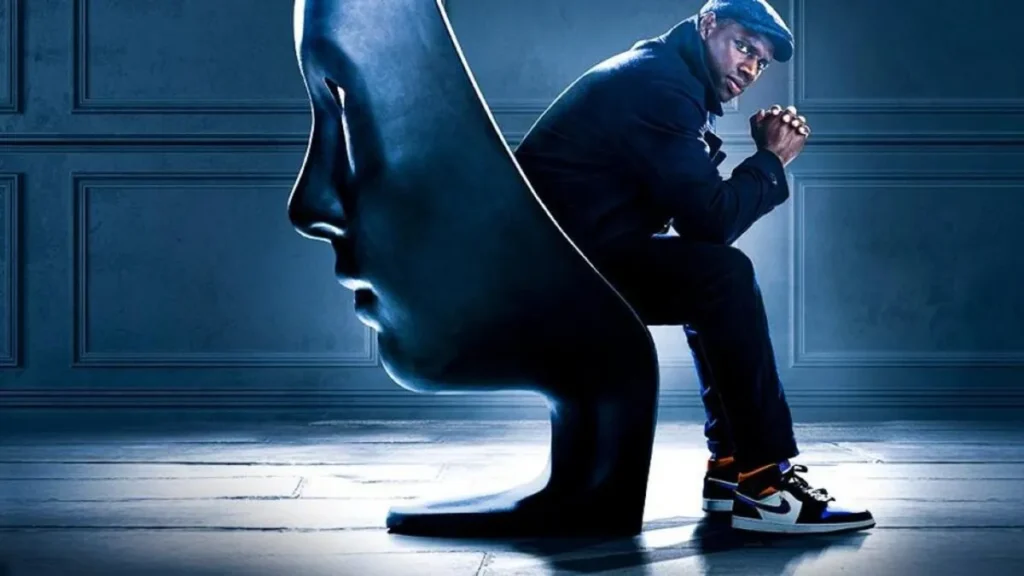
The Air Jordan story has repeatedly returned to the spotlight through documentaries, movies, and television series.
- The Last Dance (2020): documents Michael Jordan and the Chicago Bulls, providing context for the early Nike relationship.
- Air (2023): dramatizes the negotiations that brought Jordan to Nike. The film is based on real events, but several situations were changed or condensed for storytelling.
- Lupin: Jordan 1s in Assane Diop’s wardrobe show how the silhouette continues to work as a fashion item decades after its athletic debut.
Dramatized productions can be a great introduction to the story, but they should not replace historical documentation when details such as negotiations, design credit, or chronology are in question.
OG colorways, High, Low, Mid, and KO: What do they mean?
What does OG mean?
OG refers to original. In sneaker culture, the term has more than one use, depending on the context.
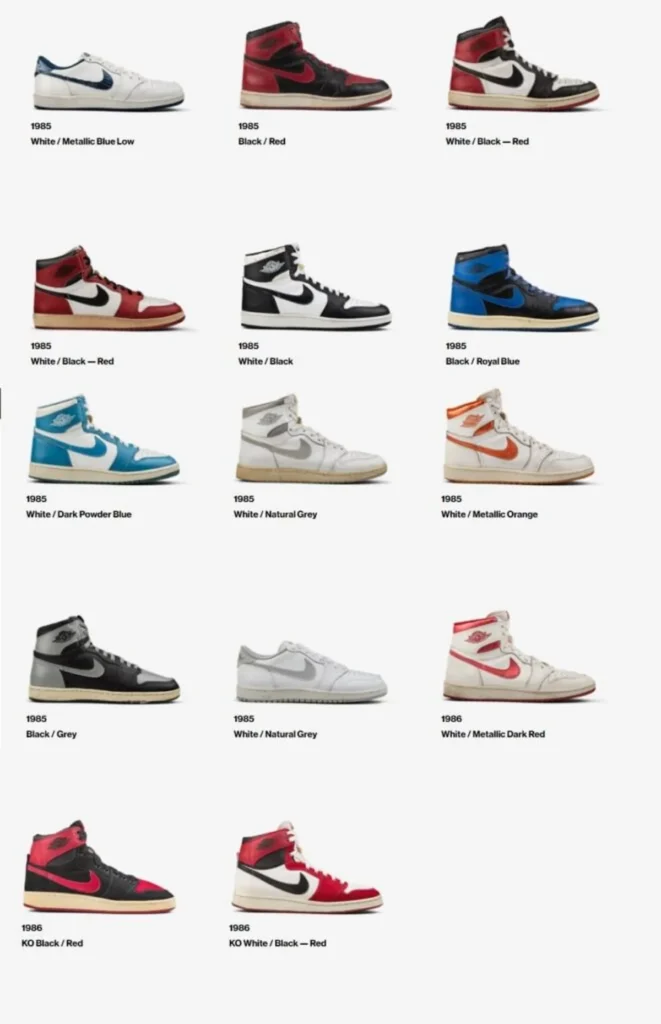
An “OG colorway” is a color combination from a model’s original era. “Air Jordan 1 High OG” is also a name Jordan Brand uses for modern releases that bring back details of the classic configuration.
An Air Jordan 1 High OG made in 2026 is therefore not a physical pair from 1985, and “OG” does not automatically mean “made with actual 1985 materials.”
Historic 1985 colorways
Color combinations associated with the original era include versions now known as:
- Chicago: white, red, and black, closely tied to the Bulls’ colors;
- Black/Red: the black-and-red combination later associated with the names “Bred” and “Banned”;
- Black Toe: a white-and-red base with black around the forefoot;
- Royal: black and blue;
- Shadow: black and gray;
- UNC/Carolina: white and light blue, visually connected to the University of North Carolina;
- Neutral Grey and Metallics: other important variations from the early catalog.
Is Shattered Backboard an OG colorway?
No.
The first Air Jordan 1 “Shattered Backboard” released in 2015. Its orange, black, and white palette was inspired by the uniform Jordan wore in an exhibition game in Trieste, Italy, in the summer of 1985, when one of his dunks shattered the glass backboard.
The event took place in 1985; the retail Shattered Backboard colorway did not debut that year.
High
The high-top is the shape most closely associated with the Air Jordan 1 Michael Jordan wore and with the line’s original imagery.
Low
The Air Jordan 1 Low also has roots in the original era. It is not simply a casual adaptation created decades later.
Mid
The Air Jordan 1 Mid is a later development with its own proportions and details. Despite its visual similarity, it should not be treated as having exactly the same construction as the High OG.
Air Jordan KO
The AJKO is also part of the Air Jordan 1 family’s early history. Its construction used different materials and design solutions from the traditional leather AJ1, showing that the line already had variations in the 1980s.
Air Jordan 1 collaborations
Decades after 1985, collaborations helped reinvent the Air Jordan 1 for different audiences.
- Off-White x Air Jordan 1: Virgil Abloh reinterpreted the model’s construction as part of The Ten.
- Travis Scott x Air Jordan 1: made the reverse Swoosh a visual signature of his Jordan Brand partnership.
- Union LA x Air Jordan 1: used a construction that combines references to different vintage AJ1s.
- Fragment Design x Air Jordan 1: brought the minimalist approach associated with Hiroshi Fujiwara.
- Dior x Air Jordan 1: placed the silhouette within an Italian-made luxury project.
For a closer look at these partnerships, read our guide to Air Jordan 1 collaborations.
The Travis Scott and Fragment partnership has also continued to generate new chapters; 90sneakers covers the subject in its article on the Travis Scott x Fragment x Air Jordan 1 Low OG.
Jordan Brand and social impact
Michael Jordan and Jordan Brand’s work also includes education programs and social commitments, each with its own objectives and funding.
Jordan Brand Wings, launched in 2015, works to provide educational access, scholarships, mentorship, design experiences, and opportunities for young people. For its 10th anniversary in 2025, Jordan Brand reported that it had supported more than 4,000 students worldwide.
In 2020, Michael Jordan and Jordan Brand also announced a joint $100 million commitment over 10 years to organizations dedicated to racial equality, social justice, and greater access to education.
These programs are part of Jordan Brand’s and Michael Jordan’s institutional efforts; they should not be described as an automatic percentage donated from every Air Jordan 1 sale.
Why is the Air Jordan 1 still around more than 40 years later?
The AJ1 reached its 40th anniversary in 2025 without relying on nostalgia alone.
Its longevity comes from a rare combination: a direct link to the start of Michael Jordan’s career, an easily recognizable silhouette, a powerful marketing history, a huge range of colors, and the ability to work outside its original basketball purpose.
The AJ1 retains a design architecture rooted in the 1980s. Today, its construction and distribution primarily serve the lifestyle market; anyone shopping for competitive basketball should compare current performance shoes rather than choose solely on Jordan’s legacy.
Frequently asked questions about the Air Jordan 1
Is the Air Jordan 1 comfortable for casual wear?
Comfort is subjective. Its construction is relatively firm and simple compared with modern sneakers. Some people like it for daily wear; others prefer softer, more flexible midsoles.
Do Air Jordan 1s always go up in value?
No. Secondary-market prices change with supply, demand, size, condition, and timing. An Air Jordan 1 should not be treated as an investment with guaranteed appreciation.
How do you authenticate an Air Jordan 1?
No single detail can prove authenticity. The SKU, inside label, box, materials, construction, stitching, shape, and edition-specific features need to be assessed together. Buying from a trustworthy source lowers the risk, but it does not replace a careful assessment when something is in doubt.
Are new Air Jordan 1s still being released?
Yes. Jordan Brand continues to use the silhouette for retros, new colorways, High, Mid, and Low versions, and special projects. Names and availability change from season to season.
The AJ1’s story brings together sports, marketing, and cultural adoption. Separating the 1984 Air Ship from the 1985 Jordan 1 helps explain it without losing the context of the “Banned” campaign. Explore more chapters in Sneaker History and Culture.