Before a running shoe could be rotated on a screen, it could be studied on a printed page. Road Runner Sports grew around the problem of selling a technical, highly personal product to someone who was not standing in a store. Its history belongs to running culture and to the history of communicating at a distance: an advertisement, a telephone conversation, a parcel and eventually a website.
The company dates its beginning to 1983, when Mike Gotfredson started the business from a garage in the San Diego area. Its own account still presents a family enterprise, with his sons participating in the business. The origin is modest in physical scale, but the selling model already looked beyond a single neighborhood.
In a 2004 interview with SGB, Gotfredson recalled starting with a small advertisement in Runner’s World. He distinguished that opening step from the first catalog, which he placed in late 1984 and described as a simple foldout. That detail gives paper and print a precise place in the chronology.
Learning to describe a shoe
Mail order requires a retailer to make the product understandable before it can be tried. For a running specialist, that means more than showing a color. The description has to help a reader compare intended uses and decide which questions to ask. In this setting, selling and explaining become unusually close activities.
A contemporary Total Retail profile in 2001 described Road Runner Sports testing shoes and supplying detailed fit information. It also reported that the company arranged continued production of selected popular models, including the Brooks Chariot. The catalog could preserve access to a familiar shoe as well as introduce a new one.
That is a different relationship with novelty from one organized entirely around the next release. A runner who wants to replace a trusted pair creates a commercial reason to maintain continuity. The interesting cultural object is therefore not only the new model, but also the older model that a community of users still wants to wear.
In his 2024 Vistage interview, Mike Gotfredson Jr. recalled catalogs tailored to customers’ buying habits and brand preferences, supported by a call center that helped select shoes. His account shows that personalization was already part of the business before today’s digital shopping interfaces.
The company’s 2025 presentation hosted by ASICS dates its website launch to 1997 and its first remote retail store to Seattle in 2001. The word “remote” matters here: it describes expansion away from the home base, rather than establishing that no earlier local retail activity existed.
These developments altered the means of contact without making the earlier problem disappear. Whether a recommendation arrives on paper, over a telephone or at a fitting bench, the retailer still has to translate a large assortment into an intelligible choice for one person.
The fitting bench and the neighborhood
The current Perfect Fit Zone description combines a conversation about goals with video gait analysis, a three-dimensional foot scan and personalized product recommendations, including insoles and socks. Those are advertised retail fitting services. They should not be confused with a medical diagnosis or a guaranteed improvement in performance.
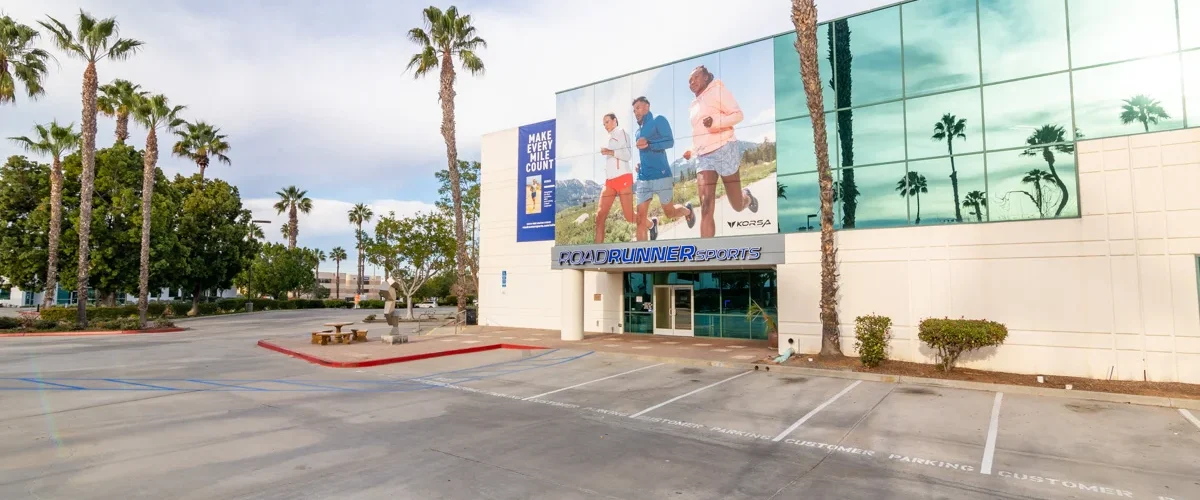
A 2022 Star-News report on the Chula Vista opening adds a local dimension. Company representative Sean Peterson described demand from South Bay customers and shoppers traveling from Tijuana as reasons the Otay Ranch location mattered. The account connects a store-opening decision to specific patterns of travel in the border region.
This is a useful counterpoint to the catalog’s reach. A national direct-selling business can cover distance, while a nearby shop can shorten it. Both are forms of access, and neither alone explains the company’s identity. The physical store adds the possibility of a shared setting to a relationship that can also exist remotely.
Movement beyond the purchase
Athletes Helping Athletes, launched in 2000, supports adaptive cycling for children with permanent physical disabilities. Road Runner Sports’ account describes custom-built adaptive bikes provided without cost to recipient families. This is a distinct charitable program associated with the business, rather than a claim that buying any particular shoe produces a specified donation.
A separate company page describes a used-shoe collection partnership with Got Sneakers that raises support for the charity. It brings footwear after its first period of use into the retailer’s public story, linking the circulation of shoes with another form of sporting equipment.
The National Sporting Goods Association inducted Gotfredson into its industry Hall of Fame in 2022. That recognition places his career within the trade’s institutional record, alongside the more personal company narrative of garage beginnings and family continuity.
The San Diego flagship is currently listed at 5553 Copley Drive. Its page describes race-packet pickups, school team nights, group runs and fitness events as parts of its community role, without establishing a particular upcoming schedule.
Road Runner Sports ultimately illustrates how a specialty can travel across formats. The paper page, telephone and fitting bench all organize a conversation about a shoe someone intends to use. Its history becomes most distinctive when that conversation, and the many ways of participating in movement around it, stays at the center.
Company timeline presented at ASICS
Related store histories
Fleet Feet
On