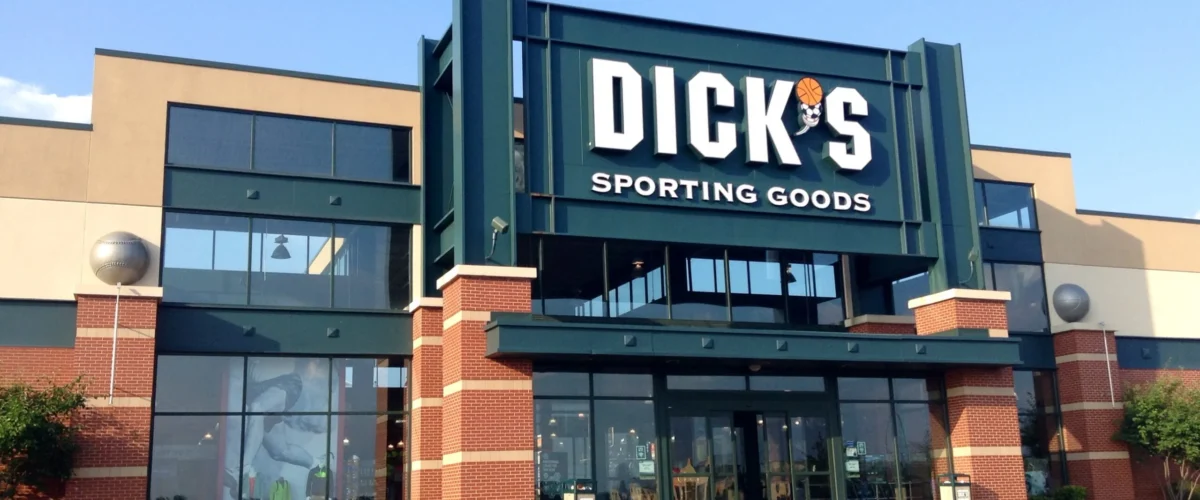
A shoe in a sporting-goods store belongs to a larger set of objects: a ball, a racket, a glove, a uniform. DICK’S Sporting Goods is important to sneaker retail partly because of this wider frame. Footwear appears as something to wear and as equipment for an activity, while the contemporary House of Sport format brings parts of that activity into the store.
DICK’S began with Richard “Dick” Stack’s bait-and-tackle shop in Binghamton, New York, in 1948. The company says its eighteen-year-old founder received $300 from his grandmother’s cookie jar, giving a household object a lasting place in its identity.
The 2002 annual report records Ed Stack taking leadership of the then two-store operation in 1984. It also places a substantial expansion of sports equipment, apparel and footwear between 1986 and 1993. The broad sporting-goods assortment was built over time, rather than appearing fully formed with the original shop.
Equipment becomes a retail world
The fiscal 2002 Form 10-K records the completion of the company’s initial public offering in October of that year. It described a business centered on equipment, apparel and footwear for athletic participation. That positioning helps explain the relationship between the shoe department and the rest of the selling floor.
For a customer preparing to take up a sport, several purchases may belong to one project. A pair of cleats connects to a playing surface and team equipment; a running shoe connects to clothing and an intended routine. The retailer can organize those relationships physically, making the activity itself a way to navigate the assortment.
DICK’S added its DSG brand in August 2019, presenting apparel and equipment for adults and children with an emphasis on accessible pricing and a broader range of sizes. The launch also included a commitment to direct one percent of DSG purchase prices to the company foundation’s Sports Matter program.
The foundation’s 2022 Purpose Playbook dates Sports Matter to 2014. It describes grants and programming support for under-resourced youth sports organizations and public schools. This establishes a specific institutional effort around participation, while its stated aims should be distinguished from any claim that access barriers have been solved.
Giving the store a playing surface
House of Sport opened its first location in Victor, New York, in April 2021. The launch announcement described a turf field and running track, climbing wall, batting cage and golf-testing spaces. It also introduced a House of Cleats, placing specialized footwear beside opportunities to try equipment in motion.
These features change what a visit can contain. A conventional display lets a shopper inspect an object; a practice space lets the same object be considered through movement. The store becomes a setting for comparison and activity as well as a place where a transaction can be completed.
The seasonal use of the space was visible quickly. In December 2021, the company reported that Victor’s outdoor field had become an ice rink with open sessions, beginner classes and time for hockey leagues. The field was intended to return to turf after winter.
That example is revealing because it treats a retail site as something with a calendar. The sporting season changes the use of the space, rather than simply changing which merchandise is promoted. It is a concrete expression of the relationship between selling equipment and accommodating the activities associated with it.
Footwear, membership and the stories of athletes
In November 2021, DICK’S and Nike announced that customers could connect Scorecard and Nike Membership accounts through the retailer’s app. The partnership included member product access and events, with an early Air Force 1 and Blazer launch. It linked digital membership to the physical retail relationship.
A separate collaboration addressed basketball participation. The 2023 announcement for the It’s Her Shot tour with Nike included Sheryl Swoopes and recalled its debut at Venice Beach in 2021. The program centered opportunities for young female athletes to take part on court.
In June 2023, the Sports Change Lives campaign with Nike and Jordan Brand featured athletes including Carmelo Anthony, Sabrina Ionescu and Mike Trout. Alongside their personal sports stories, the announcement set out nominations for youth-organization grants. The campaign connected recognizable professionals with the company’s broader participation theme.
These are different kinds of partnership: a system for shopping, an event program and a media campaign. Keeping their functions distinct makes the cultural history clearer. A recognizable logo can organize access to merchandise, help frame an activity or lend visibility to a story, with different evidence required for the effects of each.
Back to the Binghamton area
The Johnson City House of Sport at 629 Harry L Drive offers a contemporary reference point near the company’s origins. Its official page lists a climbing wall, HitTrax multi-sport cage and turf for comparing cleats. These are features of this format and location, not promises about every DICK’S store.
The company’s fiscal 2025 annual report records its acquisition of Foot Locker and distinguishes the DICK’S and Foot Locker businesses as separate reporting segments. The purchase widened its place in footwear retail without making every banner the same kind of store.
DICK’S history connects the practical purchase to the imagined experience beyond it: the next game, a new activity, a place to practice. Its distinctive contribution to a sneaker-store map lies in that connection between footwear and the surrounding world of sport.
Related store histories
Champs Sports
Fleet Feet