A regional shoe store needs to understand more than which brands are popular. The local calendar, the way families use a shopping center and the styles associated with a place can all shape the visit. Shoe Station’s history makes those details visible. Its transformation into a much larger banner raises an enduring retail question: how can local knowledge remain useful when the name travels far beyond its first city?
Department-store experience finds a new setting
Terry Barkin founded Shoe Station in Mobile, Alabama, in 1984, using a former tire-and-battery store at 450 Bel Air Boulevard. The company’s anniversary account describes large, self-service, open-shelf stores. The arrangement made selection visible and reachable, giving customers room to compare footwear while bringing several household needs into the same commercial space.
Barkin arrived with a long retail apprenticeship. His published obituary records work at Rich’s department store in Atlanta from 1962 to 1984, eventually overseeing divisions that included shoes and handbags. Shoe Station therefore emerged from experience with buying and merchandising, with an established understanding of products carried into a business of his own.
In a 2014 anniversary interview, Barkin recalled handling buying, operations and advertising himself through the first five stores. Brent Barkin remembered handing out balloons and popcorn on opening day. The recollections give the early company a human scale: a founder managing several roles and children participating in the public arrival of a family business.
The Barkin family recalls Shoe Station’s early years
In an interview published by the University of South Alabama, Brent described adjusting to regional tastes and the timing of Mardi Gras and back-to-school. He also discussed store events such as Senior Day and Vendor Day. The historical account explains local knowledge as operating practice, connecting merchandise and a reason to visit with the community calendar.
A regional voice across different channels
The appointment of Lewis Communications in April 2014 joined two businesses with Mobile origins. The agency’s brief covered print advertising, ShoeStation.com and social media. That move shows a regional retailer trying to make its message consistent across places where customers encountered it, while retaining the connection between recognizable brands and attention to household spending.
The university’s January 2023 endowment list includes the Terry S. Barkin Memorial Shoe Station Endowed Scholarship in Business. This is a specific institutional trace of the founder’s local legacy. It places the company’s name in an educational setting as well as a commercial one, linking the memory of a retailer with the education of a new generation in business.
Shoe Carnival announced its purchase of substantially all Shoe Station assets on December 3, 2021. Brent Barkin initially remained responsible for the banner within the acquiring company.
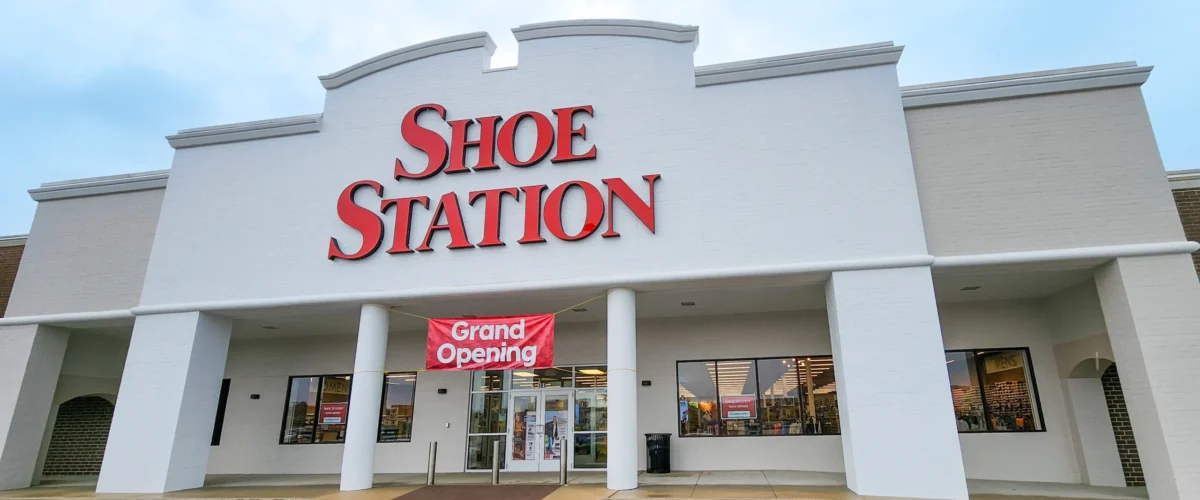
The acquirer’s 2022 annual report documented a store-design refresh through before-and-after images of Shoe Station interiors and exteriors. The presentation treated the existing customer experience as something to develop. A regional name was being retained while its physical expression changed, making design part of the transition between family ownership and a larger retail organization.
The fiscal 2025 report describes curated displays, optional staff assistance and higher-end footwear at Shoe Station. The open-shopping idea remained visible within a more brand-led presentation.
Expansion and the return to local fit
By November 2024, the company reported a new Shoe Station in Tennessee and ten completed conversions from Shoe Carnival. The expansion combined fresh geography with changes inside an existing store network. A new sign could therefore represent several different histories, including a newly opened location or a retail address whose customer proposition was being reworked.
In March 2025, the parent announced a broader strategy to develop Shoe Station nationally after the initial conversion test. Its filing framed the decision around matching markets and customers to the banner. That reasoning echoes the earlier regional emphasis on local taste, though the scale and corporate tools available to make those decisions had changed substantially.
The corporate parent adopted the Shoe Station Group name on June 12, 2026. The acquired regional banner had become the namesake of a company that continued operating multiple retail identities.
The September 2026 update paused further conversions for the rest of that fiscal year after 21 completed changes. National growth remained an evolving strategy, with its pace revised.
The September 2026 update on store conversions
On October 13, 2026, Shoe Station’s official directory listed Springdale Shopping Center at 3250 Airport Boulevard in Mobile. This is a current branch in the founding city, distinct from the original Bel Air Boulevard address. It grounds the wider corporate story in the place where the business first developed its relationship with shoppers.
The current Springdale Shopping Center store
Shoe Station’s history is strongest when its regional detail remains in view. Calendars, family memories, advertising and educational ties help explain what a store name can carry from one era into another. Expansion does not settle the question of identity once and for all. It creates new occasions to test whether a familiar approach to selection can find a meaningful place in a different community.
Related store histories
Shoe Carnival
DSW