
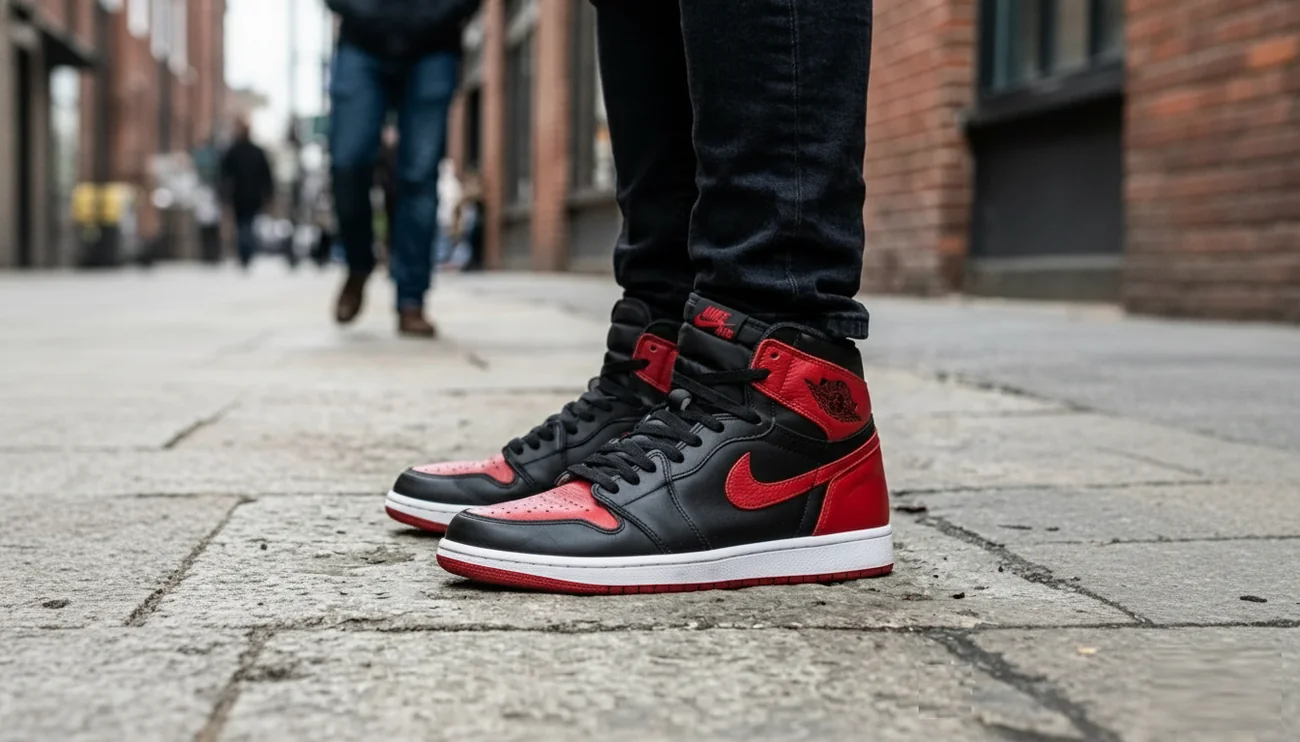
A retro sneaker is generally a new edition, reintroduction, or re-release of a silhouette that already existed. The design comes from the past, but the pair returning to stores is a later production. That means a retro can be factory-new even when it brings back a model created decades earlier.
The word is not perfectly standardized across the footwear industry. Jordan Brand uses “Retro” in many official product names, while other brands may prefer terms such as reissue, re-release, archive, heritage, re-edition, or OG. Not every comeback will therefore be officially labeled a Retro.
Retro also does not automatically mean vintage, replica, original colorway, limited edition, or an exact reproduction of the first release. Because the term belongs to a larger vocabulary, the Sneakerhead Dictionary helps connect it with other expressions used by brands, stores, and collectors.
What Does “Retro” Mean in Sneakers?
In sneaker culture, “retro” usually identifies a later edition of a model or silhouette that was previously released. A brand returns to an older design and manufactures it again, sometimes with close fidelity to an earlier version and sometimes with new colors, materials, or details.
The term mainly describes the relationship between the current release and an earlier design. It does not describe the physical condition of the pair. A retro can be new, Deadstock, VNDS, used, or heavily worn.
Retro is also not a colorway. The same retro silhouette can appear in many color combinations, including historically accurate colors and completely new ones.
To avoid confusion, separate three different dates:
- Silhouette creation date: when the design first appeared.
- Reference release date: when a particular version or colorway originally reached the market.
- Physical production date: when that specific pair was manufactured.
A current Air Jordan 1 can reproduce a silhouette from 1985 without being a pair manufactured in 1985. That difference between the age of the design and the age of the physical object is the foundation for understanding what “retro” means.
Is a Retro Sneaker an Old Sneaker?
Not necessarily. A sneaker manufactured decades ago does not become a retro simply because it aged. It may be an original-period release, a vintage sneaker, a used pair, or even old Deadstock.
A retro is usually a later production that brings back an earlier model. An old design can therefore produce a newly manufactured retro, while an original pair stored for decades can be vintage without ever having been a retro.
In short: the age of the design is not the same thing as the physical age of the pair.
What Is the Difference Between Retro and Vintage?
Vintage refers to the actual physical product manufactured in the past. Retro refers to a later edition that brings back a previously released design.
An Air Jordan 1 manufactured in 1985 belongs to the original period of the model and can now also be considered vintage. An Air Jordan 1 manufactured decades later as a re-release is a different physical release, even if it reproduces a 1985 colorway.
Vintage by itself does not describe condition. A vintage sneaker can be worn, Deadstock, extremely well preserved, or compromised by aging materials.
For that concept in detail, see what vintage sneakers are. Our guide to retro vs. vintage vs. OG sneakers compares the three terms directly.
What Is the Difference Between Retro and OG?
“OG” comes from original, but its meaning changes with context and commercial naming. It can identify the first physical release, an original colorway, historical design characteristics, or simply be part of the name of a current product.
Seeing “OG” in a product name does not prove that the pair was manufactured in the year the silhouette debuted. You have to identify how the term is being used.
OG Release
When used to mean original release, OG refers to the first release of a specific model or version. An original 1985 Air Jordan 1 belongs to the period release, not a later production.
OG Colorway
An OG colorway is a color combination that existed during the original period of the silhouette or line, within the correct historical context. A retro can bring back an OG colorway, but it can also debut a completely new colorway.
That means retro and OG colorway are not synonyms. See our guide to what an OG colorway means.
What Does Air Jordan 1 Retro High OG Mean?
In the name Air Jordan 1 Retro High OG, “Retro” places the product within a later edition of the historic silhouette, while “High OG” identifies the configuration and design lineage Jordan Brand is using.
That does not turn a pair manufactured today into an original Air Jordan 1 made in 1985.
Nike currently uses Air Jordan 1 Retro High OG naming on modern releases, including new colorways. The “Retro High OG” designation therefore does not mean the colorway itself must come from 1985.
The example makes an important distinction: Retro High OG does not automatically mean OG colorway. For the broader term, see what OG means in sneakers.
Does a Retro Have to Be Identical to the Original?
No. Some reissues try to reproduce a specific historical version closely. Others preserve the main silhouette while changing parts of the product.
Even when historical fidelity is the goal, differences can appear in:
- shape and proportions;
- molds and tooling;
- leather, textiles, and synthetic materials;
- foams and rubber compounds;
- adhesives and construction methods;
- branding;
- finishing;
- box and accessories.
“Retro OG” should not automatically be interpreted as “1:1 reproduction.” Naming depends on the brand and the release. The comparison has to be made between specific products rather than inferred from words in the product name.
Can a Retro Use a New Colorway, Materials, or Construction?
Yes. A retro can reproduce a historical colorway or introduce new colors and new color blocking. It can also use materials, molds, and manufacturing methods that differ from previous editions.
Those changes are not automatically improvements or downgrades. Different leather, foam, shape, or tooling has to be evaluated within the specific product.
Jordan Brand’s official Retro collections document new materials, color blocking, and reimagined treatments applied to historic silhouettes. Nike has explicitly described these collections as “inspired by the past and created for the future,” which makes clear that “retro” does not require every detail of a previous edition to be repeated.
The same caution applies to technology and comfort. A re-release can retain older solutions, adapt components, or change construction, but the word “retro” does not promise modern cushioning, superior materials, or greater comfort.
A silhouette designed decades ago can also return mainly as a lifestyle product, keeping characteristics that differ considerably from today’s performance footwear.
Is There a Minimum Age for a Sneaker to Be Retro?
There is no universal minimum of 5, 10, 15, or 20 years. The important point is that an earlier edition or design already exists and the product is being presented again as a return, reissue, or reinterpretation.
Each brand decides when and how to work with its archive. Long gaps are common in many re-releases, but they are not a technical requirement.
Historical importance is not mandatory either. Fame, anniversaries, nostalgia, and demand can explain why some models return, but a company can also revive a niche or little-known sneaker. Cultural relevance provides context; it is not a retro certification.
Are Retro, Reissue, and Re-Release the Same Thing?
These terms often overlap, but they do not form a universal industry taxonomy:
- Reissue and re-release: generally indicate a new edition or new launch of a previously introduced product.
- Retro: a cultural and commercial term associated with the return of earlier models, with especially strong use in the Air Jordan franchise.
- Archive and heritage: usually connect a product to a brand’s back catalog or legacy without defining exactly how closely it copies the original.
- Remake, re-edition, and reimagined: may emphasize reconstruction or intentional reinterpretation, but the exact meaning depends on the project.
It is not safe to create rigid rules such as “reissue always means an exact copy” or “retro always means a modernized version.” Brands do not use the vocabulary consistently enough for that.
adidas currently sells its Japan line as a return to an archival design, while Reebok explicitly calls the Camargue “a luxe reissue of an archive trainer” and “a retro revival” of a shoe from 1978. These examples show how different brands can describe similar archive-driven ideas with different words.
The concepts are related, but commercial language varies across companies and releases.
Are Retro and Reimagined Synonyms?
Not as a universal rule. Retro describes the return of an earlier model. Reimagined usually highlights an intentionally modified interpretation, but the exact meaning still depends on the project.
A reissue may try to preserve the historical look closely. A reimagined version may change materials, finish, aged appearance, or color blocking to create a different narrative.
A product can also belong to a Retro collection while being described by the brand as reimagined. That does not make the terms equivalent in every context.
Air Jordan and the Use of the Word Retro
The Air Jordan franchise is the best-known example because Jordan Brand explicitly uses “Retro” across many products and seasonal collections.
Nike’s official Air Jordan 1 archive records the original release in 1985 and credits Peter Moore as the designer. Jordan Brand then uses Retro and related historical naming to continue that lineage through later releases.
For the original model without turning this page into a complete chronology, read the history of the Air Jordan 1.
That does not mean every current Jordan product is retro. Jordan Brand also releases new performance models, lifestyle lines, Low and Mid versions, hybrids, athlete signature shoes, and other constructions. A Jordan name or Jumpman logo does not replace identifying the specific product.
Is the Nike Dunk a Retro?
It depends on the edition. Some Nike Dunk releases bring back earlier designs or colorways and can reasonably be discussed as reissues or retros. Nike Dunk, however, is now a broad and continuously evolving product family.
A new Dunk colorway should not automatically be called a retro just because the silhouette originated in the past. You need to identify what exactly is being re-released and how Nike presents that edition.
Is the Air Force 1 a Retro?
Not automatically. The Air Force 1 has its own history of launch, withdrawal, return, and long-term commercial continuity. A current Air Force 1 can use a historic silhouette without being officially classified as a Retro.
Certain editions may reproduce archival versions or details, but the entire Air Force 1 family should not be labeled retro indiscriminately. The naming and documentation of the specific release matter.
Are Retro Sneakers Authentic?
An official retro produced or authorized by the brand is authentic. “Retro” does not mean replica, fake, or counterfeit. The word describes the release’s relationship to an earlier design, not whether the product is legitimate.
A seller can still misuse the word “retro” in a listing. The label alone does not authenticate the pair. Confirm the release, provenance, and product details together.
How Can You Identify Which Retro Generation You Have?
The same silhouette—and even the same historical colorway—can be re-released multiple times. There may be an OG release, a retro from one decade, and additional retros in later years. Each is a separate physical release.
To identify the generation, compare:
- the full official product and colorway name;
- style code or SKU;
- production dates on the inside label;
- box label and code;
- official product page, brand release, or release archive;
- materials, shape, branding, and details specific to that edition.
The SKU helps distinguish versions, but it does not authenticate a pair by itself. Counterfeits can reproduce codes. Authentication requires consistency between identification, construction, provenance, and documentation.
That is especially important when the same OG colorway has several reissues. Different years can use different codes, labels, boxes, materials, proportions, and branding applications.
Can an Older Retro Crumble or Separate?
Yes, depending on the physical age of the pair, the materials, and storage. A newly manufactured retro is a new physical object even when its design is old. A retro made 15 or 20 years ago has physically aged and may show drying, oxidation, separation, or material degradation.
Certain polyurethane components can be vulnerable to hydrolysis, but not every sneaker uses the same materials or fails in the same way. Keeping a pair unworn also does not stop every chemical aging process.
Before wearing an older edition, inspect the midsole, outsole, adhesives, stitching, and flexibility. See our guide to why sneakers crumble and how hydrolysis works.
Can a Retro Basketball or Running Shoe Still Be Used for Performance?
Do not assume so. A model that represented advanced technology when it debuted may return mainly as a lifestyle product. Its geometry, cushioning, weight, traction, or stability may lag far behind current performance shoes.
The word “retro” tells you about design lineage. It does not certify that the shoe is suitable for competitive basketball, running, or training.
Before using a retro for sport, check the official category and description for that edition. Also consider fit, the physical condition of the specific pair, and the demands of the activity.
Why Do Brands Re-Release Sneakers?
The reasons vary and can include:
- demand for the model;
- a silhouette anniversary;
- sports legacy;
- bringing back part of the brand archive;
- the return of a particular aesthetic trend;
- introducing the design to a new generation;
- collaborations;
- commercial strategy.
Nostalgia can play a role, but it is not the only explanation. A buyer also does not need to have lived through the original launch to appreciate the silhouette.
A return gives people who never had access to the earlier product a chance to buy a newly manufactured edition. That does not make every retro rare, limited, or valuable on the secondary market. Some sell out, some remain widely available, some go on sale, and some trade below retail.
Are Retro Sneakers Worth Buying?
They can be, as long as the decision is based on the specific product. Before buying, consider:
- whether you actually like the silhouette and colorway;
- whether you prefer a new production over an older physical pair;
- whether the fit and comfort suit your intended use;
- which materials and construction methods are used in that edition;
- whether the pair is recent or old enough to have aging-related risks;
- whether the price makes sense compared with the available alternatives;
- whether you plan to use it for lifestyle wear or athletic performance.
Do not buy with guaranteed appreciation in mind. Resale prices change with supply, demand, size, condition, restocks, and market timing. Being retro, OG, or historically inspired does not turn a sneaker into a predictable investment.
Retro Sneaker FAQ
What Does Retro Mean in Sneakers?
It usually means a new edition, reintroduction, or re-release of a silhouette that already existed. Exact usage varies between brands and products.
Are Retro Sneakers Authentic?
Yes, when they are officially produced or authorized by the brand. Retro does not mean replica or counterfeit, although the word in a seller listing does not prove authenticity by itself.
Is Retro the Same as OG?
No. Retro describes a later edition of an earlier design. OG can identify the original release, an original colorway, a historical configuration, or be part of the naming of a current edition.
What Does Retro High OG Mean?
In Air Jordan 1 naming, Retro indicates a later edition of the historical silhouette, while High OG identifies the configuration and design lineage Jordan Brand is using. It does not mean the physical pair was manufactured in 1985.
Does Retro High OG Have to Use an Original Colorway?
No. An Air Jordan 1 Retro High OG can use a completely new colorway. High OG does not automatically mean OG colorway.
What Is the Difference Between Retro and Vintage?
Vintage refers to a physical object actually produced in the past. Retro refers to a later production based on a model that was previously released.
Is Retro the Same as Reissue?
The terms can overlap, but there is no universal distinction used by every footwear brand. Check the official language used for the specific release.
How Old Does a Sneaker Have to Be to Be Retro?
There is no universal minimum age. An earlier design or edition has to exist, but the gap before a new edition depends on the brand and project.
Can a Retro Use Different Technology From the Original?
Yes, but it depends on the product. Some editions change components and manufacturing methods, while others preserve older solutions. Retro does not automatically mean updated technology or greater comfort.
Is Every Current Air Jordan a Retro?
No. Jordan Brand sells retros of historical models, but it also creates new performance shoes, lifestyle products, hybrids, athlete signature models, and other lines.
How Can You Tell the Year of an Air Jordan Retro?
Compare the style code, inside label and production dates, box, colorway, and official release documentation. None of those elements should be used alone for authentication.
Can an Old Retro Crumble?
Yes. The risk depends on the physical age of the pair, the materials, and storage—not only on the age of the design it reproduces.
Do Retro Sneakers Usually Go Up in Value?
There is no rule. A retro can resell above, near, or below retail. Supply, demand, size, condition, restocks, and market timing all affect price.
Conclusion
A retro sneaker is, in broad terms, a new edition of a silhouette or model that was released before. The concept does not depend on a minimum age, does not require an original colorway, and does not promise an exact reproduction, updated comfort, rarity, or resale appreciation.
The more useful question is not only “How old is this design?” but also “When was this pair manufactured, and which release does it belong to?” That distinction separates retro, vintage, OG release, and OG colorway while also helping with materials, condition, authenticity, and intended use.
For more models, terms, and events that put these re-releases into context, visit Sneaker History & Culture.