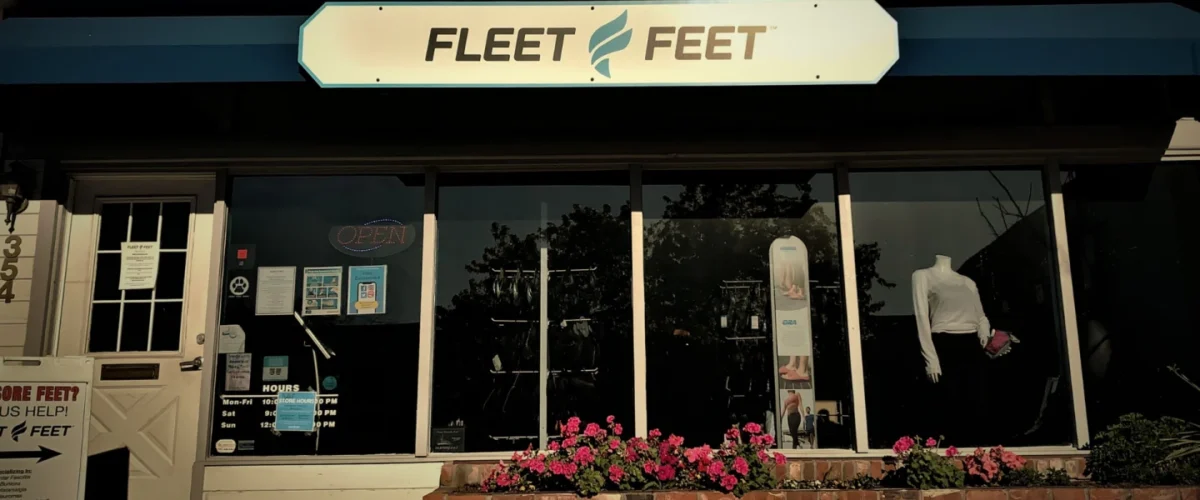
Before Fleet Feet became a familiar name in running, its founders took shoes to potential customers in a former postal truck. Sally Edwards and Elizabeth Jansen filled it with boxes and visited Sacramento-area high schools. It is a revealing image from the business's early years: the shop's work continued beyond the shop itself.
Running Insight recorded that recollection in its 2026 interview with Edwards. Half a century after the first opening, the truck offers a useful way to understand Fleet Feet's particular retail culture. Shoes need a place to be sold, but running also needs places to begin, people to ask and reasons to return. Much of this company's history concerns the relationship among those needs.
Two teachers and a house on J Street
Edwards and Jansen opened Fleet Feet in Sacramento in 1976. Both were schoolteachers, and the first shop occupied a Victorian house on J Street. Their initial target was modest: selling five pairs a day would cover their break-even calculation. The business began with the immediate problem of making a small shop viable.
Fleet Feet's own history describes the racing team and events that grew around that early store. Customers could come back to run or spend time together, even when another pair of shoes was not the reason for returning. That pattern gave the location a function beyond supplying equipment. It also made the founders' interests in sport part of everyday business practice.
The fact that two women established the company belongs at the center of its story. They were owners deciding what a sporting-goods business could look like and whom it could serve. The company's later account records another change in its audience: women's shoe sales exceeded men's for the first time in 1998. Those two milestones are different, but together they widen the picture of who built and sustained the business.
Repeating a relationship in another town
A second shop opened in Chico in 1978. Franchising followed, and the first store outside California opened in Washington, D.C., in 1984. Growth required the founders to consider which parts of their original approach could travel. A sign and an assortment were reproducible; relationships in a neighborhood needed people who would build them.
In Fleet Feet's historical account, Jansen explains that the founders turned away applicants interested only in a financial investment. That decision reveals the kind of work they expected from an owner. The commercial opportunity involved participation in a place, including the less visible effort of organizing, introducing people and keeping commitments after a transaction was complete.
Sacramento itself continued to change. The shop moved from the original Victorian building to a larger property farther along J Street. Pat and Jan Sweeney bought the store in 1997. During their ownership, it developed event-management and training operations and an after-school running nonprofit, as their 2023 Running Insight interview recounts.
The address therefore carries a history of successive stewards rather than an untouched founding scene. The people who organize a race, prepare a training group or teach a new employee also help determine what a store means locally. That work can outlast a particular owner, interior or product selection.
Making room for the beginner
Fleet Feet's training model made that social role more explicit. No Boundaries, developed with New Balance, expanded through a mid-2000s pilot period before a broader franchise rollout in spring 2008. Contemporary trade reporting described weekly coaching and educational sessions for people with little running experience.
A beginner program changes the relationship between expertise and the customer. Someone need not arrive with a race result or a settled training routine to have a reason to participate. The retailer has an interest in that person's continued activity, while the participant gains a structure for returning. The commercial and communal purposes occupy the same calendar.
That is a different kind of cultural influence from a famous shoe release. Its visible result may be a weekly group rather than an object collected and displayed. The store becomes part of the ordinary repetition through which a person starts thinking of running as something they do.
The fitting conversation gains new tools
The service side evolved too. Fleet Feet dates a proprietary fitting process to 2003. In June 2017, it introduced 3D foot scanning with technology partner Volumental as part of fit id. A contemporaneous announcement from the Rochester store emphasized reviewing the scan together with the customer and using it alongside staff expertise.
The measurements also informed collaboration with a manufacturer. For the Karhu Ikoni introduced in 2018, Fleet Feet supplied data from more than 100,000 customer foot scans to help develop the shoe's fit. The store was contributing information from its fitting encounters to product development, extending its role beyond choosing a finished assortment.
Today, Fleet Feet's description of its process combines a conversation about the customer's goals with measurements and observation of walking. That is a retail service description, not a medical diagnosis or a promise that one shoe solves every problem. The human exchange remains important to understanding what the numbers are meant to support.
From the early truck to group training and digital fitting, Fleet Feet's continuity lies in showing up where running happens. Its story is made through repeated local encounters: someone asks a question, learns a name, returns for a group and eventually helps another newcomer begin. A national retail name can provide the structure. The culture still has to be practiced by people.
Fleet Feet looks back at its origins
Sally Edwards recalls the first fifty years
Pat and Jan Sweeney on the Sacramento store
The introduction of 3D scanning with Volumental
Related store histories
Road Runner Sports
HOKA