
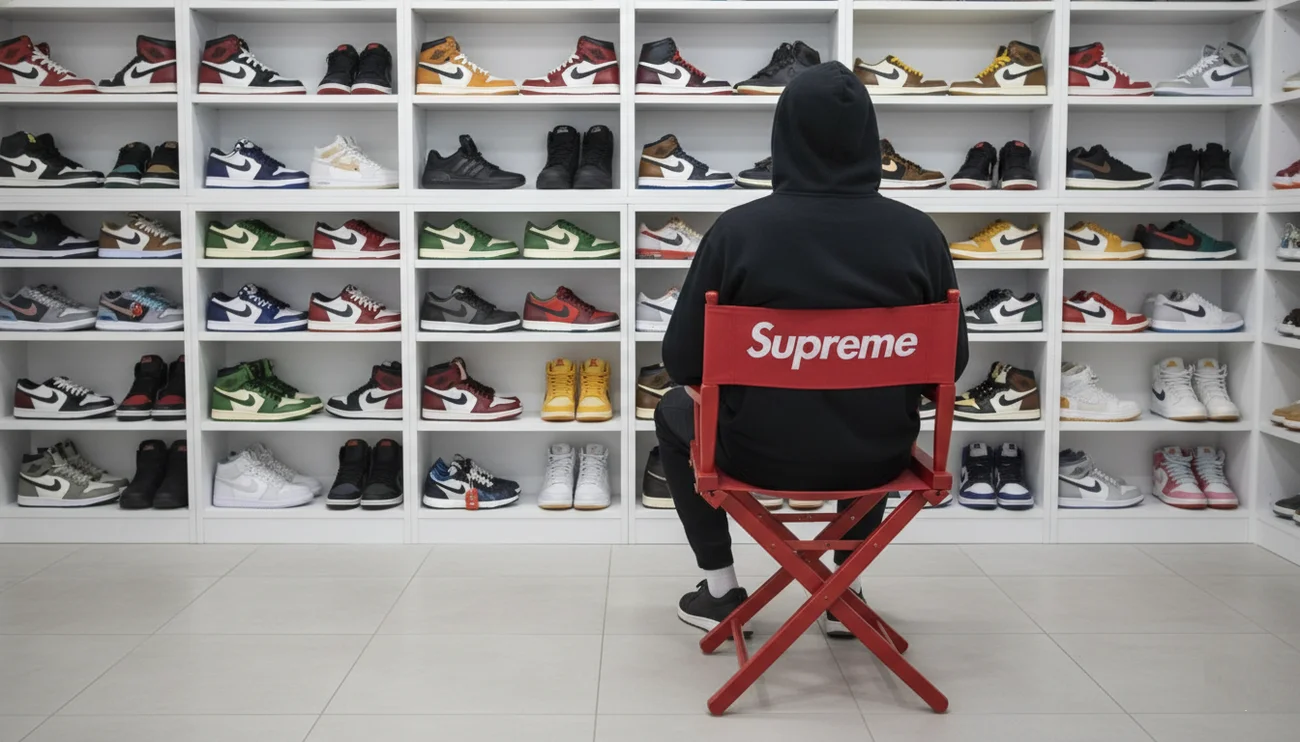
A sneakerhead is someone with a genuine—and often deep—interest in sneakers and the culture around them. They might collect pairs, wear everything they own, study design history, follow footwear technology, talk about materials, or simply become curious about how a shoe designed for the court ended up becoming part of everyday style.
There is no membership card, oral exam on colorways, or minimum number of boxes required. Price, rarity, and hype do not issue credentials either. What connects sneakerheads is the idea that sneakers can bring together sport, music, fashion, memory, technology, design, and community.
I have considered myself a sneakerhead and participated in this culture since 2007. Over that time, one thing has become increasingly clear: the pair matters, of course, but the desire to understand what exists behind it is often even more interesting.
What Does Sneakerhead Mean?
The word combines sneaker with head, an informal suffix used in English to describe someone who is especially interested in a subject. In practice, a sneakerhead is a sneaker enthusiast—someone whose interest goes beyond simply owning footwear.
That interest can show up in many different ways:
- wearing and trying different types of sneakers;
- collecting particular models, versions, decades, or brands;
- researching the history of silhouettes, athletes, designers, and colorways;
- studying materials, construction, shape, cushioning, and footwear technology;
- following releases, retros, restocks, collaborations, and archive models;
- photographing, customizing, reviewing, restoring, or creating sneaker-related content;
- participating in sneaker conversations and communities online or in person.
Those are possibilities, not requirements. One person may be fascinated by running shoes and performance technology; another may focus on Air Jordans, 1980s adidas, skate shoes, Y2K runners, or vintage pairs. Sneaker culture is too broad to fit on one shelf.
The Sneakerhead Dictionary can help decode the language used by collectors and retailers, but nobody needs to memorize every acronym before they are allowed into the conversation.
Do You Need a Huge Sneaker Collection to Be a Sneakerhead?
No. Collecting is an important part of sneaker culture, but it is not an entry fee. Someone may own three carefully chosen pairs, wear them until the soles tell their own story, and know those designs deeply. Someone else may maintain a large collection. Both relationships with sneakers can be genuine.
There is also no requirement to keep every pair unworn. Some collectors preserve certain sneakers, some follow the informal “wear your kicks” philosophy, and many do both. A collection does not have to look like store inventory, and wearing sneakers does not erase historical interest.
Quantity measures quantity. It does not measure curiosity, memory, knowledge, taste, or attachment—and it certainly does not determine who likes sneakers more.
How Did Modern Sneaker Culture Begin?
There is no official day when someone opened a shoebox and declared sneaker culture established. It developed across decades as athletic footwear, athletes, local communities, music, style, retail, design, and technology began influencing one another.
The museum exhibition Out of the Box: The Rise of Sneaker Culture, organized by the American Federation of Arts and the Bata Shoe Museum, traced that evolution through roughly 150 pairs, from 19th-century athletic footwear to performance icons, fashion objects, and collectibles. It is a useful reminder that sneaker history begins long before apps, raffles, and resale platforms.
Before the 1980s: Sport Built the Foundation
Basketball, running, tennis, track, and other sports pushed footwear companies to experiment with materials, traction, cushioning, fit, and construction. Models such as the Converse Chuck Taylor All Star show how a shoe can begin in an athletic setting and then develop a second life in music, fashion, and different subcultures.
That transition did not happen because sport stopped mattering. The interesting part is the opposite: performance, form, and identity began to interact. A detail created to improve grip or hold the foot securely could also help create a silhouette recognizable from across the street.
Basketball, Michael Jordan, and the Air Jordan 1
In the 1980s, basketball accelerated the relationship between performance footwear and personal identity. Star athletes, signature shoes, television exposure, and bold design made people want more than equipment for playing; they wanted products connected to personality, aspiration, and style.
Nike’s official Jordan archive documents the Air Jordan 1 as an original 1985 release designed by Peter Moore. The model became a major chapter in the relationship between athlete, product, and culture. Michael Jordan did not create sneaker culture by himself, but it is impossible to explain the modern U.S. sneaker landscape without recognizing how important the Air Jordan line became.
It is equally important not to erase the communities that gave sneakers meaning outside corporate campaigns. North Carolina State University research on sneakerhead identity highlights the importance of basketball, hip-hop, history, and community—particularly in the experiences of African-American men who grew up during the 1970s and 1980s.
For the full story of the silhouette without repeating its entire chronology here, see our history of the Air Jordan 1.
Run-D.M.C., the adidas Superstar, and Hip-Hop
If basketball demonstrated the cultural power of athletes, hip-hop showed that the street could choose its own footwear icons. The adidas Superstar began as a basketball shoe but gained another layer of meaning when Run-D.M.C. made adidas part of the group’s signature look.
According to adidas’ official history, Run-D.M.C.’s relationship with the Superstar helped move the shoe into street fashion, and “My Adidas” in 1986 helped formalize a connection between music and sportswear that had already been happening culturally.
Run-D.M.C. did not single-handedly invent sneaker culture, and the group does not need to carry that impossible claim. Its importance lies in showing how hip-hop, style, and athletic footwear could reinforce one another—and how consumers could give a product cultural meaning before a brand campaign caught up.
Nike Dunk, Skateboarding, and Nike SB
Skateboarding tells another essential part of the story. Nike’s official Dunk history traces the model to the 1985–86 college basketball season and the College Colors Program. During the 1990s, skateboarders found discounted Dunks and appreciated their shape, leather construction, and traction.
Nike later re-engineered the Dunk for skateboarding. Nike’s own SB archive explains that a skate-specific Dunk initiative began in 2001 and the Nike SB Dunk released in 2002 with added cushioning, a padded tongue, and Zoom Air.
The SB Dunk story is more than “a brand released another version.” Skateboarders, independent skate shops, artists, musicians, and local scenes helped turn the shoe into a platform for expression. Some colorways were built to skate; others became collectibles; many lived in both worlds.
Our history of the Nike Dunk goes deeper into that movement from college basketball to skateboarding, collaborations, and lifestyle culture.
When Sneakers Became More Than Sports Equipment
Sneakers never completely left sport. What changed was the range of meanings they could carry. Technologies, materials, and shapes developed for courts, tracks, gyms, and streets became part of everyday clothing. One model could carry athletic history, musical references, local identity, and personal style at the same time.
Streetwear and sneaker culture grew in conversation with one another, but they are not synonyms. Streetwear includes a broader world of clothing, brands, music, scenes, graphics, and codes; sneakers can be central to it without defining all of it. Likewise, someone who cares mainly about performance running or basketball shoes can still be a sneakerhead without building streetwear outfits.
Sneaker collaborations expanded those connections further by bringing brands together with athletes, artists, designers, musicians, retailers, characters, and communities. A strong collab matters for more than two logos—it can reinterpret an existing story from a new point of view.
How the Internet Changed Sneaker Culture
For years, sneaker knowledge moved through stores, conversations, magazines, catalogs, phone calls, meetups, and local scenes. The internet did not create the interest, but it changed its speed and reach. Forums and blogs made it easier to compare photos and release history; social media turned launches into visual conversation; e-commerce, apps, and marketplaces connected regions that once felt far apart.
That also changed the role of the audience. Sneakerheads do not only receive brand campaigns: they publish reviews, photograph pairs, document collections, discuss authenticity, preserve forgotten stories, and create their own interpretations. A study in Transformative Works and Cultures describes sneaker fandom as participatory culture in which collecting knowledge can matter alongside collecting shoes.
The change brought advantages and tensions. Information became easier to find, but so did noise, urgency, FOMO, and price obsession. The secondary market grew dramatically without turning every sneakerhead into a merchant. Reselling is part of the ecosystem; it is not the definition of sneaker culture.
What Has Changed Since I Started in 2007?
When I started participating in sneaker culture in 2007, following footwear felt very different from today. Information existed, but it was more scattered. Now a release photo, material comparison, archive image, or restock alert can travel across the world and reach a phone almost immediately.
Apps reorganized launches; raffles replaced some physical lines with digital waiting; marketplaces made asking prices and availability visible; social platforms connected collectors, stores, designers, and creators. Not everything became better or worse—it became faster, broader, and sometimes much louder.
What has not changed is the pleasure of noticing a detail and wanting to know where it came from. Technology can change how you discover a pair; curiosity is still the engine.
Sneaker Culture in the United States
For U.S. readers, sneaker culture cannot be reduced to one city, one brand, or one decade. Basketball, running, hip-hop, skateboarding, fashion, school identity, local retailers, neighborhood style, and youth communities all contributed different chapters. New York matters, but so do Philadelphia, Baltimore, Chicago, Los Angeles, the Bay Area, Atlanta, and countless other local scenes.
Black American communities are central to this history, especially in the relationship between basketball, hip-hop, style, aspiration, and identity. Research from NC State emphasizes how sneakerhead identity among participants was tied to memories of basketball stars, hip-hop artists, community membership, and the 1970s and 1980s. That history should not be reduced to a marketing timeline created only by brands.
At the same time, U.S. sneaker culture continued expanding through skate scenes, running communities, college sports, independent shops, collectors, designers, musicians, and internet communities. There is no credible single “first American sneakerhead,” because people were building relationships with athletic shoes long before the label became widely used.
Access has also never been equal. Geography, retail distribution, price, income, transportation, and online availability shape which sneakers people can actually buy. Being a sneakerhead therefore does not require owning a limited collaboration. A general release bought on sale, a performance runner chosen for comfort, or a classic worn until the outsole fades can carry just as much personal meaning.
What Really Defines a Sneakerhead?
If there is one common thread, it is interest. Sneakerheads tend to see something beyond the immediate function of footwear: design history, a performance solution, a cultural reference, a memory, a material choice, or a connection with other people.
That interest can be deep without being encyclopedic. Nobody needs to know every designer, recognize every SKU, or explain foam chemistry over lunch. Knowledge grows through time and curiosity; it is not an identity document.
For some people, being a sneakerhead becomes a major part of identity and routine. For others, it remains a favorite hobby. Both experiences fit comfortably inside the term.
Are Sneakerheads, Collectors, Resellers, and Hypebeasts the Same Thing?
Sneakerhead
A sneakerhead is someone who identifies with sneakers and some part of the culture around them. They may wear, study, collect, customize, photograph, restore, or follow performance and design. There is no minimum number of pairs.
Collector
A collector gathers objects according to an interest or theme. A sneaker collector can be a sneakerhead, but collecting is a practice rather than the only way to participate. Collections can focus on worn pairs, vintage sneakers, samples, performance models, general releases, one brand, or one era.
Reseller
A reseller sells products on the secondary market. They may know and love sneakers, or they may approach them mainly as merchandise. A sneakerhead can resell a pair and a reseller can be a sneakerhead, but the words are not synonyms.
Buying pairs because you expect them to increase in value also does not automatically make someone a sneakerhead, nor does it guarantee a return. Sneakers have transaction costs, physical condition issues, changing trends, restocks, and limited liquidity. Treating every pair as a conventional investment can flatten the culture into a price chart.
Hypebeast
Hypebeast is commonly used for someone perceived as strongly driven by hype, trends, logos, and exclusivity. Depending on the conversation, it can be descriptive, teasing, or insulting. The boundary is subjective: liking a popular release does not erase knowledge, and rejecting everything popular does not grant cultural superiority.
The Role of the Sneakerhead Community
Sneaker culture survives because people talk to one another. Release information may start at a local shop; an old pair might be identified in a forum; the history of a colorway may be corrected by someone who saved an old catalog. Community can function as archive, debate, education, and discovery—even if not every sneaker argument has the calm atmosphere of afternoon tea.
Forums, blogs, social platforms, events, stores, and group chats expanded that exchange. They also created gatekeeping, status competition, misinformation, and pressure to consume. Healthy participation means sharing knowledge, respecting different experiences, and keeping some critical distance from rumors, prices, and marketing narratives.
Our guide to the sneakerhead community explores how those relationships work online and offline.
Why Do People Care So Much About Sneakers?
There is no single answer. One person may associate a model with an athlete or song; another may care about the design solution. Some people love materials, some chase comfort, some connect a pair with a period of their life, and some simply think a particular color combination looks great—which is a perfectly valid reason.
Memory, nostalgia, identity, research, completion, fandom, and self-expression can all play roles in collecting. That does not mean every buyer should be psychologically diagnosed, and it does not require romanticizing excessive consumption. People can care deeply about sneakers while still setting budgets and deciding that some releases are not worth chasing.
How to Get Into Sneaker Culture Without Buying Everything
Start with whatever made you curious. It might be a silhouette, an athlete, a cushioning technology, a music scene, a decade, a designer, or a sport. There is no official classic you must buy first—and no requirement to buy anything on day one.
- Research one story at a time: learning why a model exists is usually more rewarding than memorizing lists.
- Study the shoe itself: materials, panels, outsole, proportions, and construction reveal how it was designed. Our sneaker anatomy guide gives those parts names.
- Use different kinds of sources: brand archives are useful, but athletes, musicians, skateboarders, designers, stores, historians, and communities fill in different parts of the story.
- Ask questions without embarrassment: nobody is born knowing every retro, colorway, suffix, or material.
- Buy within your reality: FOMO usually fades faster than debt.
- Develop your own taste: hype can introduce you to a pair, but it does not need to choose for you.
For a wider historical view, continue with Sneaker History & Culture. The best way to begin is not necessarily to buy more; it is to notice more.
Sneakerhead FAQ
What Is a Sneakerhead?
A sneakerhead is a person with a genuine and often deep interest in sneakers and the culture around them, including history, design, performance, music, fashion, collecting, and community.
What Does the Word Sneakerhead Mean?
It combines sneaker with the informal English suffix -head, which can describe someone especially interested in a subject. In cultural use, it means sneaker enthusiast rather than a literal description.
How Many Pairs Do You Need to Be a Sneakerhead?
There is no minimum. Owning many pairs is not a requirement, and owning only a few does not make someone less interested in sneaker culture.
Do You Have to Collect Sneakers to Be a Sneakerhead?
No. Collecting is one form of participation. You can also engage by wearing sneakers, researching history, photographing footwear, customizing pairs, studying technology, or participating in the community.
Is a Sneakerhead the Same as a Reseller?
No. Sneakerhead describes cultural interest; reseller describes participation in selling products on the secondary market. One person can be both, but neither role automatically implies the other.
Are Sneakerheads and Hypebeasts the Same?
Not necessarily. Hypebeast is often used for strong orientation toward hype, trends, and exclusivity, sometimes negatively. Sneakerhead is broader and describes an interest in sneakers; the boundaries are subjective rather than rigid.
When Did Sneaker Culture Start?
There is no universal starting date. Athletic-footwear history reaches back much further, while basketball, hip-hop, collecting, and street style accelerated modern sneaker culture particularly in the 1970s and 1980s. Skateboarding, the internet, apps, and new retail systems expanded it later.
Who Created Sneaker Culture?
No single person or company created it. Athletes, Black communities, musicians, skateboarders, designers, fans, retailers, collectors, and brands all built different chapters of sneaker history.
What Was Michael Jordan’s Role in Sneaker Culture?
Michael Jordan and the Air Jordan line helped connect elite performance, athlete identity, design, style, and collecting on an enormous scale. The Air Jordan 1, released in 1985, became one of the central landmarks of modern sneaker culture.
Why Are Run-D.M.C. and the adidas Superstar Important?
Run-D.M.C. made adidas footwear part of the group’s recognizable style and released “My Adidas” in 1986. Their story demonstrates how a basketball shoe could gain cultural meaning through hip-hop and street style before and beyond traditional sports marketing.
What Role Did Skateboarding Play in Sneaker Culture?
Skateboarders adopted and reinterpreted shoes for grip, durability, feel, and style. The Nike Dunk is a well-known example: it began in college basketball, was adopted by skateboarders, and received skate-specific changes through Nike SB in 2002.
Is Sneaker Culture Big in the United States?
Yes. The U.S. has played a major role through basketball, hip-hop, skateboarding, running, college sports, retail, fashion, local communities, and sneaker media. The culture is not one national story, though; different cities and communities developed their own histories and priorities.
How Do I Know if I Am a Sneakerhead?
There is no test. If sneakers genuinely interest you and you identify with some part of the culture around them, the term may fit. Curiosity matters more than the size or price of your collection.
A Sneakerhead Is Someone Who Keeps Wanting to Know More
After participating in this culture since 2007, the most useful definition still feels simple: a sneakerhead is someone for whom a sneaker is rarely just a sneaker. There may be a story, memory, athlete, song, technology, material, or construction detail capable of creating the next question.
You do not need to turn enthusiasm into accumulation, price competition, or status. Sneaker culture is richer when there is room for the collector and the person who wears everything, the basketball fan and the skateboarder, the hyped collaboration and the comfortable general release. Boxes take up space. The stories are what keep the culture moving.