
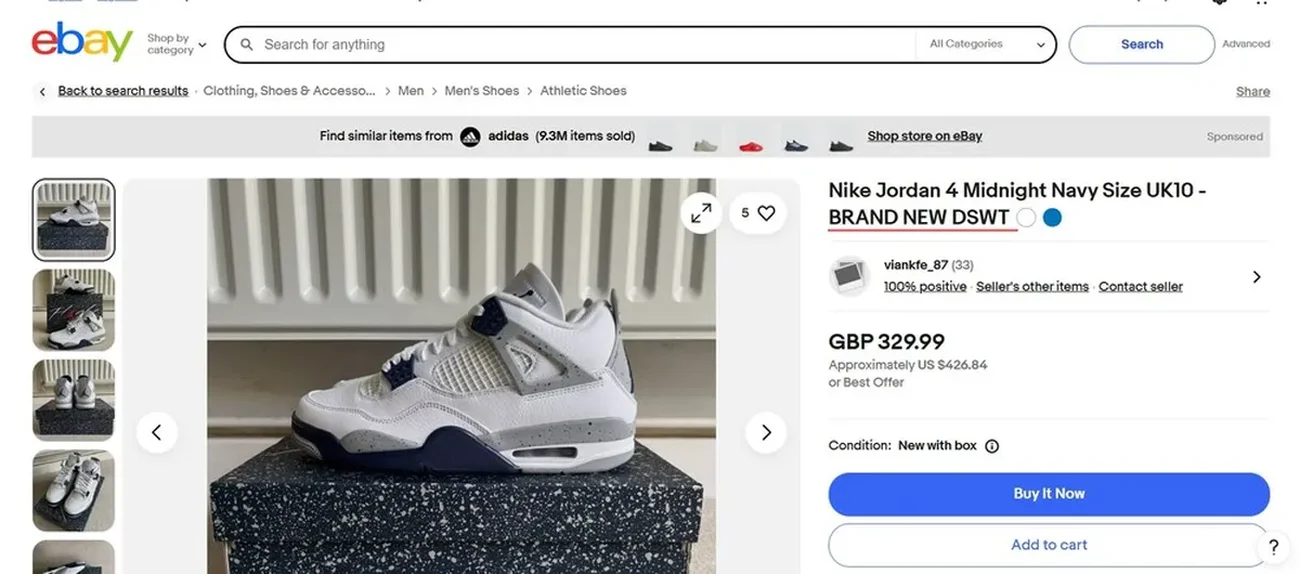
DSWT means Deadstock With Tags. In sneaker resale language, it usually describes a pair presented as Deadstock—new and unworn in the seller’s terminology—with the relevant original tags still included.
The acronym sounds more precise than it really is. DSWT is not a universal condition grade used identically by Nike, Jordan Brand, adidas, eBay, StockX, GOAT, every consignment shop, and every collector.
The safest way to evaluate a DSWT listing is to separate five questions: Is the pair truly unworn? Which tags are present? Are the box and original accessories included? What is the physical condition today? And is the sneaker authentic?
What Does DSWT Mean in Sneakers?
DSWT stands for Deadstock With Tags.
In modern sneaker conversation, Deadstock usually points to a pair presented as new and unworn, while “With Tags” adds information about the relevant original removable tags.
The term is most common in resale listings, collector groups, forums, and private transactions where sellers need a short way to describe condition.
DSWT does not automatically mean sealed, flawless, original-box-complete, authenticated, rare, or investment-grade.
Is DSWT an Official Condition Grade?
No single authority controls the term across the sneaker market.
Brands generally describe products through their own retail condition and product systems rather than a universal DSWT standard.
Marketplaces also use their own condition rules, which can differ from collector slang.
That is why the listing description and the platform’s current policy matter more than the acronym by itself.
- Nike does not issue a universal DSWT certification.
- adidas does not issue a universal DSWT certification.
- Jordan Brand does not define one global DSWT resale grade.
- eBay uses category-specific condition labels.
- StockX applies marketplace-specific condition standards rather than a public DSWT tier.
What Does “With Tags” Mean in Practice?
“With Tags” refers to relevant removable tags or retail/manufacturer tags associated with the specific product.
There is no single tag that every sneaker must have, so the release itself determines what should be present.
Hangtag
A hangtag is a removable branded tag attached to certain sneakers, often through the laces or an eyelet.
Some releases use a distinctive hangtag as part of the product presentation.
Many sneakers never came with one, so the absence of a hangtag cannot be judged without knowing the original release.
Retail Tag or Price Tag
A store may add its own barcode, price, or inventory tag at retail.
That can support provenance, but a retailer tag is not the same thing as a manufacturer-specific release tag.
Brand Tag or Release-Specific Tag
Some shoes include removable brand cards, product tags, or release-specific labels that matter to collectors.
The correct comparison is always with documented examples of that exact model, colorway, size category, and release year.
The Internal Size Label Is Not the Same Thing
The internal size/manufacturing label is normally a permanent component of the sneaker.
It can contain size, style code, manufacturing dates, and origin information even after years of wear.
Its presence does not make a used sneaker “With Tags” in the DSWT sense.
Not Every Sneaker Originally Comes With a Hangtag
This is one of the most important details in the entire topic.
A sneaker cannot be incomplete for lacking a tag that was never included at retail.
Some releases come with obvious removable tags, some include cards or accessories, and others have no removable tag at all.
Before judging DSWT, confirm what the exact release originally included.
Is a Marketplace Tag the Same as an Original Manufacturer Tag?
No. A tag added by StockX, GOAT, a consignment shop, or another authentication service documents that company’s process.
It does not become an original Nike, Jordan Brand, adidas, New Balance, or retailer tag retroactively.
Marketplace tags can be useful transaction evidence, but they answer a different question from the product’s original retail presentation.
When a listing says DSWT, ask whether the seller means factory/retail tags, marketplace tags, or both.
- Factory/manufacturer tag: originates with the product or brand.
- Retail tag: can be added by the selling store.
- Marketplace tag: added later during authentication or fulfillment.
What Is the Difference Between DSWT and DS?
DS means Deadstock. DSWT adds the “With Tags” detail.
In casual sneaker slang, both usually imply an unworn pair, but DS does not automatically tell you whether removable tags are present.
A pair can be described as DS even when the release never came with a removable hangtag.
A DS pair can also be missing a tag that some collectors would expect for a fully complete set.
That is why DSWT can be more descriptive without becoming a universally higher grade.
For the full condition discussion, see what DS means in sneakers.
Condition language works best when the seller explains the actual pair instead of relying on one acronym.
Is DSWT Better Than DS?
Not as a universal rule.
A DSWT pair may be more complete for a release that originally included removable tags, and some collectors may value that completeness.
A DS pair with no original hangtag because none ever existed is not “worse.”
The actual condition, box, accessories, authenticity, age, and price matter more than an invented hierarchy.
What Is the Difference Between DSWT and VNDS?
VNDS means Very Near Deadstock. It is a subjective community term for a pair considered very close to Deadstock condition.
DSWT presents the pair as Deadstock/unworn with relevant tags; VNDS usually enters the conversation after some wear or handling has occurred.
There is no official number of wears that universally defines VNDS.
See what VNDS means for the broader condition distinction.
What Is the Difference Between DSWT and NWT?
NWT means New With Tags. The concepts can overlap, but the terms come from different language traditions.
NWT is broader e-commerce and fashion language; DSWT is more specifically tied to sneaker resale slang.
A sneaker may reasonably be described as both when it is genuinely new/unworn and retains the relevant tags.
Neither term automatically guarantees the original box, every accessory, mint condition, or authenticity.
See what NWT means in sneakers for the category-specific differences.
How Does eBay Classify New Products With Tags?
eBay’s condition labels show why sneaker slang should not be treated as a universal marketplace standard.
For clothing, eBay uses “New with tags.”
For shoes, eBay currently uses conditions such as New with box, New without box, and New with defects.
That means an eBay footwear listing may accurately describe a new pair without ever using DSWT.
Always follow the platform’s own condition field and then read the seller’s description for tags, box, accessories, and defects.
What Is the Difference Between DSWT and NIB?
NIB means New In Box. It emphasizes the box, while DSWT emphasizes Deadstock condition plus tags.
The same sneaker can satisfy both descriptions.
A DSWT pair can also create ambiguity if the seller does not say whether the original box is present.
The most useful comparison is:
NIB answers a packaging question; DSWT answers a condition-and-tags question.
- DSWT: Deadstock + relevant tags.
- NIB: new + in box.
- Both: possible on the same pair.
Are DSWT and OG All the Same Thing?
No.
OG All generally refers to having the original components and accessories that came with the release.
DSWT tells you about Deadstock condition and tags, not the entire original set.
A pair can have its tags while missing another accessory.
Conversely, a pair can retain every original accessory after the tags were removed.
The release determines what “all” originally included.
- original box;
- extra laces;
- hangtags;
- cards or inserts;
- lace locks or hardware;
- other release-specific accessories.
Does DSWT Require the Original Box?
The acronym itself does not contain the word box.
In collector practice, many people expect a Deadstock pair to include appropriate original packaging, especially for higher-value transactions.
Other sellers may use DSWT for an unworn tagged pair even when the original box is missing.
Because expectations differ, the box should always be stated explicitly.
Do not make the buyer reverse-engineer packaging from four letters.
- original box present;
- replacement box;
- damaged original box;
- no box.
How Does StockX Treat Boxes, Tags, and Condition Today?
StockX currently uses different condition systems depending on the marketplace.
On the Verified Marketplace, sneakers must be brand new and include the correct brand-issued box, subject to StockX’s condition guidelines.
StockX says shoes can still pass verification after being unlaced or tried on for fit if they otherwise meet its standards.
The platform accepts certain minor box imperfections and can accept limited age-related discoloration or storage damage on older sneakers.
StockX also requires original accessories that came with the sneakers at purchase when applicable.
On the Listings Marketplace, New, New – Other, and Used are separate condition levels with photos and descriptions for the exact item.
Those rules are StockX policies—not a universal definition of DSWT.
Does a Loose Tag in the Box Still Count as DSWT?
There is no universal authority deciding this across every collector and marketplace.
Some buyers use “With Tags” to mean the tags are present even if detached.
Others interpret DSWT more strictly and expect the relevant tag to remain attached.
The listing should remove the ambiguity by saying exactly what happened.
- Tags attached: still physically attached to the sneaker.
- Tags included: detached but kept with the pair.
Does Removing the Tag Mean the Sneaker Was Worn?
No.
A person can remove a tag from an unworn shoe.
The opposite is also true: a tag can remain attached during a brief indoor try-on.
Condition should be evaluated from the sneaker itself, not inferred entirely from the tag.
Transparent disclosure is more useful than trying to make the tag prove something it cannot prove.
Can a DSWT Sneaker Have Been Tried On?
This is one of the areas where collector expectations differ.
A strict private collector may reserve DSWT for a pair that was never tried on.
A marketplace may allow a brief fit try-on while still treating the sneaker as new under its own condition rules.
StockX, for example, currently states that sneakers may pass its verification even if they have been tried on for fit.
That does not redefine DSWT for every collector.
If a pair was tried on, the cleanest practice is to disclose it.
The buyer can then decide whether that history fits their own standard.
Can a DSWT Sneaker Have Been Relaced?
Relacing does not prove wear.
A sneaker can be unlaced or relaced while remaining physically unworn.
Factory lacing can still matter to collectors who value original presentation.
StockX currently allows some unlaced sneakers to pass verification, which shows that factory lacing and new condition are not automatically identical concepts.
If the pair was relaced, say so when presentation matters to the transaction.
Do Tags Prove the Sneaker Was Never Worn?
No.
Tags can support a condition story, but they are not surveillance equipment.
A seller or buyer should still inspect wear-sensitive areas.
Useful checks include:
- outsole dirt or abrasion;
- toe creasing;
- heel drag;
- insole compression;
- sock lint or interior debris;
- collar wear;
- odor or other signs inconsistent with an unworn claim.
Does DSWT Prove the Sneaker Is Authentic?
No.
A counterfeit can be brand-new and can arrive with convincing tags.
Condition and authenticity are separate questions.
Counterfeiters can reproduce many of the details people mistakenly treat as automatic proof.
That is why tags should be one evidence category, not the entire authentication method.
For the broader process, see our Legit Check guide.
- hangtags;
- retail tags;
- box labels;
- style codes;
- barcodes;
- receipts;
- marketplace-style accessories.
Do the Style Code and Box Label Authenticate a DSWT Pair?
No. They help identify which product the pair is supposed to be.
A correct style code and matching box label are useful consistency checks, but printed information can be copied or mismatched.
Authentication still requires release-specific evaluation of the physical sneaker and its provenance.
Does DSWT Mean Mint Condition?
No. Deadstock and mint are not universal synonyms.
A new, unworn pair can still have manufacturing flaws, storage marks, box damage, or age-related changes.
Older pairs can yellow, oxidize, separate, or harden without being worn.
Describe those issues separately rather than hiding them behind DSWT.
Useful condition details include:
- yellowing;
- oxidation;
- glue marks;
- paint flaws;
- storage creases;
- box damage;
- material cracking;
- sole separation.
Can a DSWT Sneaker Yellow or Age Without Wear?
Yes.
Materials continue to change while the sneaker sits in storage.
Light, oxygen, heat, humidity, adhesives, foams, rubber, leather, and coatings all influence aging.
An unworn pair can therefore look different from launch-day photos years later.
StockX also warns that sneakers five years or older may have structural weakness or reduced durability because of age.
That warning is not a universal expiration date; it is a reminder that new condition and material age are separate concepts.
Does Vintage DSWT Mean the Sneaker Is Still Wearable?
No guarantee exists.
A vintage DSWT pair can remain unworn while structural materials deteriorate.
Before wearing an older pair, inspect the model-specific weak points.
Pay special attention to:
If preservation or collectible originality matters more than wear, using the pair may also change its condition category and market value.
For age-related deterioration, see our guide to hydrolysis and sneaker crumbling.
- midsole integrity;
- adhesive separation;
- outsole hardness;
- foam cracking;
- mold or moisture damage;
- brittle coatings.
Is DSWT Always Worth More Than DS?
No universal price rule exists.
Tags can add value when collectors care about completeness, but their effect depends on the release.
The larger market still considers many other variables.
Compare truly equivalent pairs before assigning a premium.
Relevant factors include:
- model;
- colorway;
- size;
- release year;
- actual physical condition;
- original box;
- accessories;
- whether tags are attached or loose;
- provenance;
- current demand;
- recent completed sales.
Does DSWT Mean Rare, Hype, or Limited Edition?
No.
A widely available general-release sneaker can be DSWT if it is unworn and retains the relevant tags.
A rare collaboration can be used and no longer qualify under a strict DSWT description.
Condition terminology does not determine production quantity or demand.
- not automatically limited;
- not automatically rare;
- not automatically hyped;
- not automatically expensive;
- not automatically collectible.
Is DSWT an Investment Category?
No.
DSWT describes a claimed condition and tag status, not a financial asset class.
Market value can fall because of changing demand, restocks, retros, aging, condition issues, or simply because buyers move on.
How Should You Evaluate a DSWT Listing?
Treat DSWT as a claim that needs supporting detail.
Confirm the exact release before judging the tags.
Then evaluate condition, completeness, authenticity, and seller credibility separately.
A strong listing should answer the following:
- exact model and colorway;
- style code/SKU;
- size;
- whether the pair was worn;
- whether it was tried on;
- which tags are present;
- whether tags are attached or loose;
- original box status;
- extra laces and accessories;
- defects or storage marks;
- restoration or repairs;
- age-related issues;
- current photos of the actual pair.
What Photos Should You Request for a DSWT Pair?
Request clear photos of the actual item rather than catalog images.
- lateral side of both shoes;
- medial side;
- toe boxes;
- heels;
- outsoles;
- insoles and interior;
- inside size labels;
- each removable tag;
- how each tag is attached;
- box and box label;
- extra laces;
- cards and accessories;
- defects or aging;
- overall pair in natural light.
How Should You List a DSWT Sneaker Transparently?
Use DSWT only if it matches your honest description of the pair.
Then explain the details instead of expecting the acronym to do all the work.
A strong listing can disclose:
- unworn condition;
- try-on history;
- relacing;
- which tags are present;
- whether tags are attached;
- original box or replacement box;
- box damage;
- extra laces;
- missing accessories;
- aging or yellowing;
- manufacturing defects.
How Should You Store a DSWT Sneaker?
Good storage cannot stop aging completely, but it can reduce unnecessary stress.
Keep pairs away from extreme heat, direct sunlight, persistent moisture, and large temperature swings.
Avoid sealing a damp shoe in airtight storage and avoid chemicals that can damage materials.
For valuable older pairs, inspect them periodically instead of assuming the box protects everything forever.
- cool, stable environment;
- low direct sunlight;
- reasonable humidity;
- clean, dry storage;
- no heavy weight crushing the box;
- periodic inspection;
- material-appropriate preservation.
Is It Safe to Buy DSWT Online?
It can be, but the transaction is only as strong as the evidence and buyer protection around it.
A high-value DSWT listing deserves more documentation than four letters and one blurry photo.
Use protected payment and platform systems when possible.
- verify seller history;
- review actual-item photos;
- confirm tags and box;
- check authenticity separately;
- read return rules;
- understand platform condition rules;
- avoid pressure to pay off-platform;
- save listing screenshots and messages;
- compare market price before paying.
DSWT FAQ
What Does DSWT Mean?
DSWT means Deadstock With Tags.
Does DSWT Mean Deadstock With Tags?
Yes. That is the standard expansion used in sneaker resale language.
Is DSWT the Same as DS?
Not exactly. DSWT adds information about relevant tags; DS by itself does not.
Is DSWT Better Than DS?
Not universally. Tags can matter to completeness, but there is no official condition hierarchy.
Does DS Mean the Sneaker Has No Tags?
No. A DS pair can still include tags; DS simply does not communicate that detail explicitly.
What Counts as a Tag in DSWT?
Release-specific removable manufacturer or retail tags can count; the exact answer depends on what that product originally included.
Does Every Sneaker Have a Hangtag?
No. Many sneakers never came with a removable hangtag.
Does the Internal Size Label Count as a DSWT Tag?
Not in the usual sense. It is a permanent product label rather than the removable tag implied by “With Tags.”
Is a StockX or Marketplace Tag a Factory Tag?
No. It documents the marketplace process, not the original manufacturer presentation.
Does DSWT Prove the Sneaker Was Never Worn?
No. Tags cannot independently prove wear history. Inspect the shoe and ask for disclosure.
Does DSWT Prove Authenticity?
No. Condition and authenticity are separate evaluations.
Can a Fake Sneaker Have Tags?
Yes. Counterfeit products can reproduce tags, labels, boxes, and codes.
Does DSWT Require a Box?
The acronym itself does not say box. The seller should disclose original-box, replacement-box, or no-box status.
Can DSWT Exist Without a Box?
Some sellers use the term that way, but collectors may disagree. Clear packaging disclosure is essential.
If the Tag Was Removed but Kept in the Box, Is It Still DSWT?
Usage varies. Say “tags included, detached” rather than relying on the acronym.
Can a DSWT Sneaker Have Been Tried On?
Expectations vary. Some marketplace new-condition rules allow fit try-ons, while stricter collectors may not.
Can a DSWT Sneaker Have Been Relaced?
Yes in some condition systems; relacing does not prove wear. Disclose it when presentation matters.
Are DSWT and NWT the Same Thing?
They can overlap, but NWT is broader commercial language while DSWT is sneaker-specific resale slang.
Are DSWT and NIB the Same Thing?
No. DSWT emphasizes condition plus tags; NIB emphasizes being new and in a box.
Does DSWT Mean OG All?
No. Tags alone do not guarantee every original accessory is present.
Does DSWT Mean Mint?
No. An unworn pair can still have defects, storage marks, or aging.
Can a DSWT Sneaker Yellow?
Yes. Yellowing can occur without wear.
Can Vintage DSWT Sneakers Separate?
Yes. Adhesives and materials can degrade with age even in storage.
Does Vintage DSWT Mean the Sneaker Is Wearable?
No. Structural condition must be evaluated separately.
Is DSWT Always Worth More Than DS?
No. The value premium, if any, depends on the release and buyer demand.
Is DSWT an Investment?
No. It is a condition description, not a guaranteed investment category.
Is It Safe to Buy DSWT Online?
It can be when the seller, photos, authenticity, condition, payment protection, and platform policies are strong.
Conclusion: DSWT Describes Tags, Not Magical Powers
DSWT is useful shorthand because it combines two ideas: Deadstock condition and the presence of relevant tags.
It becomes misleading when buyers or sellers use those four letters as proof of authenticity, perfection, rarity, or investment value.
The tag itself also needs context: factory tag, retail tag, permanent size label, and marketplace tag are different things.
For older sneakers, remember that unworn does not mean unaged. A DSWT pair can yellow, separate, harden, or become structurally fragile while sitting in storage.
The best listing therefore explains the pair in full: wear history, tags, box, accessories, defects, age, authenticity, and provenance.
For related condition language, continue with the Sneakerhead Dictionary.