
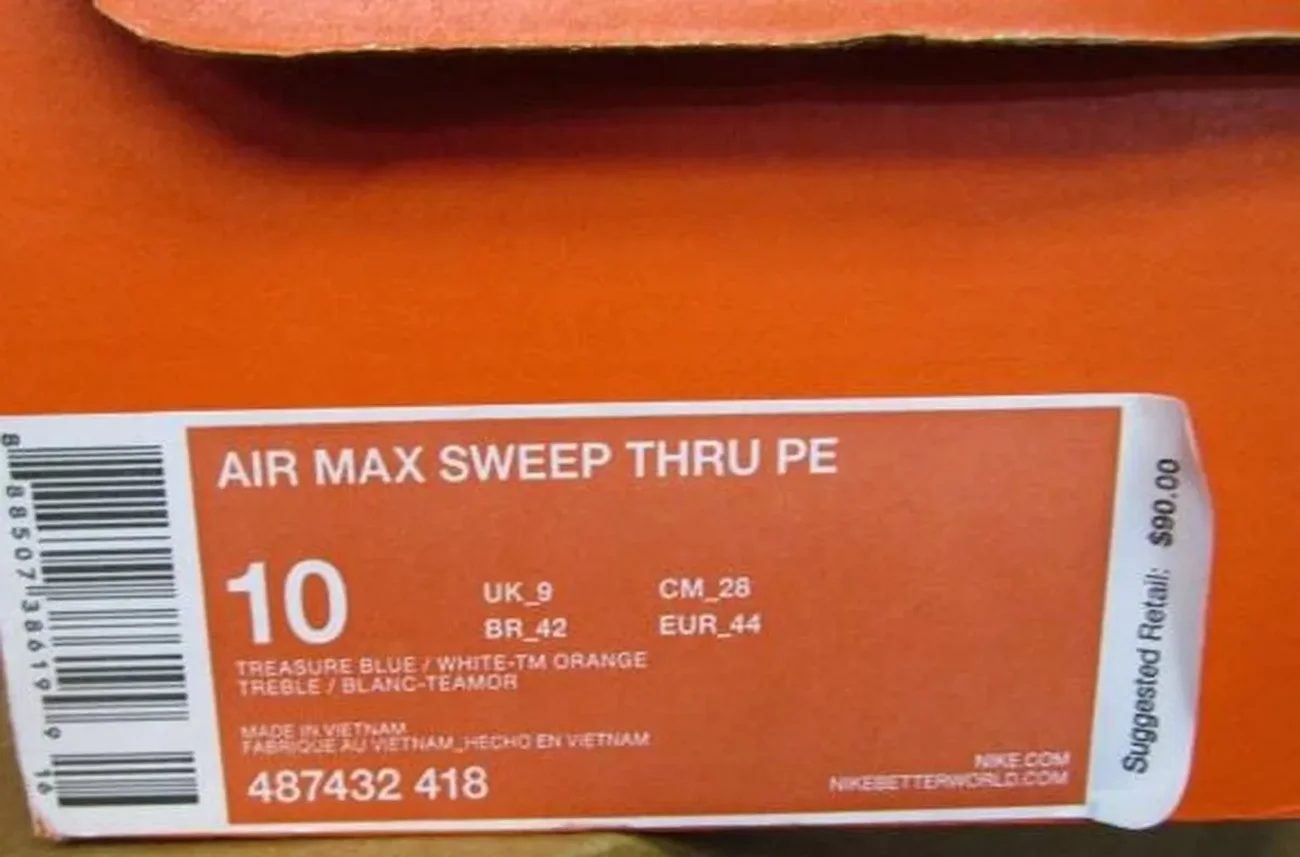
PE means Player Exclusive. At Nike and Jordan Brand, the term appears on footwear created in connection with specific athletes, teams, or programs. But it does not automatically mean “one custom-made pair that can never be sold to the public.”
That last point is where the topic gets interesting. A PE can feature a colorway created for one athlete, team colors, jersey numbers, initials, logos, personal messages, or references to family, school, city, or country.
Some pairs issued directly to professional athletes can also include functional adjustments. Others keep the standard performance platform of the model and change mainly through color, materials, branding, or storytelling.
There is another myth worth removing immediately: a PE—or a colorway that began life as a PE—can eventually reach retail. Nike has documented examples of Player Exclusive footwear being sold to consumers.
So those two letters do not tell you production quantity, market value, authenticity, or whether the shoe will ever release. PE identifies the athlete-related context. Everything else has to be investigated separately.
What Does PE Mean at Nike?
PE means Player Exclusive. Nike itself uses the expression “player-exclusive (PE) footwear” when discussing athlete partnerships.
In a 2024 WNBA report, NIKE, Inc. said it maintained 20 player-exclusive footwear partnerships, including relationships with Jewell Loyd, Yang Liwei, and Jonquel Jones. Nike also said Jones would debut a KD17 PE.
That wording matters because it confirms that PE is not merely collector slang. It is terminology Nike uses in official basketball communication.
PE therefore describes a product context tied to a player or athlete. It is not cushioning technology, a foam compound, a manufacturing method, or a universal rarity grade.
For other abbreviations used in sneaker names, boxes, and listings, see the Sneakerhead Dictionary.
Are Player Exclusive and Player Edition the Same Thing?
They can overlap in everyday sneaker conversation, but it is better not to declare that they are always identical corporate terms.
Nike clearly uses Player Exclusive and the abbreviation PE in official basketball contexts.
At the same time, Nike also uses Player Edition. In December 2024, for example, the company introduced the Nike G.T. Hustle 3 Paige Bueckers Player Edition.
Both expressions can describe athlete-specific product stories, but Nike does not publish one universal rule saying that “Player Exclusive” and “Player Edition” are interchangeable in every era and every product category.
When explaining the abbreviation PE itself, Player Exclusive is the expansion directly documented by NIKE, Inc.
What Is a PE Sneaker in Practice?
A PE is best understood as an execution of a model associated with a particular athlete, team, school, or program.
Depending on the project, that execution may include:
- a specific colorway;
- the athlete’s jersey number;
- initials, logos, or personal marks;
- team, school, or national colors;
- personal messages;
- family, city, school, or geographic references;
- release-specific materials;
- documented functional adjustments in certain cases.
The important word is may. PE is not a universal technical specification.
There is no requirement that every PE must have an embroidered number, a team color palette, a custom midsole, or a one-of-one production count.
Is Every PE Custom-Made for the Athlete?
No. It is not safe to assume that every PE is fully bespoke.
Professional athletes can receive footwear with specific fit, insole, support, or other functional needs. Those possibilities are real, but they do not turn every PE into a completely rebuilt shoe.
Many publicly documented PEs differ most clearly through visual identity.
The G.T. Hustle 3 Paige Bueckers Player Edition is a useful example. Nike highlighted baby blue and lavender, references to UConn and Minnesota, “buckets” embroidery, and a message from her father.
Those details make the shoe deeply personal without giving us permission to invent secret changes to foam, Air Zoom, or tooling that Nike never documented.
Is a PE the Same as a Signature Shoe?
No. This is one of the most important distinctions in the topic.
A signature shoe is a model or franchise developed around the identity and performance needs of a particular athlete.
LeBron James has the LeBron line. Kevin Durant has KD. Sabrina Ionescu has Sabrina. A’ja Wilson has the A’One and, in 2026, the A’Two.
A PE, by contrast, can be a specific execution of one of those models for another athlete.
NIKE, Inc. documented a KD17 PE for Jonquel Jones. The KD17 remains Kevin Durant’s signature shoe; Jones’s version is a Player Exclusive built from that platform.
Signature and PE therefore can coexist. One describes the broader athlete franchise; the other describes a particular execution.
PE and Custom Sneakers Are Different Things
A sneaker painted, cut, reconstructed, or modified after production by an artist does not become a Player Exclusive simply because it was personalized for someone.
PE describes a product created inside an official brand relationship or authorized athlete, team, or program context.
A factory-created PE can certainly include customized graphics, colors, or athlete-specific details.
But “custom” and “Player Exclusive” are not synonyms. Origin and authorization matter.
Michael Jordan Shows That PE Is Not a New Idea
Player-specific footwear existed long before today’s social-media reveal posts and digital launch calendars.
Michael Jordan’s early Nike history includes documented PE footwear both before and after the Air Jordan franchise became established.
Nike Air Ship PE: Before the Air Jordan 1
Nike’s official The Last Dance footwear archive documents Michael Jordan wearing a Nike Air Ship PE during his rookie season.
Nike specifically notes “Nike Air” heel branding on the pair and shows Jordan in White/Red and Black/Red versions, particularly in footage against Milwaukee.
This is useful evidence that player-specific Nike footwear was already part of Jordan’s story before the Air Jordan 1 became the icon most people associate with his footwear history.
It should not be turned into an unsupported absolute claim that the Air Ship PE was “the first Nike PE ever.” The surviving documentation does not justify that title.
Air Jordan XIII Low PE in 1998
The same Nike archive documents Jordan wearing an Air Jordan XIII Low PE during the 1998 Eastern Conference Finals and NBA Finals.
Nike also shows Jordan in the Air Jordan XIII Low PE during practice scenes from his final Chicago season.
That example makes the distinction especially clear: Jordan already had his own signature franchise, yet PE executions still existed inside that franchise. Signature shoe and Player Exclusive are not mutually exclusive ideas.
Team PE and College PE: Not Every Exclusive Belongs to One Person
Player-specific footwear also has a long history in team and college programs.
In a Department of Nike Archives story published in 2026, Nike revisited how Georgetown received player-only versions of the Nike Terminator with HOYAS stamped across the heel.
That article does not prove that every college-exclusive shoe should formally be called a “Team PE.” It does show that Nike has a deep history of making footwear specifically for players within a program.
Collectors often use phrases such as team PE and college PE, but the official naming should still be verified product by product.
What Can Actually Change on a PE?
The answer depends on the product.
On the visual side, a PE can incorporate:
- athlete-specific colors;
- team or school colors;
- jersey numbers;
- initials or personal logos;
- family references;
- city, school, or national references;
- messages or phrases;
- special graphics or material treatments.
On the functional side, an athlete-issued pair can sometimes include:
- fit adjustments;
- different insoles or orthotics;
- support modifications;
- padding changes;
- size or width specifications not normally offered at retail;
- other performance changes documented for that specific athlete or pair.
The crucial rule is evidence. Do not assume a functional modification simply because the shoe is a PE.
Does Every PE Use Different Technology?
No. PE is not a technology.
A Player Exclusive can use the same performance platform as the standard version and differ primarily through color, branding, materials, or storytelling.
This is especially important with signature footwear. A KD PE still begins with the corresponding KD platform; a LeBron PE begins with that LeBron model; a Kobe PE begins with the architecture of that Kobe product.
If cushioning, tooling, fit, plate structure, foam, or other technical elements were changed, that should be supported by documentation for the specific pair.
PE alone does not mean better performance, more cushioning, or a secret athlete-only setup.
Does Every PE Have the Athlete’s Number or Team Colors?
No. Those details are common, but they are not requirements.
Some PEs use obvious team palettes or jersey numbers.
Others are intensely personal and reference family, hometown, school memories, music, hobbies, or colors with no direct relationship to the athlete’s uniform.
That freedom is part of what makes Player Exclusives interesting: they can document a season, a person, or a moment through product design.
Is Every PE Rare?
No. You cannot measure rarity by reading PE in the name.
Scarcity can depend on:
- how many pairs were actually produced;
- whether the pair was athlete-issued only;
- whether a retail version later released;
- how much inventory survives;
- current collector demand.
An unreleased athlete-issued PE can be extraordinarily difficult to find. A PE-inspired colorway that later receives a public release may be much easier to buy.
The abbreviation identifies the athlete context—not a guaranteed level of scarcity.
How Many Pairs of a PE Are Produced?
There is no universal number.
One project may involve only enough footwear for an athlete’s season or team needs. Another athlete-specific colorway can later be produced in normal retail quantities.
Brands do not always publish production counts, especially for athlete-issued product.
Claims such as “every PE has 2, 5, or 12 pairs” should not be repeated unless a reliable source documents that number for the exact release.
Can a PE Be Sold to the Public?
Yes. This is one of the most important corrections to the myth that a “real PE” can never reach retail.
Several different things can happen:
- a Player Exclusive can be created for an athlete and remain athlete-only;
- a PE concept can be reproduced for consumers;
- a colorway that began as a PE can later inspire or receive a retail release;
- a product can be marketed as a Player Edition and sold directly to consumers from launch.
The specific history of the release determines which case applies.
House of Hoops: Player Exclusives at Retail in 2007
On November 19, 2007, Nike and Foot Locker opened the first House of Hoops on 125th Street in Harlem.
Nike’s launch announcement called it the only U.S. destination at the time featuring player exclusive footwear.
The company described limited-edition personalized performance shoes associated with players such as Kobe Bryant, Jason Kidd, and rookie Kevin Durant, and said those styles would be made available to consumers at House of Hoops.
So Nike itself demonstrated in 2007 that “Player Exclusive” and “never sold to the public” were not absolute synonyms.
Paige Bueckers: A Player Edition Released at Retail
In December 2024, Nike introduced the G.T. Hustle 3 Paige Bueckers Player Edition while she was still at UConn.
Nike called Bueckers the first NIL athlete to design and launch a Nike Player Edition basketball sneaker, and documented personal details tied to her favorite colors and her connections to Minnesota and UConn.
The shoe launched December 7 on SNKRS and at select retail locations—clear evidence that “Player Edition” can be an official consumer product.
Kobe: A Previously Unreleased PE Reaches Retail in 2026
A 2026 release provides an even more direct example.
Nike launched the Air Force 1 Low Protro “Obsidian and White”, style IM1980-400, and described the design as a previously unreleased Player Exclusive from 2006 connected to Kobe Bryant.
The U.S. SNKRS page listed the shoe at $150 and updated the classic Air Force 1 with a ReactX drop-in midsole paired with Nike Air cushioning.
The important distinction is provenance: the retail product is a new consumer release based on the historical PE design.
That does not mean every retail pair was physically produced for or issued to Kobe Bryant in 2006. The origin of the colorway and the provenance of one individual pair are different questions.
Athlete-Issued PE and Retail Release Are Not the Same Thing
Three categories help keep the terminology clear:
- Athlete-issued PE: a specific pair produced or supplied for the athlete, team, or program.
- Originally PE colorway: a design created in the athlete-exclusive context that later may be reproduced or adapted.
- Retail release: a version officially manufactured for consumers, possibly based on the earlier PE.
Those categories can share colors and design language while having very different provenance.
That is why a marketplace title containing “PE” does not automatically tell you what object is actually being sold.
If a seller claims a pair is athlete-issued or game-used, provenance becomes far more important than the acronym.
PE Sneakers in Women’s Basketball and the WNBA
Player Exclusives are not a men-only basketball story.
In 2024, NIKE, Inc. reported 20 player-exclusive footwear partnerships and highlighted athletes including Jewell Loyd, Yang Liwei, and Jonquel Jones.
Nike also said Jones would debut a KD17 PE, another example of a player using a PE built from someone else’s signature platform.
At the same time, women’s basketball increasingly includes signature franchises of its own.
In 2026, Nike launched the Sabrina 4 signature collection for Sabrina Ionescu, while A’ja Wilson entered the second year of her signature journey with the A’Two.
Signature footwear and PE therefore represent different ways of expressing athlete identity inside Nike Basketball, and both can coexist in the same era.
Is PE Rarer Than QS, SP, or SE?
There is no universal scale that lets us answer yes.
PE describes a relationship with a player, athlete, team, or program.
QS, SP, and SE are different Nike naming conventions with different histories.
An unreleased athlete-issued PE can be extraordinarily scarce.
A particular QS, SP, or SE product can also have very narrow distribution.
So a ladder such as SE < QS < SP < PE is not a documented Nike hierarchy.
If those other abbreviations appear on the product you are researching, read them separately: Nike QS, Nike SP, and Nike SE.
Is a PE Automatically More Expensive?
No. PE is not a pricing formula.
Price can depend on:
- the athlete;
- the model;
- whether the pair was athlete-issued;
- documented provenance;
- condition;
- size;
- production and availability;
- collector demand;
- whether a retail version exists.
A genuine athlete-issued pair with strong documentation may attract serious collectors. A Player Edition released at retail can simply have a normal MSRP established by Nike.
PE therefore does not mean “fortune,” and the acronym should not be treated as a guaranteed investment thesis.
What Do Game-Worn and Game-Issued Mean on a PE?
These terms often appear when PEs enter the collector market.
Game-worn means the claim is that the athlete actually wore that specific pair in competition.
Game-issued or player-issued generally means the pair was supplied or prepared for the athlete, but the wording does not automatically prove it was worn in a game.
The value of either claim depends heavily on provenance—photos, team or athlete records, documentation, chain of ownership, and other evidence connecting the physical pair to the athlete.
A correct colorway alone cannot establish game use.
How Do You Identify Which PE You Are Looking At?
Start with the release identity, then investigate the athlete connection.
- Model: which sneaker platform is it?
- Athlete or team: who is the version associated with?
- Colorway and details: do they match documented images or records?
- Style code: is there a retail or archival identifier?
- Date or season: when did the PE appear?
- Provenance: if it is claimed to be athlete-issued or game-worn, what evidence connects that pair to the athlete?
The more exceptional the claim, the more documentation matters.
“Looks like the PE” and “this exact pair was issued to the player” are two very different statements.
Does PE Always Appear on the Inside Size Tag?
No. There is no evidence of one universal Nike size-tag field where PE must appear on every Player Exclusive.
Depending on the product, PE may appear in Nike or Jordan naming, archive pages, launch descriptions, retailer records, media coverage, packaging, or other documentation.
Some athlete-issued products may use identifiers that make sense only within a specific team or development system.
The old assumption that “PE is always a marking on the tag” is too narrow for how widely the term is used.
Does PE on the Box or Product Name Prove Authenticity?
No. Product identification and authentication are separate processes.
A counterfeit can reproduce:
- the PE abbreviation;
- a player number;
- a style code;
- the box label;
- a documented colorway;
- personal logos or graphics;
- packaging details.
For athlete-issued or game-worn PEs, provenance is especially important: where did the pair come from, who owned it, and what evidence supports the connection to the athlete?
A convincing story without documentation is still only a story.
For the broader process, see our Legit Check guide.
Is Buying a PE Worth It?
That depends much more on the product than on the two letters.
For a retail release derived from a PE, evaluate:
- the design and story;
- fit and comfort;
- performance or intended use;
- price;
- whether you actually want to wear or collect it.
For a claimed athlete-issued or game-worn PE, the analysis changes: release identity, documentation, condition, and provenance become much more important.
A rare story can make a pair historically fascinating without making it a sensible purchase at any price.
Buying only because you expect guaranteed appreciation is not a strong reason. PE describes athlete context, not a promise of financial return.
Nike PE FAQ
What Does PE Mean at Nike?
PE means Player Exclusive. NIKE, Inc. officially uses the phrase “player-exclusive (PE) footwear” when discussing athlete partnerships.
Are Player Exclusive and Player Edition the Same Thing?
Nike uses both expressions in different contexts. Player Exclusive is the directly documented expansion of PE; Player Edition also appears officially on products such as the G.T. Hustle 3 Paige Bueckers Player Edition. They should not be treated as a universal corporate synonym without checking the product.
Is Every PE Made for One Individual Athlete?
No. There are versions tied to individual athletes as well as footwear created for teams, schools, programs, or groups of players.
Is Every PE Completely Custom-Made?
No. Some athlete-issued pairs may use functional adjustments, while many publicly documented PEs differ mainly through colorway, branding, materials, or personal references.
Is a PE the Same as a Signature Shoe?
No. A signature shoe is the athlete’s broader model or franchise. A PE is a specific execution. A KD17 PE for Jonquel Jones is still built from Kevin Durant’s signature model.
What Is the Difference Between a PE and a Custom Sneaker?
A PE originates through an official brand relationship with an athlete, team, or program. A custom is generally a shoe modified after production. A unique custom does not become a Player Exclusive merely because it was made for one person.
Does Every PE Use Different Technology?
No. Do not assume changes to cushioning, tooling, fit, or performance systems unless the specific pair is documented that way.
Does Every PE Have the Athlete’s Number?
No. Numbers, initials, logos, and team colors are common design tools but are not universal requirements.
How Many Pairs of a PE Exist?
There is no universal production number. Some athlete-issued projects are extremely small; others become retail releases. Production quantity must be documented release by release.
Is Every PE Rare?
No. An unreleased athlete-issued pair can be extremely scarce, while a PE-originated colorway that later reaches retail can become much more available.
Can PE Sneakers Be Sold in Stores?
Yes. House of Hoops sold player-exclusive footwear in 2007, Paige Bueckers’ Player Edition launched through SNKRS in 2024, and Nike released a Kobe-inspired Air Force 1 Protro based on a previously unreleased 2006 PE in 2026.
Is a Retail PE the Same Physical Pair the Athlete Wore?
Not necessarily. A retail release can reproduce or reinterpret a colorway that began as a PE. That does not mean each consumer pair was produced for or issued to the athlete.
Do WNBA Players Have PEs?
Yes. NIKE, Inc. reported 20 player-exclusive footwear partnerships in 2024 and highlighted athletes including Jewell Loyd, Yang Liwei, and Jonquel Jones.
Is PE Rarer Than QS, SP, or SE?
There is no universal hierarchy among those labels. Rarity has to be demonstrated for the specific release.
Is a PE Automatically More Expensive?
No. Price depends on the model, athlete, provenance, condition, availability, demand, and whether a consumer release exists.
Does PE Always Appear on the Size Tag?
No. There is no documented universal requirement for PE to appear in one fixed location on every inside label.
Does PE on the Box Prove Authenticity?
No. Boxes, PE markings, style codes, numbers, and colorways can be reproduced. Identifying the release and authenticating the physical pair are separate tasks.
PE Tells the Player’s Story—not a Rarity Formula
Player Exclusives are interesting because they place a human layer on top of performance footwear.
Sometimes that layer appears through colors. Sometimes through numbers, family references, school identity, a hometown, or a private message. In certain documented cases, an athlete-issued pair can also carry functional adjustments.
Michael Jordan wore a Nike Air Ship PE before his own signature franchise dominated basketball, and he was still wearing Air Jordan XIII Low PEs in 1998 after that franchise was fully established.
Decades later, WNBA athletes receive Player Exclusives on contemporary models, Paige Bueckers launched a Player Edition at retail, and Nike brought a previously unreleased Kobe Bryant PE design to consumers through the 2026 Air Force 1 Low Protro.
PE means Player Exclusive: an execution tied to the athlete and the context of that product. Technology, production quantity, distribution, rarity, price, availability, game use, and provenance all require separate evidence.
To keep decoding sneaker nomenclature without turning abbreviations into myths, use the Sneakerhead Dictionary. For more stories where basketball, design, and sneaker culture overlap, explore Sneaker History & Culture.