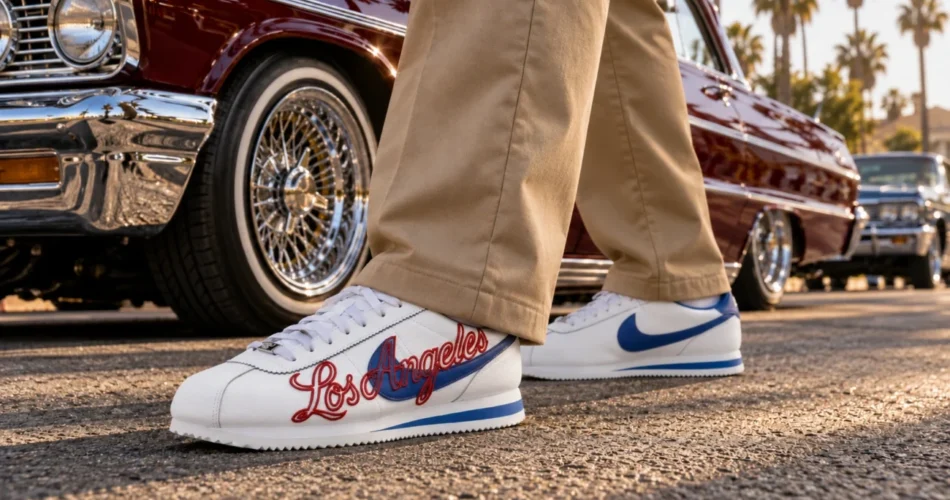
The Nike Cortez reached the market under the Nike name in 1972, but its story began earlier, while Blue Ribbon Sports worked with Japan’s Onitsuka. Bill Bowerman’s search for a better-cushioned distance-running shoe produced a design that later found a very different home in Los Angeles streetwear, West Coast hip-hop and popular culture.
That journey is what makes the Cortez worth studying. Its low profile, prominent Swoosh and herringbone outsole connect Nike’s early running years with generations of people who adopted the shoe for reasons its original designer could never have specified. Performance history and cultural history meet in the same familiar shape.
Nike Cortez at a glance
- Nike release: 1972, following development with Onitsuka during the 1960s.
- Designer: Bill Bowerman, Nike co-founder and University of Oregon track coach.
- Key construction: Continuous cushioning through the midsole, developed from Bowerman’s earlier experiments with different rubber densities.
- Name: The Cortez naming story refers to Hernán Cortés, following a conflict over the proposed Aztec name.
- Cultural reach: Running, Los Angeles streetwear, West Coast hip-hop, Chicano identity, movies and music.
- Shared roots: The Nike Cortez and Onitsuka Tiger Corsair belong to a history that predates Nike’s independent footwear business.
From a running problem to an enduring silhouette
The Nike-branded Cortez arrived in 1972 as the young company built an identity around its own products and the Swoosh. Bowerman had been working on the cushioning problem since the Blue Ribbon Sports years. The low upper, continuous midsole and closely spaced outsole grooves made the design distinctive. Calling it a shoe invented overnight for the Munich Olympics compresses a much longer development story.
More than five decades later, the Cortez still connects different parts of sneaker culture. A distance-running design became recognizable through Los Angeles street style, Eazy-E’s image and Forrest Gump’s cross-country run. Contemporary celebrity styling, including the Jeremy Allen White image below, is another chapter in that visibility. The same silhouette can read as a running artifact, a movie reference or an everyday wardrobe staple.
The running years that shaped the Cortez
In the 1960s, Bowerman was looking for ways to reduce footwear weight and improve the experience of his runners. His experiments grew out of coaching, athlete feedback and dissatisfaction with particular shoes. That is a more useful starting point than dismissing all earlier running footwear as crude or all rival brands as uninnovative. The important question was what he changed and why.
Bowerman and Phil Knight founded Blue Ribbon Sports in 1964 to distribute Onitsuka shoes. Nike’s archive traces a key development to Oregon runner Kenny Moore in 1965: after examining the shoes Moore had been using, Bowerman worked with different cushioning densities and sent instructions and samples to Japan. Moore logged more than 1,000 miles in Bowerman’s evolving footwear. An early-1967 catalog documented the resulting Tiger Cortez.
The timing mattered. Jogging was becoming a broader American pastime, and Bowerman helped popularize it in Eugene and through his 1967 book, Jogging. A training shoe could now reach beyond elite competition. The history of Nike begins partly in this exchange between athletes’ practical needs, an expanding running public and a small business willing to rethink the product.
From the Tiger years to the Nike Cortez
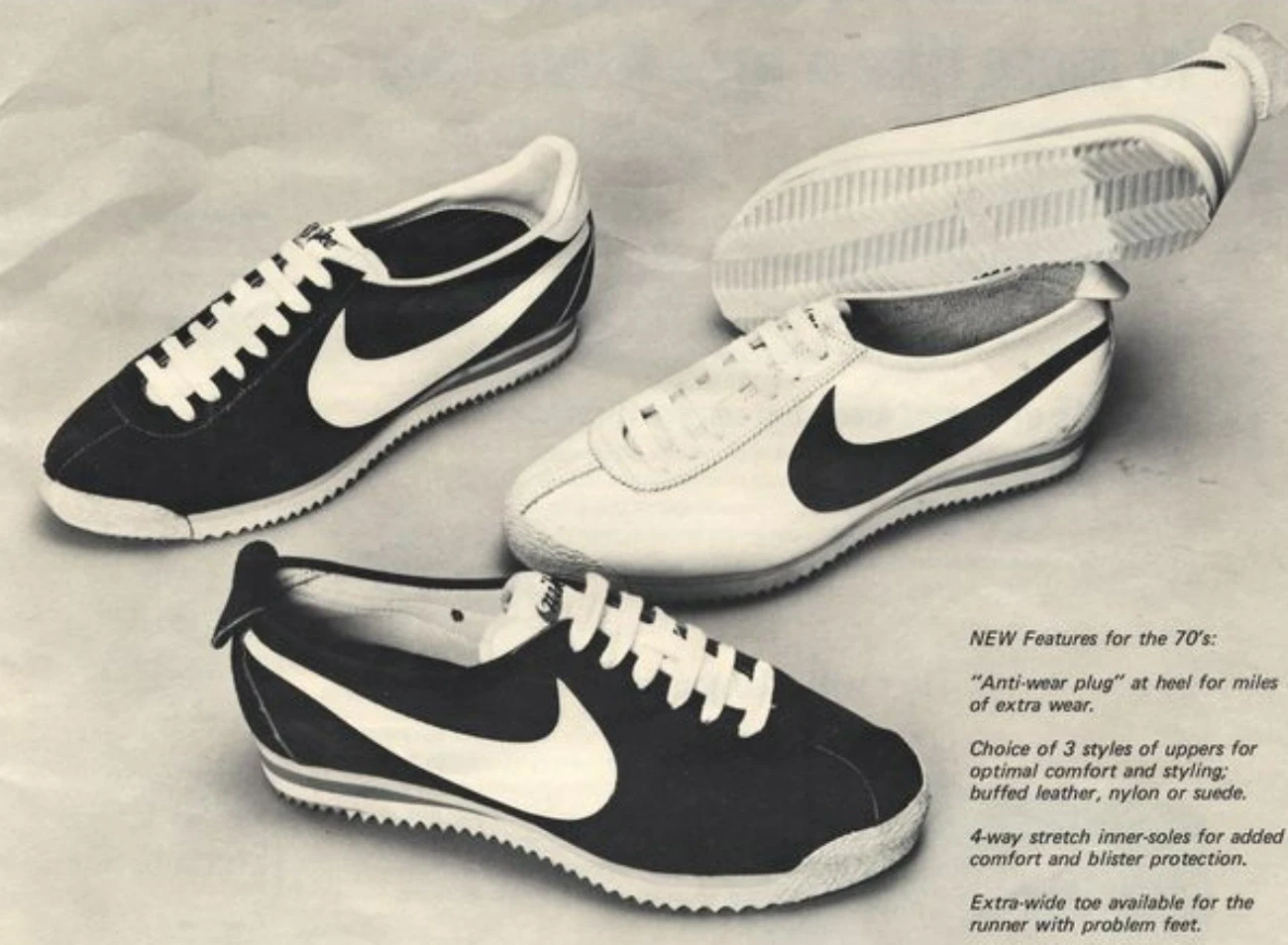
Bowerman’s process involved taking shoes apart, altering their construction and listening to runners. Early prototypes used separate cushioning pads beneath the heel and forefoot; the design developed toward the continuous midsole he wanted. The significance is in that iteration. The finished silhouette grew from a sequence of tests and exchanges with Onitsuka, rather than a single sketch or a sudden styling decision.
Names changed during the model’s early development. Histories connect TG-24 and Mexico-era products with the eventual Cortez, while the Aztec proposal ran into adidas’ existing Azteca Gold name. NPR’s 2022 retrospective, drawing on Phil Knight’s memoir, describes a threatened lawsuit over the similar names. The replacement name referenced Hernán Cortés and the conquest of the Aztecs. That origin later sat uneasily beside the shoe’s importance to Chicano communities.
As Blue Ribbon Sports and Onitsuka’s commercial relationship broke down, Nike moved toward its own footwear identity. The Nike Cortez became part of that transition; Onitsuka’s related model continued as the Corsair. Disputes over business and naming rights belong to this history, but they should not be reduced to a simple accusation of theft. Blue Ribbon Sports dates to 1964, Nike branding emerged in 1971 and the Nike Cortez arrived in 1972: those are different milestones.
The design: cushioning, proportion and traction
Bowerman’s cushioning experiments put softer material where he wanted shock absorption and firmer material where he wanted structure. The early separate pads developed into a continuous midsole, while work around the heel reflected his concerns about runners’ needs. Those features help explain the Cortez’s technical importance without claiming that it was the first comfortable running shoe ever made or that it prevented injuries for everyone.
Leather, nylon and suede all appear in the Cortez’s wider history. They should not be collapsed into a claim that every original 1972 pair had a nylon upper. The archival advertisement shown here explicitly offers different upper materials. Beneath them, the dense herringbone pattern is a recognizable design feature. Its grooves differ from the raised waffle lugs that became associated with another Bowerman project.
Nike’s archive cites a July 1973 Runner’s World assessment identifying the Cortez as the most popular U.S. long-distance training shoe at that time. That is a dated contemporary assessment, not a current sales ranking. It places the model firmly in running-footwear history, while leaving room for the Waffle Trainer and other shoes that soon advanced the category in different directions.
The Cortez Deluxe appeared in 1973 with a leather-and-suede treatment and changes around the heel, followed by the women’s Señorita Cortez in 1974, as documented in size?’s historical account. The line’s material and sizing variations widened its audience. By the later 1970s, newer running models were taking the technical spotlight. The Cortez’s next life would increasingly depend on everyday wear and cultural meaning rather than remaining Nike’s newest performance platform.
From running to Los Angeles streetwear
The transition into casual wear happened gradually. Farrah Fawcett’s appearance in Cortez shoes in Charlie’s Angels became a memorable television reference during the 1970s. It is one example of how athletic footwear entered wardrobes beyond training. The connection between screen style and the sneaker gave the design another life beyond its original running purpose.
In Los Angeles, the Cortez acquired meanings that went beyond Nike’s original running brief. Photographer Estevan Oriol’s first-person recollections in NPR’s oral history describe the shoe alongside jeans and white T-shirts in the 1980s and 1990s. His account includes gang associations in some settings, but also a broader Chicano streetwear culture. Those histories do not make a pair of shoes evidence of any wearer’s identity or affiliation.
Eazy-E helped make the Cortez visible within West Coast hip-hop, and the shoe also became associated with the wider style world around N.W.A and Snoop Dogg. Music, photography and everyday use reinforced one another. In Forrest Gump (1994), the white, red and blue Cortez reached another enormous audience. The film connection became a lasting nickname for that familiar color combination, distinct from the shoe’s official style code.
Whitney Houston wore Cortez shoes for her 1991 Super Bowl national-anthem performance; the model also appeared in television wardrobes such as Seinfeld. Kendrick Lamar referenced the Cortez in his 2013 Control verse and later developed Nike collaborations, with the Cortez Kenny releases arriving in 2018. His connection to Compton belongs to a larger story of local attachment. The sneakerhead community encounters the same shoe through music, film, family memory and neighborhood style, with no single interpretation shared by everyone.
Retros and reinterpretations across the decades
The Cortez has changed through successive versions rather than staying technically frozen. The late-1980s Cortez 2, the Flywire-equipped Cortez Fly Motion of 2009 and the slitted sole of the 2013 NM QS interpretation illustrate different attempts to update the platform. For a collector, these are separate designs and releases. The relevant comparison starts with identifying exactly which version is being discussed.
An original-era pair and a later retro may differ in toe shape, panel dimensions, midsole geometry, material finish and labels. There is no single specification for all 1970s Cortez shoes, much less every retro made since 2000. Some use leather; others use textile or different combinations. On the resale market, identify the year, style code and actual materials instead of relying on “OG,” “premium” or the Forrest Gump nickname as complete descriptions.
The white, red and blue combination has returned in multiple editions, including releases discussed in 2024. Availability and materials belong to the particular SKU. Market reports also require care: alias’s 2023 Cortez feature examined sales and recorded wants on its platform. Its 49%/51% chart divided wants between selected collaborations and other Cortez styles. Those figures describe activity within that report’s scope, rather than the whole sneaker market. Popularity data becomes useful for understanding sneaker culture only when its measure and period are clear.
Examining a vintage Cortez
The first time I held a 1970s Cortez was in a vintage shop in Portland. I remember the yellowed edges of the nylon, stiff rubber and worn suede Swoosh. That particular pair felt remarkably light beside the modern retros I knew, with a more tapered toe and a firmer-feeling midsole. Those are impressions of one aging pair, rather than specifications for every original.
A vintage pair can reveal construction details that a modern product image obscures: the edge of a panel, the shape of a heel, a label or the way the sole meets the upper. It can also show yellowing, hardened rubber, brittle foam or weakened adhesive. Those signs describe the individual object’s age and condition; they do not prove that every original was lighter, better made or more comfortable than every retro.
Compare toe profile and midsole proportions with a documented pair from the same production era. Condition can change how materials feel, so stiffness in a decades-old shoe is not a reliable guide to its original ride. Nor is trying it on always sensible: an old collectible may be too fragile for wear. Photographs, measurements and provenance can help establish what it is while avoiding unnecessary stress on fragile materials.
Why the Cortez mattered to the young Nike
The Cortez gave Nike a recognizable product as it moved beyond distributing another company’s shoes. That commercial role was important during the separation from Onitsuka. The broader story also involved other products, employees, manufacturing relationships and financing. Saying Nike would certainly have failed without this one model turns a historical contribution into an unverifiable alternate history.
Its design offers a more concrete lesson: start with the athlete’s problem, experiment with construction and let the solution shape the product. Later work, including Tinker Hatfield’s design approach, Air Max and Flyknit, can be compared through that lens. They are different technologies and histories, not automatic consequences of the Cortez. The connection is a recurring way of thinking about footwear, rather than a claim that every later Nike depended on one shoe.
Archive details and stories that need context
- Cortez and Corsair: Nike and Onitsuka’s related silhouettes reflect their shared development period and later separation. The naming dispute should be distinguished from an assertion that either company invented every part of the design alone.
- Modest materials, considered placement: Bowerman experimented with sponge and firmer rubber rather than relying on exotic ingredients. The important detail is placement: different densities gave different parts of the construction distinct roles.
- Corky Cortez: A back-to-school advertisement in the August 5, 1982 Cadiz Record lists the canvas Corky Cortez among children’s Nike shoes. It is a small, concrete reminder that the Cortez family also reached children’s everyday wardrobes.
- Steve Prefontaine: The Oregon runner belongs to the same early Nike sporting world as Bowerman and the Cortez. Athlete history and product history intersect, while the shoe’s own development remains rooted in the earlier Onitsuka partnership.
- Colors and local meanings: The Cortez’s historical gang associations in some Los Angeles settings should not be generalized to every neighborhood or wearer. Those meanings came from local use and context; a color combination alone cannot identify someone’s affiliation.
- Special editions: A commemorative design, a custom pair and footwear issued to an athlete are different categories. A collector should distinguish the story printed on a retail release from evidence that a specific pair was actually issued to or worn by an athlete.
Original, retro and premium: what can you actually compare?
| Feature | Original-era Cortez | Later Cortez retros | Premium and collaborative editions |
|---|---|---|---|
| Upper | Material varies by original model and year | Leather, textiles or combinations depending on release | Edition-specific materials; premium is not one formula |
| Midsole | Early continuous-cushioning construction | Foam and geometry depend on the particular retro | Check the named edition’s construction |
| Shape | Compare with a documented period example | Proportions can differ across production runs | May recreate older details or deliberately reinterpret them |
| Outsole | Herringbone is a defining visual feature | Compound and dimensions can change | A special label does not guarantee better traction |
| Label and branding | Era-specific labels, marks and construction | Style code and production details identify the release | Collaborator branding may join the Nike identity |
| Market value | Requires condition and provenance assessment | Compare completed sales for matching pairs | Varies by demand, size, condition and edition |
| Cultural role | Early Nike running and the beginnings of later adoption | Continued casual wear and connections across generations | New design stories built on an established silhouette |
Why the Cortez still has a place
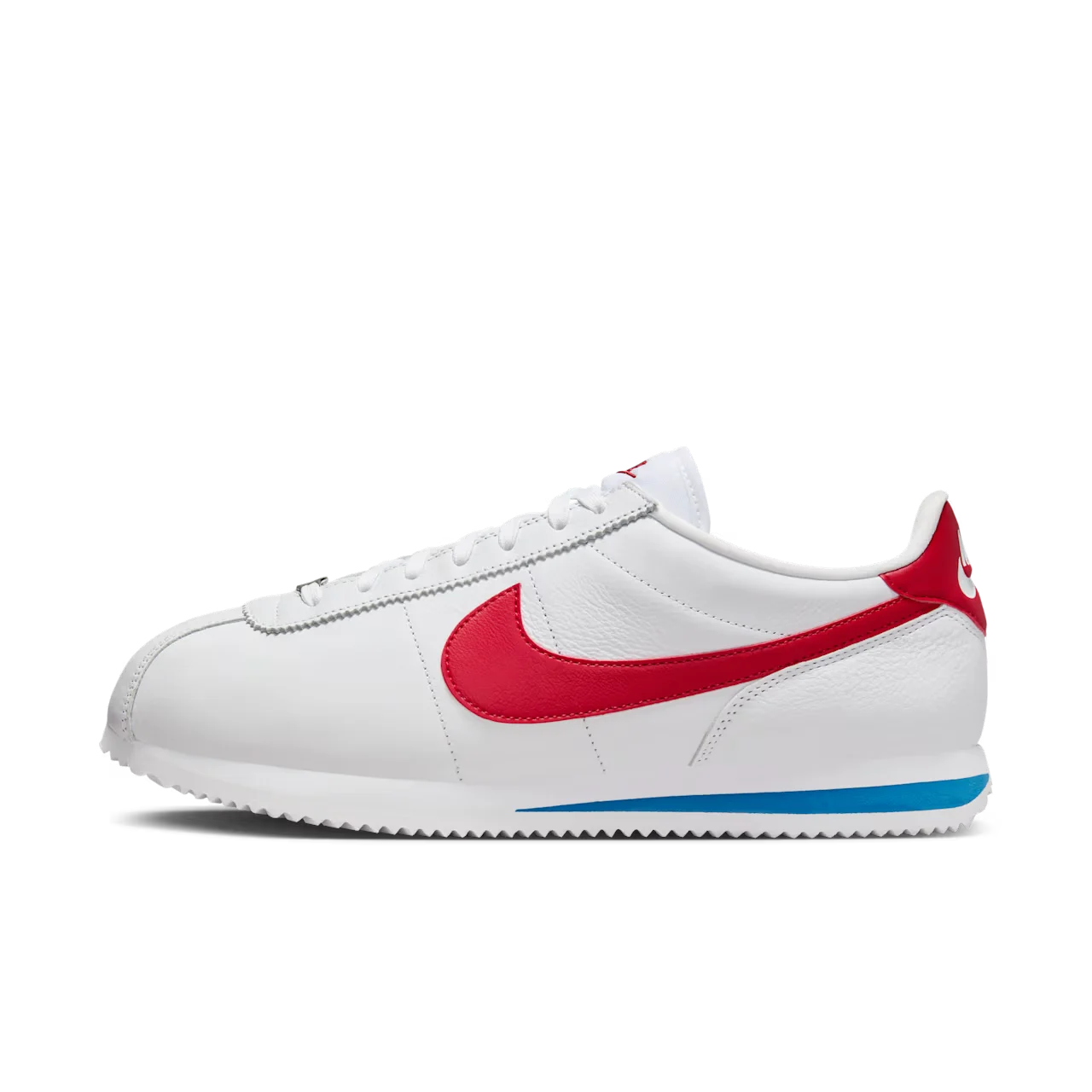
Beside carbon-plated racing shoes and complex knitted uppers, a Cortez makes its age visible in a useful way. It shows how an earlier generation solved cushioning, traction and weight problems. The anatomy of a sneaker becomes easier to understand when those parts are compared across eras. The model’s value today does not depend on outperforming modern running shoes.
Collaborations keep the shape open to new ideas. Kendrick Lamar connected it with his musical world; CLOT’s 2023 CLOTEZ explored a detachable, multi-part construction; commemorative editions, including Día de Los Muertos themes, use the shoe for other stories. These projects should be assessed individually. Some attract high resale demand, others do not, and neither a celebrity sighting nor a limited release guarantees future appreciation.
For collectors, the Cortez offers a tangible connection to Nike’s early years. An original pair is OG in the literal historical sense, while a newly made retro can reproduce an original colorway without being a 1970s object. Both can be interesting. Understanding what is old, what has been recreated and what a community has made its own is more rewarding than treating one label as a certificate of taste.
Nike Cortez questions
When was the original Nike Cortez released?
The Nike-branded Cortez debuted in 1972. Its development goes back to Bowerman’s work with Onitsuka in the 1960s, including prototypes in 1965 and the Tiger Cortez documented in an early-1967 catalog. The Munich Olympics are part of the era’s sporting context, not sufficient evidence for an exact first retail date.
Why is the Cortez associated with Los Angeles and Chicano culture?
The shoe became part of local streetwear through everyday wear, music and neighborhood identity. Accounts from people such as Estevan Oriol show that its meaning extended beyond its original sporting purpose. Some historical settings included gang associations, but the broader cultural connection must not be reduced to them or used to label an individual wearer.
How does an original Cortez differ from a modern version?
Compare the specific years and models. Materials, panel shapes, toe profile, labels, foam and outsole construction can all vary. Leather and textile constructions exist across the model’s history, so neither age nor the word retro identifies the upper material by itself. Age and storage condition also affect the surviving vintage pair.
Is the Forrest Gump Cortez an official Nike colorway?
Nike has released the white, red and blue combination associated with the film. Forrest Gump is its familiar cultural nickname, not a substitute for the official color description or style code. Different releases can use that same visual reference while differing in materials, shape and production date.
Is the Cortez still intended for running?
The modern retro is primarily a lifestyle shoe, even though the design began in distance running. For regular training or racing, compare shoes developed for your current activity, distance and fit needs. A daily trainer and a specialized plated racing shoe also serve different purposes; neither should be recommended solely because it is newer.
How much is an original Cortez worth today?
There is no reliable universal price range. Year, size, condition, completeness, provenance and actual demand all matter. Compare documented sales of similar pairs and distinguish asking prices from completed transactions. A rare or old shoe may be historically interesting even when there is no active buyer for it.
Related reading: Nike history | Air Force 1 history | Nike Dunk history | Sneakerhead dictionary
Explore more footwear history in History & Culture.