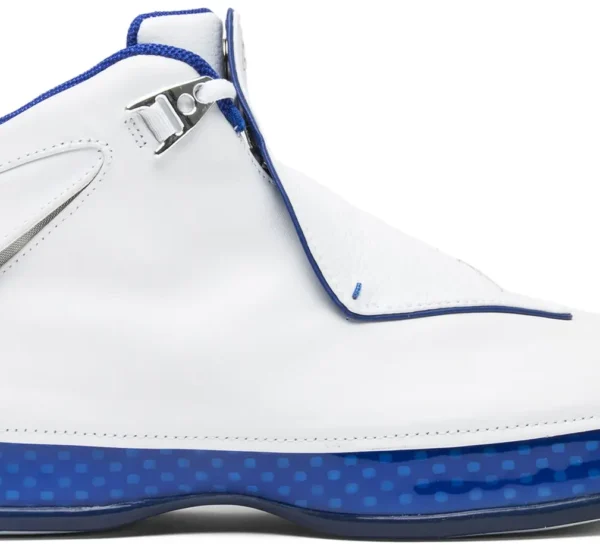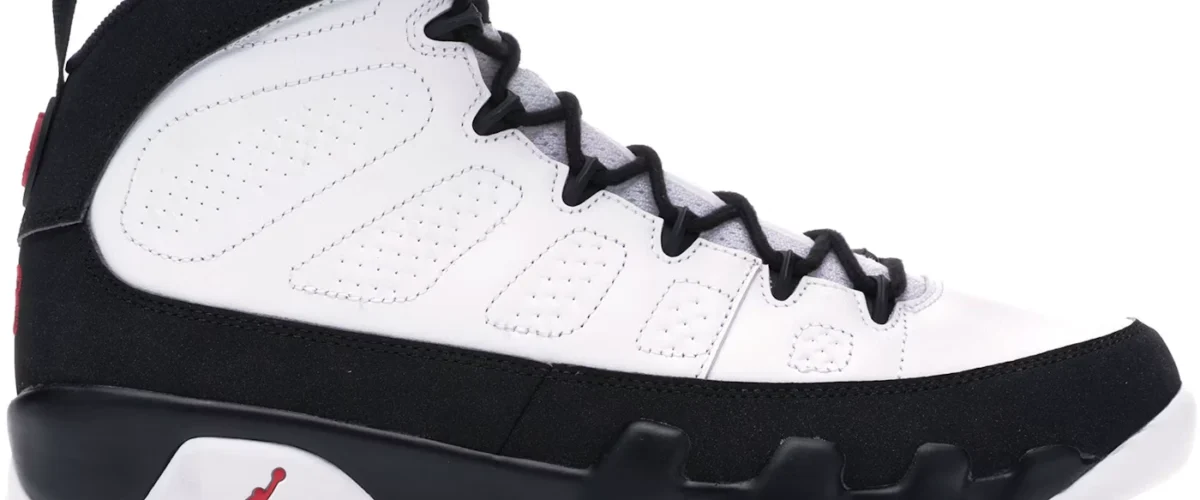
The Air Jordan 9 explores what a signature shoe can mean beyond one team or season. Its original colors and detailed graphics reveal a wider identity.
A signature line learns to continue without the season
The Air Jordan IX began in 1993, the year Michael Jordan announced his first retirement. Nike’s archive uses 1993 for the model, while the original retail story extends through 1994. Both dates matter: Powder Blue, for example, first appeared in 1994, within that initial generation.
Tinker Hatfield is the credited shoe designer. The project was developed before Jordan’s retirement, so its existence should not be explained as a shoe improvised only after he chose baseball. The circumstances changed its public meaning: a new signature model now had to represent an athlete whose immediate sporting future lay elsewhere.
The international story is under the shoe
The IX uses a comparatively restrained upper and a quick-pull lacing system. Inside, a sleeve helps hold the foot; heel and forefoot Air remain encapsulated. Its global idea appears most explicitly on the outsole, where multilingual words and graphic symbols speak to Jordan’s reach beyond one team or country.
Mark Smith is associated with that outsole graphic contribution, while Hatfield retains the lead design credit. The distinction helps reveal how a sneaker can have both a structural author and a separate visual storytelling contribution.
This is an unusual place to put a story. The most detailed message sits on a surface not fully visible when the shoe is worn. Turning the pair over becomes part of understanding it. The upper offers a recognizable outline, while the sole rewards a closer look.
The globe-associated heel graphic extends the same idea. The IX does not need to list Jordan’s achievements across every side panel to communicate scale. It makes the wearer’s movement part of a visual story about an audience that had become international.
Three entry points into the four OG colors
The original range consists of White/Black/True Red, Olive, Charcoal and Powder Blue. White/Black/True Red, Olive and Powder Blue provide three particularly different ways to read the silhouette.
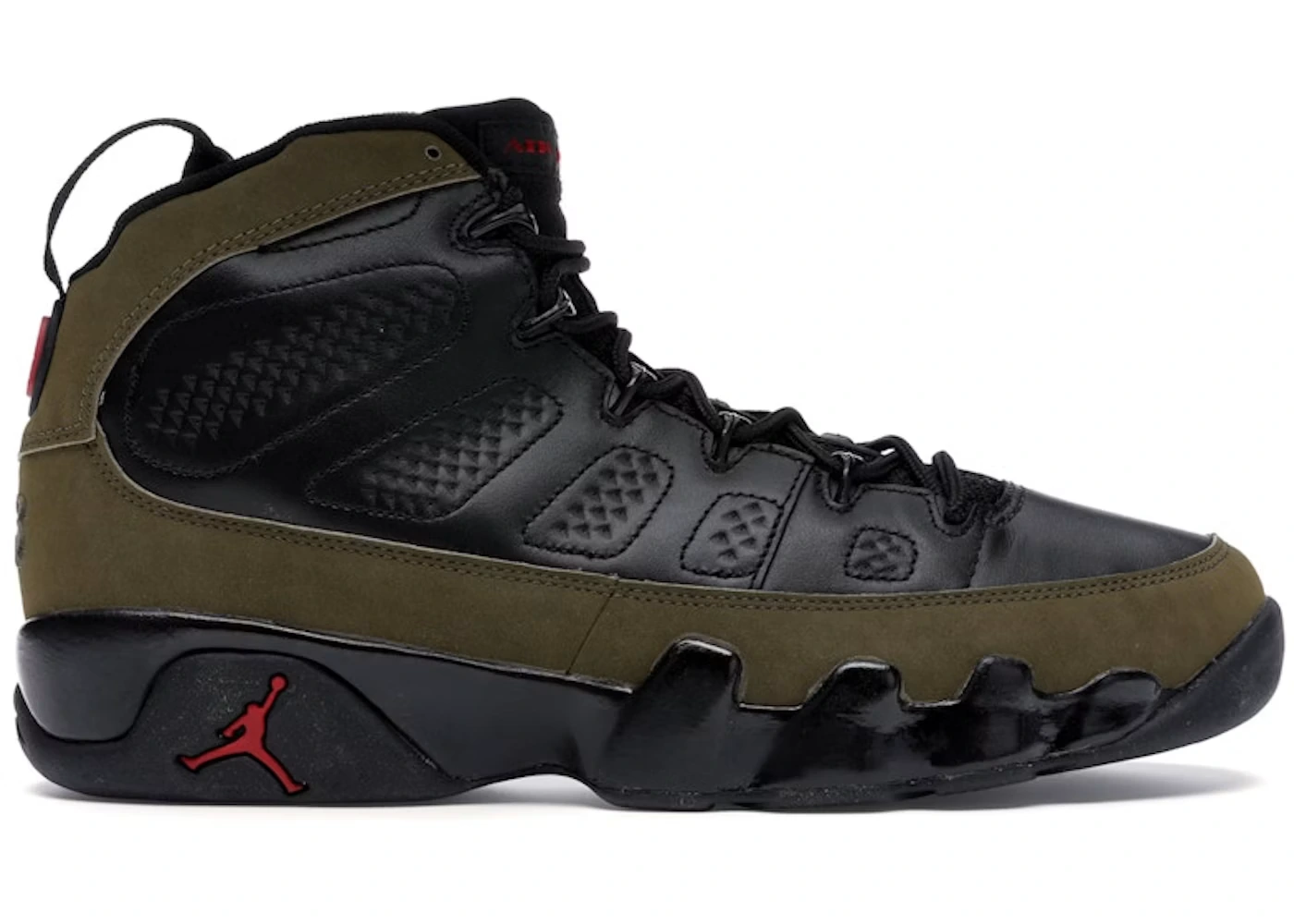
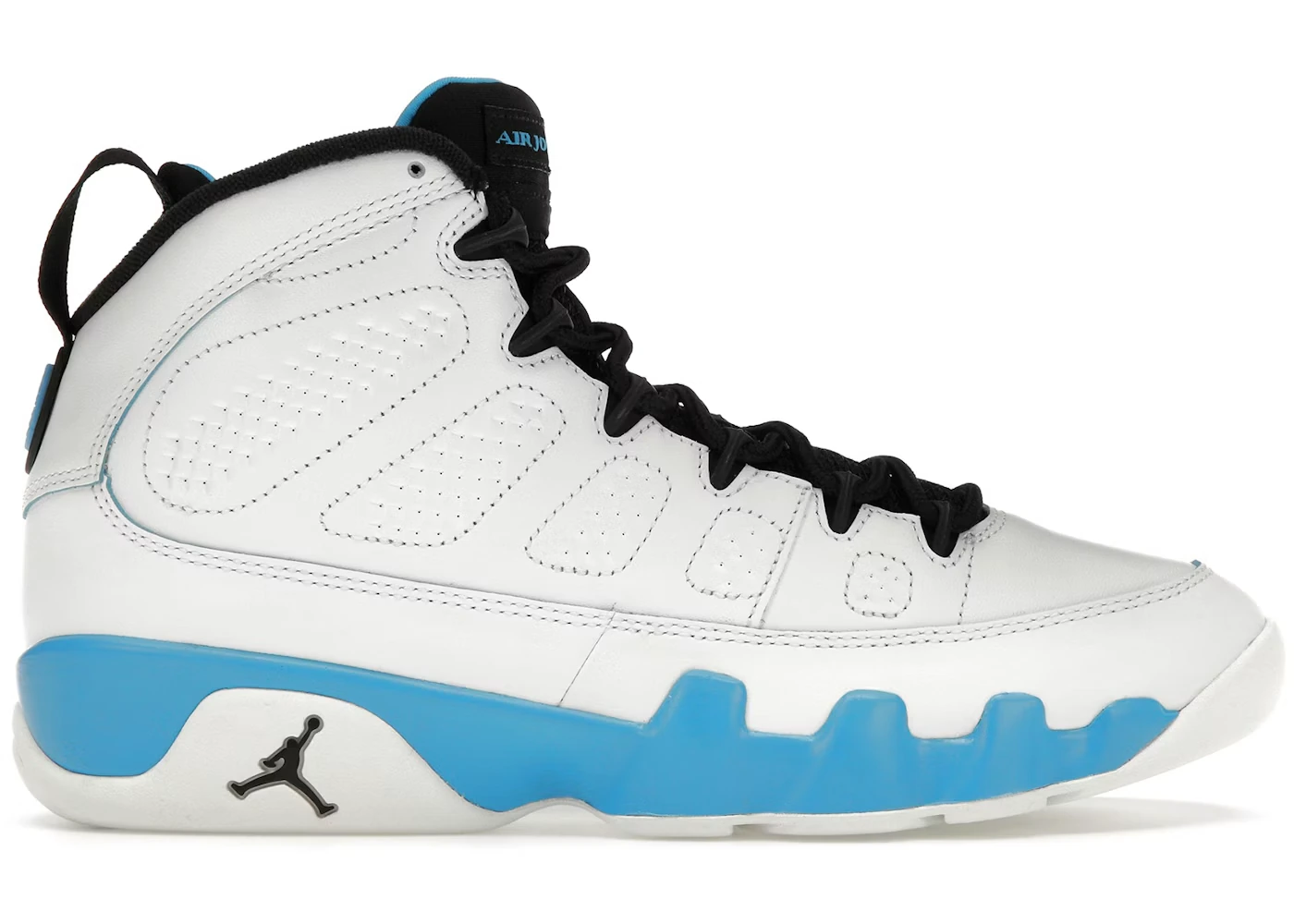
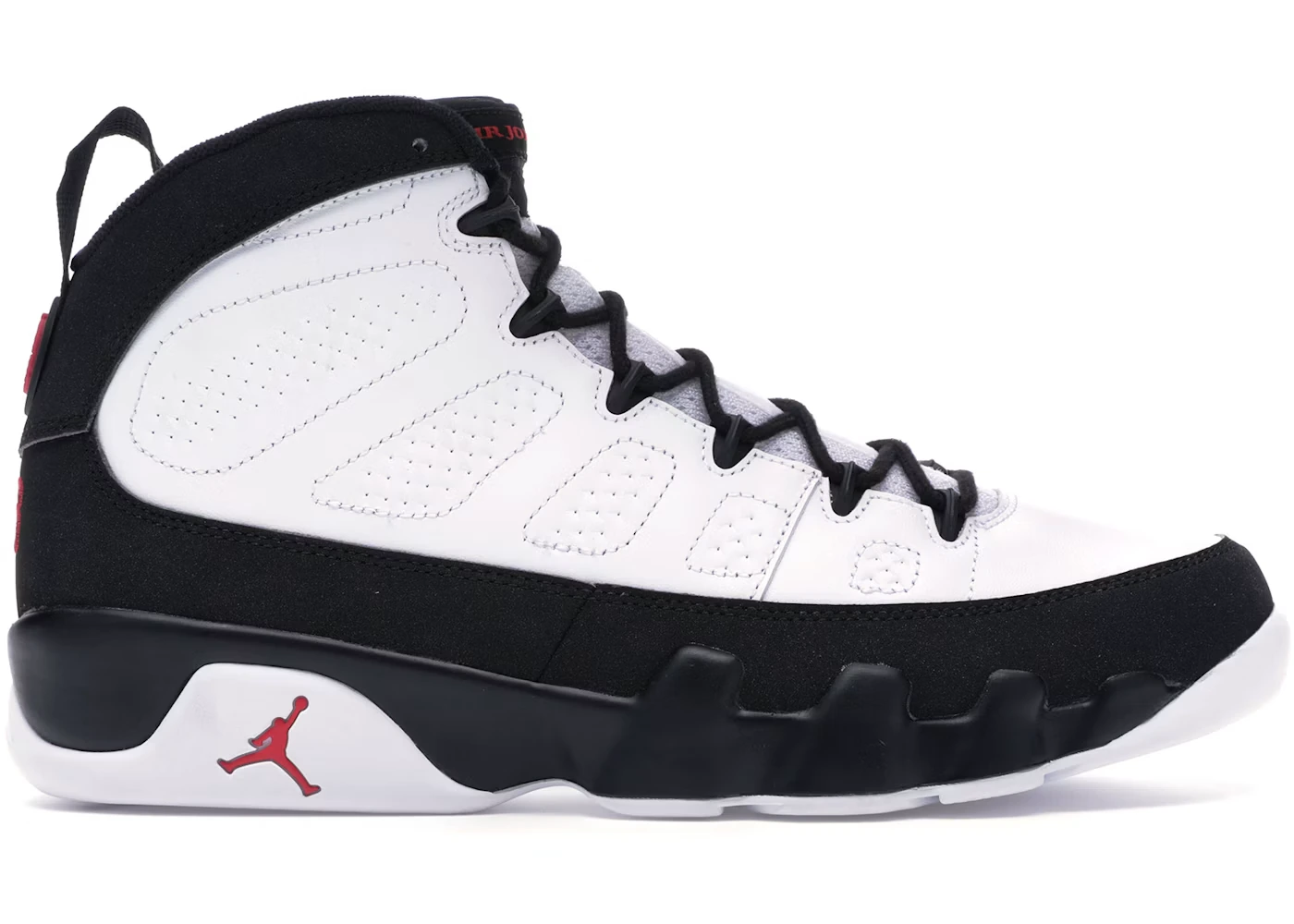
The white-and-black pair uses strong contrast to make the upper and surrounding lower panel immediately legible. Olive adds an earthy tone to a dark base, a significant departure from treating every Jordan as a variation on the Bulls uniform. Powder Blue combines a white base with black and blue accents and belongs specifically to 1994.
Charcoal is the fourth original. Its darker arrangement should not disappear simply because a three-color spotlight leaves it less space. Together, the originals show how the same relatively restrained construction can support both team-adjacent and more independent color directions.
Powder Blue is a useful reminder that a model’s first year is not necessarily the release year of every OG color. A 1994 colorway can belong to the original IX generation without changing Nike’s 1993 model-debut date.
Basketball absence, baseball presence
Jordan did not wear the IX in Bulls NBA games during its original release period. Other NBA players wore versions of the model, while Jordan’s baseball footwear included an IX-derived cleat. A basketball shoe and a cleat are different products, even when their uppers clearly share a family resemblance.
The Jordan statue unveiled at the United Center in 1994 also wears the IX. That creates one of the model’s most memorable paradoxes: a shoe absent from his original Bulls game rotation became part of the permanent image commemorating his basketball greatness.
It is easy to read that as a contradiction, but a monument is not a game-by-game equipment record. The choice can be understood as an image of Jordan’s broader identity at that moment, including the continuing signature line. The shoe’s legacy therefore lives in objects and media as well as in game footage.
The Wizards chapter corrects a familiar myth
The statement that Jordan never wore the IX in the NBA is too broad. He later wore Cool Grey IXs during his Washington Wizards period. That later appearance does not alter the absence from the original Bulls run, but it does change the answer to a lifetime yes-or-no question.
Cool Grey is a retro-era color, not a fifth original. These later branches show the difference between an original release, a new color on an older model and an athlete returning to his own archive.
The IX’s strongest contribution is that it makes the line’s continuity visible. A signature shoe could retain meaning when the athlete was not performing the expected role on an NBA court. Between global graphics, baseball adaptations and later basketball use, the model demonstrates that an evolving identity can outlast one season’s circumstances.
The Low began with White/Chrome
The earliest documented AJ9 Low retail release is July 3, 2002: White/White-Chrome, style 303895-111. The white-and-blue Blue Pearl/Midnight Navy pair followed on September 21. Color labels vary between archives, but the style code identifies the first white-and-chrome edition. (Sneaker News: Air Jordan IX Low White/Chrome; Sneaker News: second Air Jordan IX Low colorway)
That sequence separates the Low’s opening palette from its better-known blue alternative. Both belong to the later expansion of the model, rather than its initial release generation.
Frequently asked questions
What are the original Jordan 9 colors?
White/Black/True Red, Olive, Charcoal and Powder Blue.
Did Michael Jordan ever wear the 9 in the NBA?
Yes, later with the Wizards in Cool Grey. He did not wear it in Bulls NBA games during the original release period.
Is the Jordan 9 a baseball shoe?
The standard model is a basketball shoe. Jordan also wore a related baseball-cleat version during his baseball period.
Is Powder Blue a retro-only color?
No. It is an original colorway from 1994. Later editions reissued that earlier design.
Sources
Historical sources consulted October 15, 2026.