A signature line after the final retirement
Released in 2004, the Air Jordan XIX was led by designer Tate Kuerbis. Michael Jordan had already finished his NBA playing career. The nineteenth model therefore asks a different historical question from the XVIII: how could a signature basketball shoe continue to express Jordan without a new season of Jordan highlights? Nike’s archive emphasizes that his design requirements remained involved, even though he did not play NBA games in it.
The defining feature: a flexible shroud
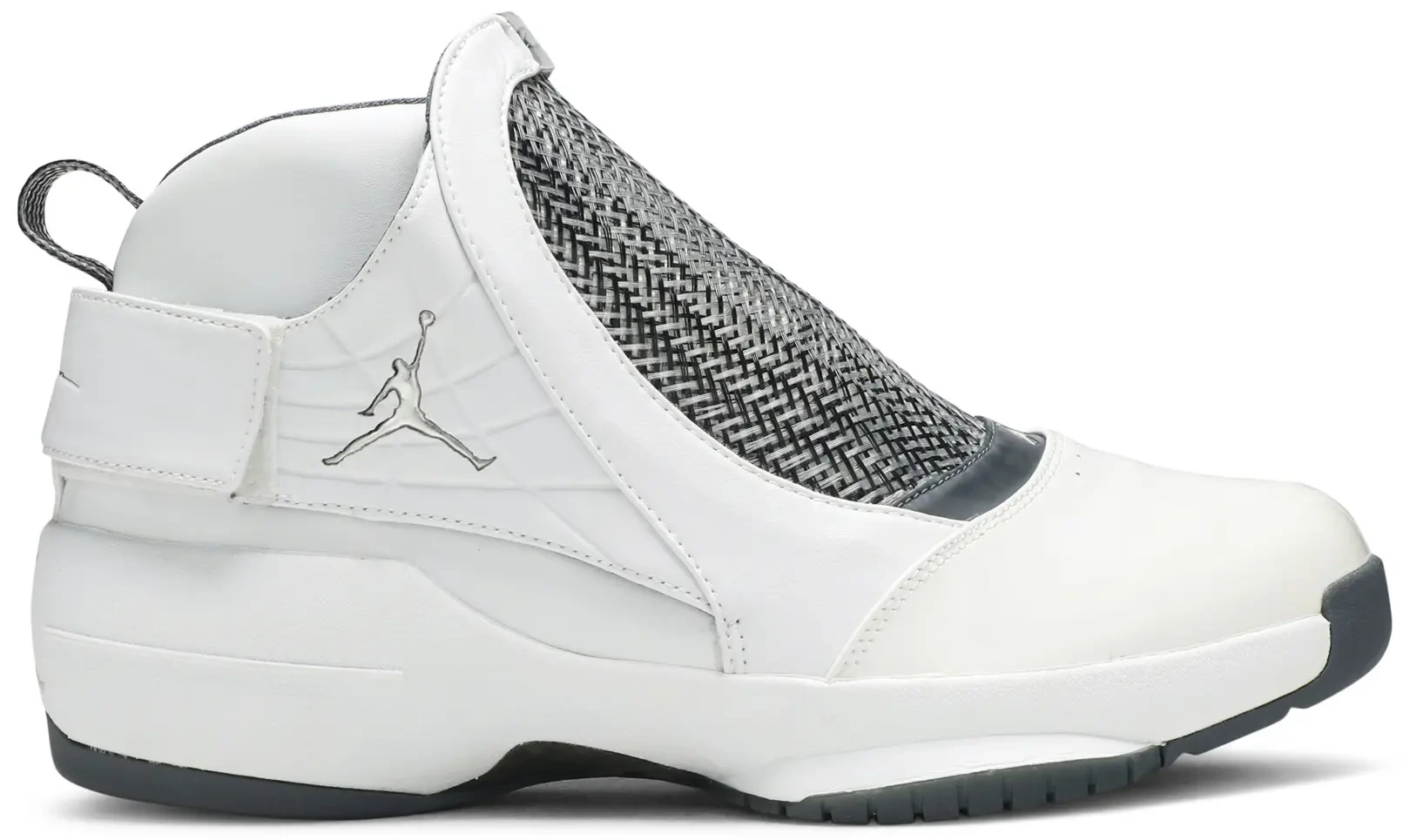
The Tech-Flex covering over the laces gives the XIX its instantly recognizable face. Nike links its inspiration to the black mamba snake and identifies Zoom Air cushioning. Detailed model histories also describe a carbon-fiber shank, Phylon midsole and patent-leather toe. The important distinction is structural: the visible mesh is part of the shoe’s layered upper, not a reason to assume that every section has the same material or behavior.
What changes from the XVIII to the XIX
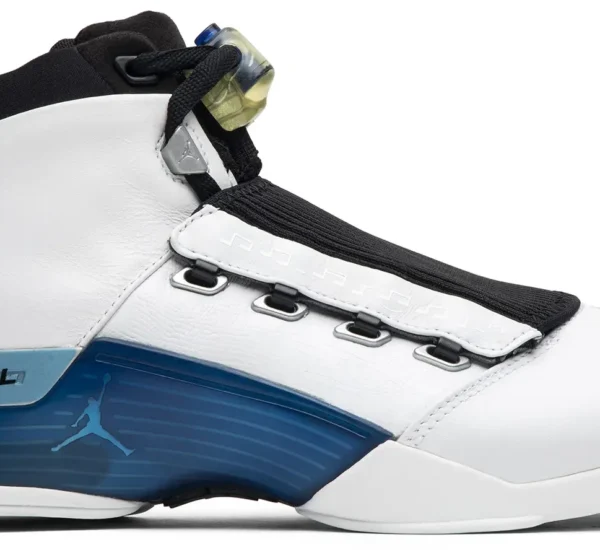
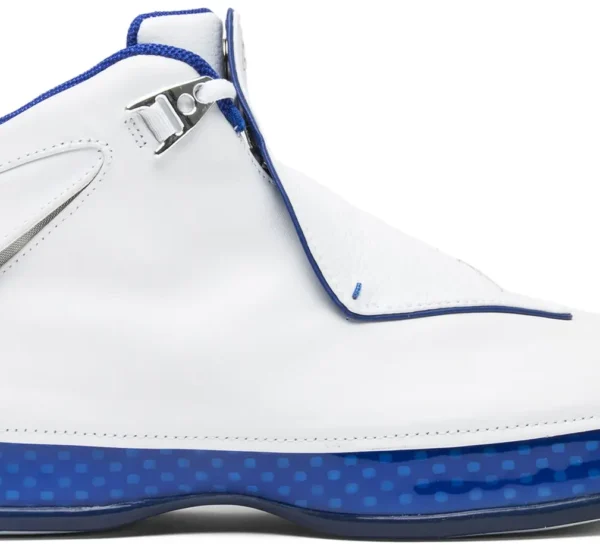
Both models cover the laces, but the material changes the idea. The XVIII presents a smooth outer surface; the XIX puts an open, flexible Tech-Flex weave at the center of the upper. Its cover works with the heel fastening rather than imitating an ordinary stitched tongue. The comparison explains why the nineteenth model is more than a material swap: the visible closure architecture becomes part of its identity.
Color placement changes the patent-leather frame
The white/Flint debut, black/red original and Midwest version do not merely recolor the woven cover. Patent leather adds a second visual register around the toe and, on some executions, beside the shroud. On Midwest, red against white makes that framing especially apparent; on the dark pair, shine and texture create separation even where colors are close. Looking at the glossy framing alongside Tech-Flex reveals the layered design more clearly than considering the shroud alone.
Three original-year reference points
White/Chrome–Flint Grey–Black is the initial March 2004 colorway. Black/Varsity Red belongs to the original run too. The White/Varsity Red–Metallic Silver Midwest version is a later 2004 regional release, one of the geographic treatments associated with the model. Together, these releases show how the base XIX developed during its first year. A regional edition is still original-year even when it follows the debut.


Why the cover changes the experience of the design
The XIX replaces the familiar complexity of visible laces with the intricate surface of its cover. The cover masks the familiar lacing system but makes its own woven structure visible. Looking at it closely produces two readings: a closed shape from a distance and an intricate surface nearby. That balance explains why a simple side profile is a poor substitute for front, rear and close-up photographs when identifying this shoe.
XIX, SE and Low are not interchangeable labels
The original family included SE and Low versions. They should not be merged into one colorway list without identifying the construction. The SE changes the upper’s presentation; the Low is a separate cut. A collector searching for the shrouded XIX can otherwise end up comparing prices and photographs of meaningfully different shoes. The question should be “which version of the XIX?” before it becomes “which color?”
Reading the regional idea carefully
The Midwest label is geographical, not a claim that the shoe was worn by Michael for a particular team. Its historical interest is the way one design could receive different regional treatments during its first year. The regional range broadens the model’s story beyond its first colorway. It also prevents original release, regional release and later retro from becoming misleading synonyms.
What changed after the XVIII
The XIX can be understood as a test of continuity. It keeps the expectation that an Air Jordan should look unmistakably different while letting the game move beyond its namesake’s active career. Its place in the sequence is clear enough: this is a new basketball design after the farewell, with a visual identity that cannot be mistaken for a simple anniversary reissue.
XIX Low: a separate 2004 debut
The first XIX Low was White/White–Black–Cement Grey, released on May 29, 2004. It removes the shroud and adds elephant print around the toe. Those changes make the Low a distinctive interpretation, not simply a shorter view of the standard XIX. Keep it separate from the SE as well: Low identifies the reduced cut, while SE identifies another construction in the family. The original covered shoe remains the baseline when a seller uses “Mid” as a height description.
Frequently asked questions
Did Michael Jordan wear the XIX in an NBA game?
No. The model came after his final retirement. His involvement in the product’s design requirements should not be confused with wearing it during an NBA season.
Is Tech-Flex the cushioning?
No. Tech-Flex refers to the distinctive upper covering. Zoom Air is the cushioning identified by Nike. Separating the visible material from the underfoot system makes technical descriptions of the XIX much clearer.
Is Midwest an original colorway?
Yes, it belongs to the original 2004 regional program. It should be described as a later original-year release rather than as the initial Flint launch or as a colorway Michael wore for a specific team.
Why do some original XIX pairs look different at the front?
Check whether the pair is an SE or Low. The family includes different constructions, so a different-looking upper is not automatically evidence of a counterfeit. First establish the exact version, then compare its details.