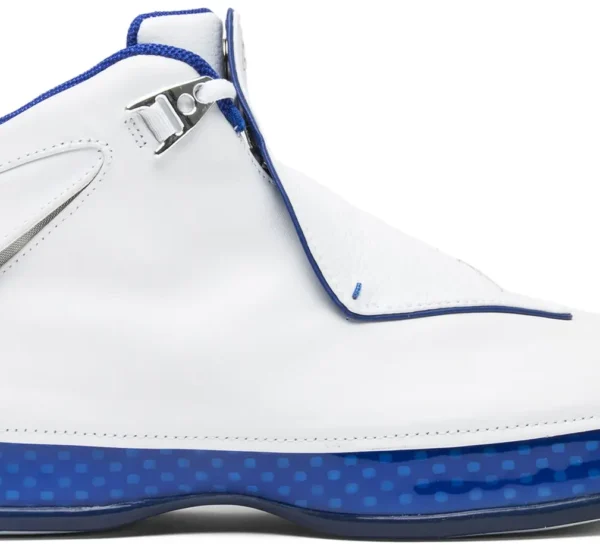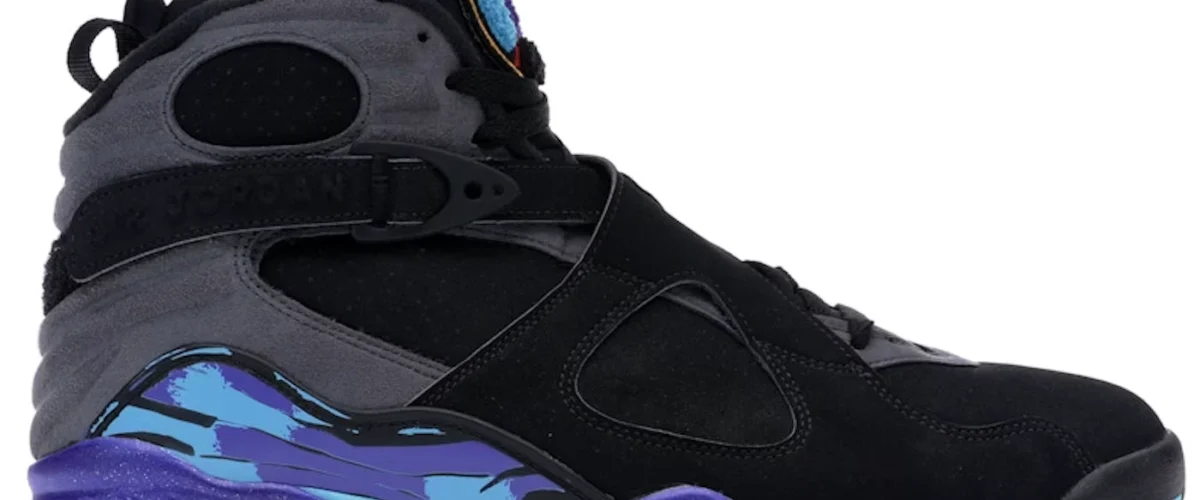
The Air Jordan 8 captures an expressive moment in sportswear. Explore how its layers, textures and original colors tell the story of a defining season.
The last shoe of the first championship run
The Air Jordan VIII launched in 1993, designed by Tinker Hatfield. Jordan wore the model during the season that ended with Chicago’s third consecutive NBA championship. It would become the last new signature shoe he wore in NBA competition before his first retirement.
That position gives the VIII a particular emotional charge. The VI had accompanied the breakthrough and the VII the repeat; the VIII marks completion of the first three-peat. The next model would have to exist in a world where its namesake was no longer playing for the Bulls.
The cross straps are the starting point
Two straps cross over the lacing area and make the VIII immediately identifiable. The inner sleeve works with that enclosing structure, while a textured chenille Jumpman patch turns the tongue into a different kind of focal point. Nike Air cushioning sits in the heel and forefoot without a visible window.
The model’s personality comes from layers: laces under straps, a soft-looking badge against a structured upper, and colorful graphics around the lower sides. Compared with the VII’s reduced exterior, the VIII is much more willing to show how many elements it contains.
A fastening idea became the model’s dominant visual signal. Even when colors change, the crossing bands preserve recognition.
The chenille patch adds another contrast. Instead of relying entirely on flat printed or embroidered branding, it gives the tongue a tactile, almost apparel-like character. Alongside the side graphics, it helps locate the VIII in the expressive visual vocabulary of early-1990s sportswear.
Exactly three original colors
The original 1993 lineup contains three colorways: the white-based version commonly called Bugs Bunny, the black-based Playoffs and Aqua. Here, a three-color overview is also a complete overview of the OG range.
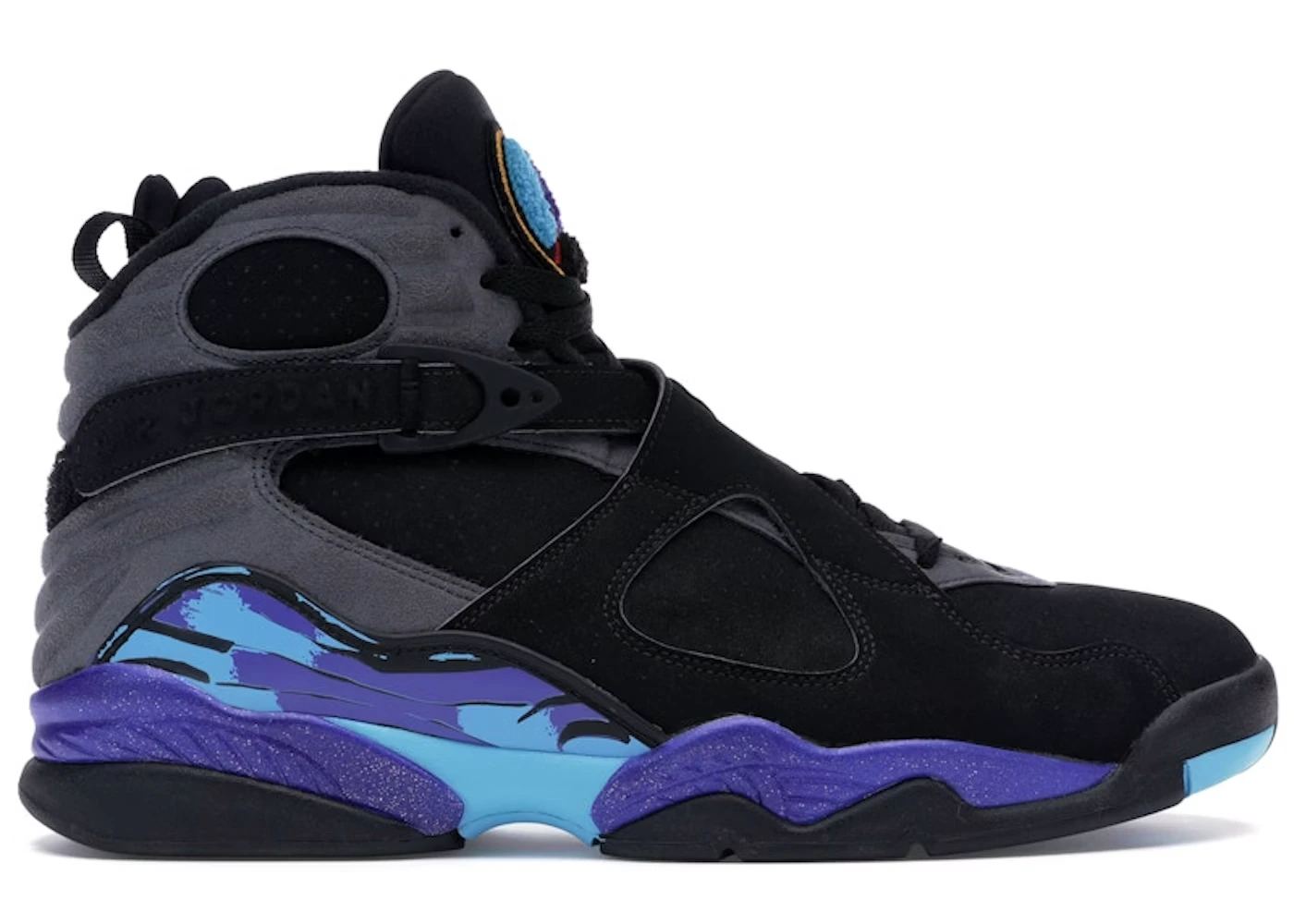
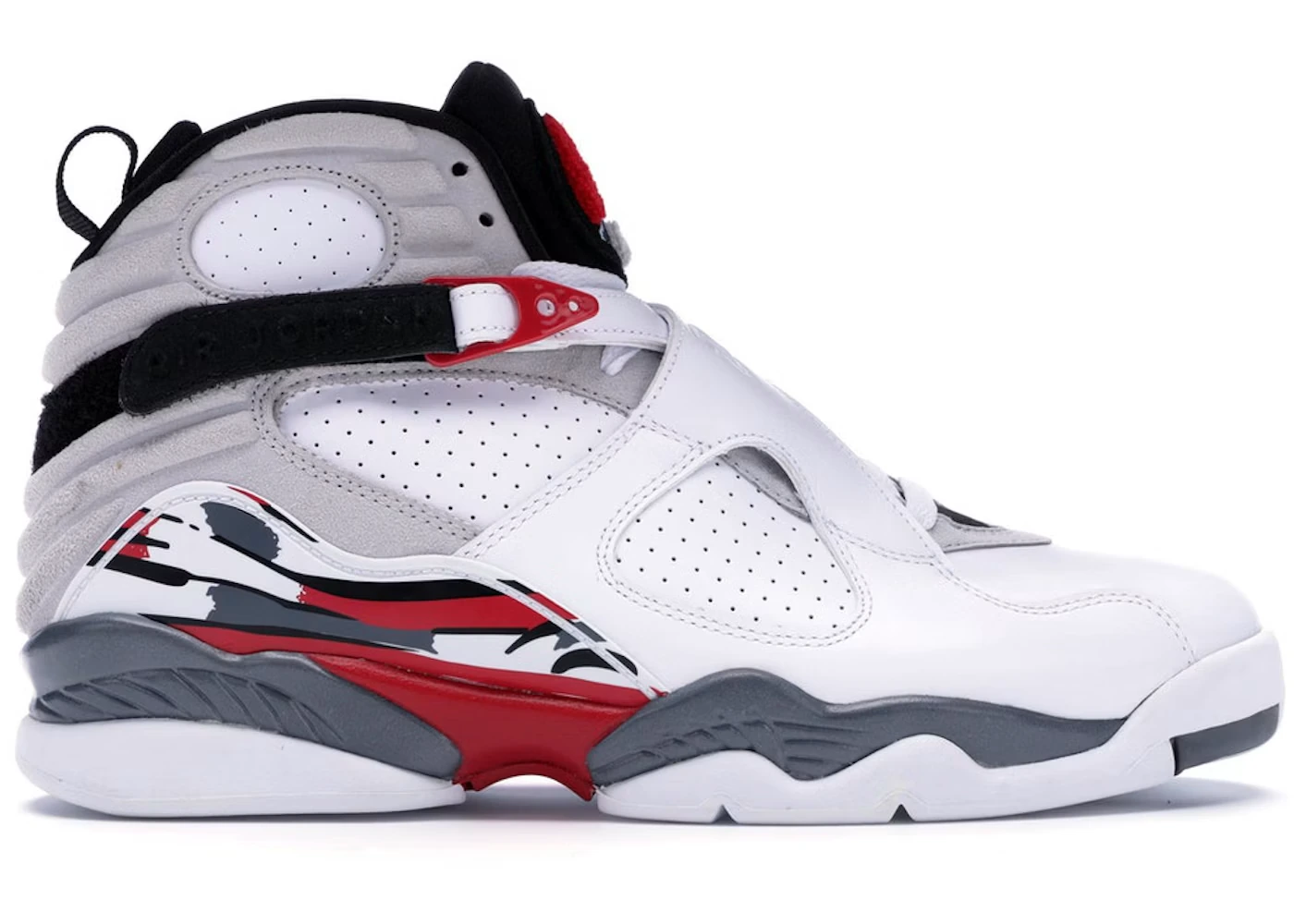
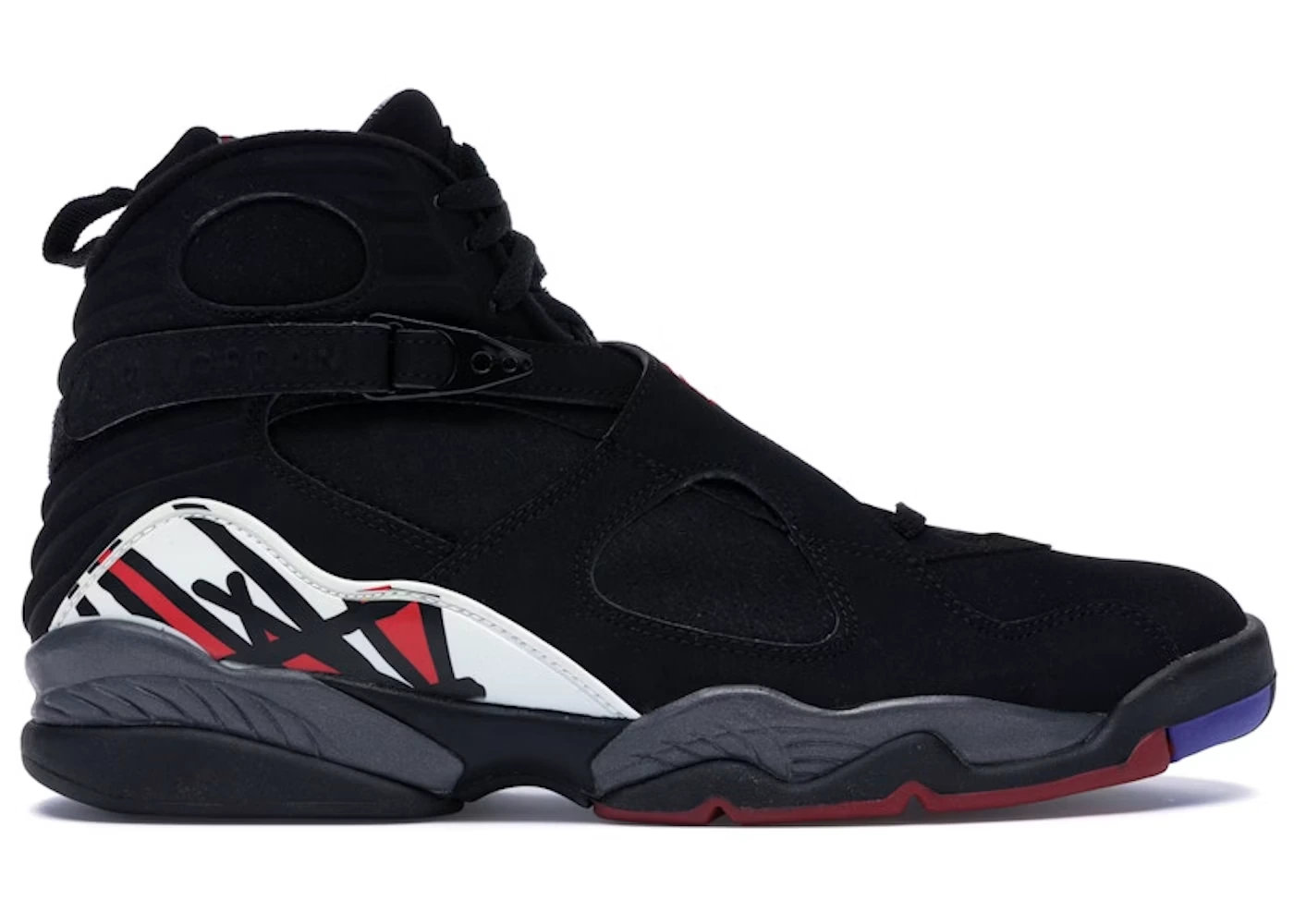
Bugs Bunny uses white with black and red accents and is associated with regular-season wear. Playoffs shifts to a dark upper and the postseason narrative. Aqua introduces vivid purple-and-aqua accents against a dark base and is linked to Jordan’s appearance in the 1993 All-Star Game.
Their differences are more than a light-versus-dark choice. On the white pair, the crossing straps stand out in another relationship to the upper. On the black versions, the side graphics and tongue patch can become stronger focal points. Aqua pushes that effect through color; Playoffs anchors it to Chicago’s championship imagery.
These names remain helpful, but the model should not be reduced to just one of them. Aqua was not a later lifestyle invention, and the white version was not merely a preview of Playoffs. All three belong to the same original release program.
What the three-peat added to the design
Chicago’s 1993 title and Jordan’s third consecutive Finals MVP award give the VIII its defining sporting context. The Finals distinction matters: it is not a claim that he won three straight regular-season MVP awards. The model belongs to the culmination of a team achievement and a remarkable sequence of Finals performances.
The shoe’s visual intensity seems well suited to that position in retrospect. The cross straps can read as a player being fully secured for one more run, while the graphics make the object unmistakably of its period. That is an interpretation of the design, not evidence that each panel was secretly intended to symbolize the championship.
Its place at the end of a chapter also explains why the VIII can feel different from an earlier model with a similarly strong game connection. The memory includes both victory and the pause that followed. Looking forward to the IX makes that transition especially clear.
Retros, low-tops and new stories
The retro era gave the VIII new opportunities to revisit its distinctive mixture of straps, textures and graphics.
Later commemorative editions added new ways to reference the championship. Nike’s Championship Trophy release, for example, used a celebratory interpretation rather than pretending to be a fourth OG. A commemorative design can be historically meaningful while openly belonging to a later year.
For comparisons, the most informative details are strap shape, tongue patch, side graphics and the distribution of color across the upper. Those features explain how a retro relates to the original design. The VIII’s legacy is not merely that it has straps; it is that the straps, textures and graphics form one of the clearest period portraits in the early Jordan line.
The first Low: White/Chrome
The Air Jordan 8 Low debuted on June 21, 2003 in White/Chrome-Metallic Silver, style 306157-101. The black-based Playoffs Low followed in August. White/Chrome is therefore the starting color of the Low branch, rather than a simultaneous companion to Playoffs. (Sneaker News: first Air Jordan VIII Low; Sneaker News: Air Jordan VIII Low sequence)
Lowering the collar changes how the straps frame the foot. That makes the first Low worth treating as a separate chapter, even though it remains recognizably part of the VIII family.
Frequently asked questions
What are the three original Jordan 8 colors?
The white Bugs Bunny, black Playoffs and Aqua. All three belong to the 1993 lineup.
Which Jordan 8 did Michael wear for the All-Star Game?
Aqua is associated with his 1993 All-Star Game appearance.
Does the Jordan 8 have Air cushioning?
Yes. It uses heel and forefoot Air without a visible Air window.
Sources
Historical sources consulted October 15, 2026.