
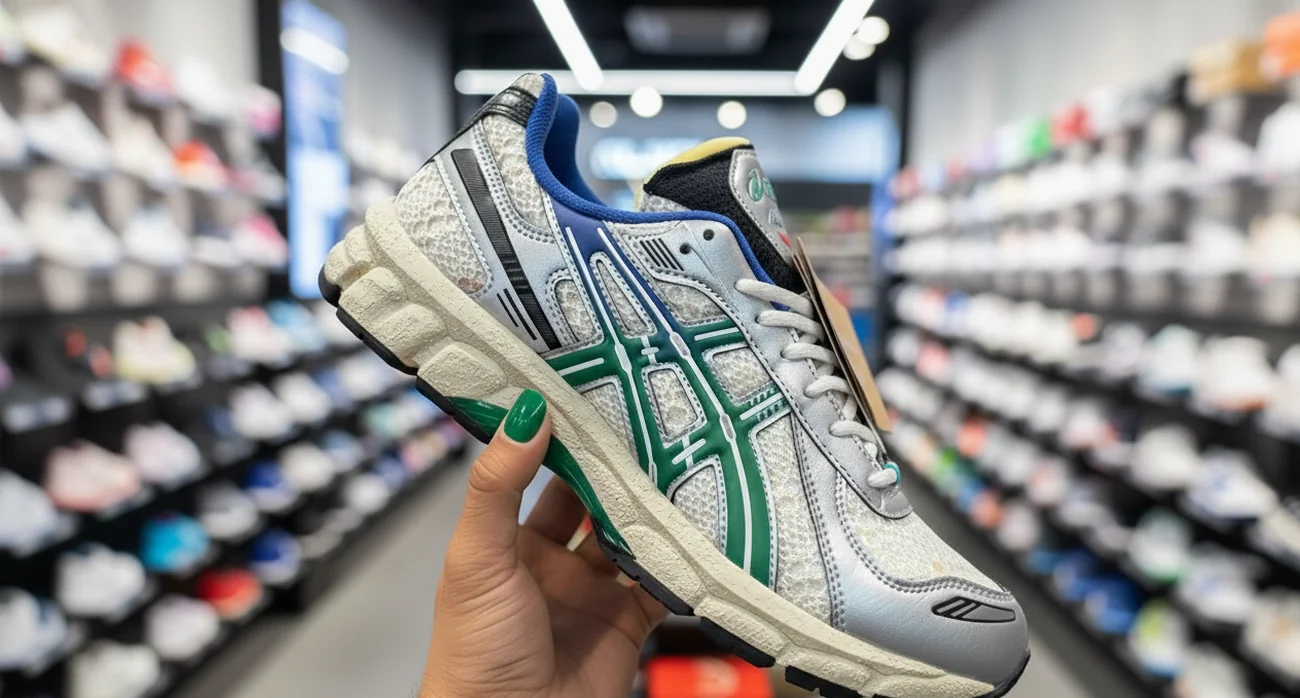
NWT means New With Tags. In resale listings, it usually indicates that the seller is presenting the item as new and unworn while the relevant original retail or manufacturer tags are still included. The acronym does not, by itself, guarantee authenticity, the original box, every accessory, flawless condition, or one universal marketplace standard.
That distinction matters because NWT contains only three letters, and none of them means “authenticated.” A tag helps document the history of a pair, but it cannot tell the entire story on its own.
To evaluate an NWT sneaker properly, separate five questions: Was the sneaker actually worn? Which tags are present? Are the box and accessories included? What is the physical condition today? And is the pair authentic? Those questions overlap, but they are not interchangeable.
What Does NWT Mean?
NWT is the abbreviation for New With Tags.
In practical resale language, it usually communicates two ideas: the seller is presenting the product as new or unworn, and the relevant tags that originally accompanied that item are still present.
The word relevant matters. Not every sneaker leaves retail with a removable hangtag, and different releases can come with very different types of tags or cards.
NWT is not a universal certification, a Nike or adidas grading system, a technology, a special product line, or an industry-issued quality seal.
Is NWT a Sneaker-Only Term?
No. New With Tags belongs to the broader language of fashion, e-commerce, and resale. Sneaker culture adopted the abbreviation as shoes increasingly moved through marketplaces, forums, buy-and-sell groups, consignment shops, and secondary-market platforms.
Current eBay condition documentation uses “New with tags” in some merchandise categories. For footwear, however, eBay currently uses labels such as New with box, New without box, and New with defects.
That difference captures a small part of the history of online commerce. Once buyers and sellers were no longer standing in front of the same shelf, complex condition details had to fit into short listing labels. NWT became one of those useful shortcuts—as long as nobody expects three letters to replace current photos and a detailed description.
For more abbreviations used across listings, forums, and collector conversations, see the Sneakerhead Dictionary.
What Does “With Tags” Mean in Practice?
“Tags” does not refer to one universal tag that every sneaker must have. The meaning depends on the product and the release.
Depending on the item, you might encounter:
- a removable hangtag;
- a manufacturer-applied product tag;
- a retail tag added by the store;
- a price tag;
- a removable product card or other release-specific commercial tag.
The better question is not simply “Does it have a tag?” but “Which tags did this exact release originally come with?”
A Hangtag Is Not the Same as the Internal Size Label
A hangtag is a removable tag or accessory included with certain products. Depending on the release, it may hang from the laces, an eyelet, or another part of the shoe.
The internal size and manufacturing label is normally a permanent part of the sneaker. It can include size, style code, production dates, and other information, and it remains inside the shoe even after substantial wear.
For that reason, the presence of an internal size label does not turn a used sneaker into NWT.
The Box Label Is Something Else Too
The sticker on the shoebox that lists size, SKU or style code, barcode, color information, and other identifiers is a box label. It can help confirm that the box and shoe are supposed to represent the same release, but it is not automatically the “tag” referenced by New With Tags.
A box label also does not authenticate a sneaker by itself. Labels, barcodes, and codes can be reproduced.
A Marketplace Tag Is Not a Factory Tag
If StockX, a consignment store, or another verification service adds its own tag during authentication, verification, shipping, or inventory handling, that tag documents the marketplace’s process.
It does not retroactively become an original Nike, Jordan Brand, adidas, or other manufacturer tag. A marketplace tag and a factory or retail tag answer different questions.
Not Every New Sneaker Comes With a Hangtag
This simple point prevents a surprising amount of confusion.
Some releases ship with large, obvious hangtags. Others include a card. Many have no removable tag of the kind people imagine when they read “With Tags.”
It makes no sense to call a sneaker incomplete because it lacks a tag that was never part of the original release.
Not every brand-new pair comes out of the box looking like a holiday tree covered in labels.
Do “Tags Attached” and “Tags Included” Mean the Same Thing?
Not exactly.
- Tags attached: the relevant tags remain physically attached to the product.
- Tags included: the tags are still part of the set but may have been removed and placed loose in the box or packaging.
There is no universal authority declaring that only one of those situations can ever be called NWT across every marketplace and product category. A detailed listing should therefore say whether tags are still attached or simply included.
Removing a tag also does not prove that the sneaker was worn. Someone can remove a retail tag from a completely unworn product.
The reverse is true as well: keeping a tag attached does not, by itself, prove that there was never a try-on or other handling.
Does NWT Have to Include the Original Box?
Not necessarily. The “T” in NWT refers to tags, not the box.
A product described as NWT could be offered:
- with the original box;
- with a replacement box;
- with a damaged original box;
- without a box.
The seller should disclose the box situation separately. NWT should not be interpreted as “no box,” and it also should not be interpreted as “perfect original box included.”
Are NWT and DS the Same Thing?
They are not universal synonyms, although they can overlap.
DS means Deadstock. In modern sneaker culture it usually describes a new or unworn pair, but the term has its own history and community conventions around presentation, box, accessories, and try-on expectations. See what DS means in sneakers.
A new, unworn sneaker with the relevant tags may be described as NWT and may also qualify as DS in a particular sneaker marketplace or collector context.
That does not create a hierarchy of DS > NWT or NWT > DS. The terms came from different language traditions and emphasize different details.
Are NWT and DSWT the Same Thing?
Not necessarily.
DSWT means Deadstock With Tags. It belongs more specifically to sneaker slang and resale terminology, while NWT is a broader commercial phrase used across fashion and e-commerce.
The concepts can overlap. A sneaker considered Deadstock that still includes its relevant tags may be described as DSWT in sneaker slang and as NWT in a broader commercial listing.
That does not make DSWT a universally “higher” condition than NWT. See what DSWT means for the release-condition context.
What Is the Difference Between NWT and NIB?
NIB means New In Box.
The simplest distinction is:
- NWT: emphasizes the tags.
- NIB: emphasizes that the item is new and in its box.
The same sneaker can be new and unworn, include the relevant tags, and still have its original box. In that situation, both descriptions may be useful.
Again, there is no universal NIB > NWT or NWT > NIB ranking. They highlight different parts of the listing.
What Does NWOT Mean?
NWOT is a common abbreviation for New Without Tags.
It is generally used when the seller presents the product as new and unworn but the relevant removable tags are no longer attached or included.
Context still matters. If a sneaker never shipped with a removable hangtag, the absence of a dangling label does not mean something is missing.
Marketplaces may also use this terminology in some merchandise categories and not others. Always read the platform’s actual condition definition for footwear instead of assuming the acronym overrides marketplace policy.
What Is the Difference Between NWT and VNDS?
VNDS means Very Near Deadstock. It is a subjective community description for a sneaker considered very close to Deadstock condition.
When real wear has occurred, VNDS usually enters the pre-owned side of the conversation. NWT, by contrast, presents the product as new or unworn with the relevant tags.
There is no official number of wears that turns a sneaker into VNDS. “Worn once” or “worn twice” is useful context, not a universal grading table. See what VNDS means for that distinction.
Does NWT Mean OG All?
No. NWT describes condition plus tags. OG All refers more broadly to the completeness of the original components that were supposed to come with the release.
Depending on the sneaker, the original set could include:
- the original box;
- extra laces;
- a dust bag;
- cards or inserts;
- lace locks;
- special paper or inserts;
- sleeves;
- other release-specific accessories.
A product can retain its tag while missing one of those components. NWT therefore does not mean the set is complete.
Can an NWT Sneaker Have Been Tried On?
This is one of the areas where community expectations and marketplace rules can diverge.
The basic NWT idea presents the item as new and unworn, but a brief indoor try-on for sizing is not treated identically in every resale environment.
StockX currently states that sneakers on its Verified Marketplace can still pass verification if they have been tried on for fit, provided they otherwise meet the platform’s new-condition requirements.
That is a StockX rule, not a universal definition of NWT.
The best practice is simple: if the pair was tried on, disclose it. Transparency is more useful than an endless argument over which buyer or seller owns the “correct” definition.
Does Relacing Eliminate NWT Status?
There is no universal rule saying it does.
A sneaker can be unlaced or relaced without ever being worn outdoors. StockX also states in its current sneaker-condition guidance that pairs can pass verification even if they have been unlaced.
Factory lacing can still matter to some collectors because original presentation has value. If the pair was relaced, disclose it when that detail is relevant to the transaction.
Does NWT Mean the Sneaker Is Authentic?
No. NWT does not answer the authenticity question.
A sneaker can be:
- authentic and NWT;
- authentic and used;
- counterfeit and new with tags;
- counterfeit and used.
Counterfeits can reproduce tags, boxes, receipts, barcodes, style codes, box labels, and accessories.
Condition and authenticity are separate questions. For the second one, see our Legit Check guide.
Do a Receipt, Style Code, and Tags Prove Authenticity?
They can add useful context, but none should be used alone as absolute proof.
A style code helps identify which release the product is supposed to represent. A receipt can help document provenance. Tags and labels can be compared with well-documented genuine examples.
The analysis still has to consider the sneaker as a whole, because documents, tags, boxes, and codes can be copied, replaced, mismatched, or transferred between products.
Can an NWT Product Have Defects?
Yes. New does not mean perfect.
eBay currently uses a footwear condition called New with defects. It can include brand-new, unused, unworn footwear with cosmetic imperfections, irregularities, scuffs, missing packaging materials, or other disclosed issues.
That is an operational eBay category, not a universal definition of NWT. It still demonstrates an important distinction: an item can be genuinely unworn without being mint.
Storage marks, minor manufacturing irregularities, aging changes, box damage, or other flaws should be disclosed separately from the basic new/unworn claim.
How Do eBay and StockX Treat New Sneakers?
The two marketplaces show exactly why there is no single international condition scale for sneakers.
eBay
In its current U.S. footwear-condition documentation, eBay uses categories including:
- New with box;
- New without box;
- New with defects;
- Pre-owned – Excellent;
- Pre-owned – Good;
- Pre-owned – Fair.
For other merchandise categories, eBay also uses labels such as New with tags and New without tags.
So even inside one marketplace, the product category can change the condition terminology.
StockX
At StockX, condition rules depend on the marketplace.
On the Verified Marketplace, sneakers and shoes must be brand new and meet StockX category standards. Current guidance says footwear includes the original brand-issued box and must be free from signs of use, damage, or tampering, with certain limited allowances for age or box condition.
On the Listings Marketplace, StockX currently uses:
- New: new, unworn, and showing no signs of wear; when applicable, original packaging or brand materials are included.
- New – Other: new and unworn, but original tags or accessories may be missing, or condition flaws may be present; buyers are told to review the actual photos.
- Used: used and showing signs of wear, with the listing photos documenting the exact item.
That is why an imaginary universal scale such as DS > NWT > VNDS does not work.
Marketplace condition is an operational rule created by that platform. Sneaker slang is cultural and commercial language developed by collectors, sellers, retailers, and communities. They can overlap without becoming the same system.
Is NWT Worth More Than DS, NIB, or VNDS?
There is no universal financial hierarchy based on those acronyms.
Price depends on factors such as:
- model and release;
- colorway;
- size;
- supply and demand;
- actual physical condition;
- original box;
- tags and accessories;
- defects or storage marks;
- authenticity and provenance;
- age;
- region;
- marketplace;
- current market timing.
An active asking price is also not proof of what buyers are actually paying.
For valuation, compare the same release, size, and condition and prioritize recent comparable completed sales. Our sneaker price-check guide explains that process in detail.
Does NWT Mean Rare, Limited, or Grail?
No.
A sneaker produced yesterday in huge quantities can be NWT. The acronym does not reveal production numbers, demand, or availability.
NWT also does not automatically mean:
- limited edition;
- collaboration;
- sold out;
- grail;
- expensive product.
Is NWT an Investment Category?
No. NWT is a condition description, not an investment class.
Tags do not guarantee appreciation, and a new sneaker can still be affected by changing demand, restocks, retros, re-releases, fashion shifts, and physical aging.
Condition can influence a particular transaction. It cannot create guaranteed investment returns.
Is an Old NWT Sneaker Still Really “New”?
It can remain new in the sense that it was never worn. That does not mean it stayed chemically identical to the day it was manufactured.
Unworn does not mean unaged.
Over time, depending on construction and materials, an unworn sneaker can develop:
- yellowing;
- oxidation;
- aging adhesives;
- separation between components;
- drying or hardening;
- cracking;
- degradation of certain foams;
- color changes;
- storage marks.
That does not mean every old sneaker develops every problem. EVA, polyurethane, rubber, adhesives, leather, textiles, and coatings age through different mechanisms.
StockX also warns buyers about older footwear. Its current guidance notes that sneakers five years or older may have structural weakness or reduced durability because of age, even when storage conditions were good.
That is a platform warning, not a universal chemical deadline after which every five-year-old sneaker becomes unsafe or unusable.
For the larger distinction between age, condition, and originality, see our guide to vintage sneakers.
Is a Vintage NWT Sneaker Automatically Safe to Wear?
No. The acronym describes a condition claim and tags; it is not a structural inspection report.
An older sneaker can remain unworn while its adhesives, foams, rubber, coatings, or other materials continue to age.
Before wearing a vintage NWT pair, consider the model, age, materials, bonded areas, midsole, outsole, and signs of cracking, separation, hardening, mold, or other deterioration.
That does not mean every old NWT sneaker is unsuitable for wear. Structural condition needs to be evaluated pair by pair.
How Should You Evaluate a Sneaker Listed as NWT?
NWT should be the beginning of your verification, not the final verdict.
- Confirm the exact release. Model, colorway, size, and SKU or style code should be clear.
- Review current photos of the actual pair. Catalog images do not prove condition.
- Inspect the outsole. Look for dirt, abrasion, or wear inconsistent with an unworn claim.
- Inspect the insole and interior. Wear, lint, debris, or compression can add context.
- Ask which tags are present. “With tag” is too vague when the release had multiple components.
- Confirm that those tags belonged to the release. Not every sneaker originally had a hangtag.
- Ask whether tags are attached or merely included.
- Check the box. Original box, replacement box, damaged box, or no box should be stated.
- Check the accessories. Extra laces, dust bags, cards, lace locks, and other extras vary by release.
- Ask about try-on. If the pair was tried on, that should be disclosed.
- Ask about relacing when relevant.
- Look for defects and storage marks. New does not mean perfect.
- Check for repairs or restoration. Repaint, reglue work, sole swaps, or other interventions should be disclosed.
- For older pairs, evaluate aging. Unworn does not mean chemically unchanged.
- Evaluate authenticity separately. Tags and codes are not authentication by themselves.
- Check the seller. History, reviews, photos, and consistency matter.
- Read the platform policies. Condition, returns, buyer protection, and authentication rules differ.
- Compare the price with truly comparable pairs. Same release, size, and condition produce the best reference.
A receipt or proof of purchase can add provenance context, but it should not be treated as a magic document that overrides inconsistencies in the product itself.
When Can Buying NWT Be Worth It?
It can make sense when the condition is well documented and the product matches what you actually want.
Before deciding, check whether:
- the actual item is shown clearly in current photos;
- the promised tags are present;
- the box and accessories are described accurately;
- defects and storage marks are disclosed;
- authenticity was evaluated separately;
- the price makes sense for that exact release and condition;
- return rules and buyer protection are acceptable;
- age and structural integrity were considered if the sneaker is old.
NWT can sell below retail, near retail, or above retail. The acronym does not tell you whether the asking price is good.
It is also not a condition category only for beginners or people who simply want to wear the shoes. New buyers and experienced collectors can choose NWT, DS, NIB, VNDS, or used pairs based on budget, goals, and preference.
How Do You Sell an NWT Sneaker Transparently?
If NWT accurately describes the product, use the acronym—but do not let it become the entire description.
A stronger listing explains:
- new/unworn condition;
- whether the pair was tried on;
- which tags are present;
- whether the tags are attached or included;
- whether the pair was relaced;
- original box, replacement box, or no box;
- box damage;
- which accessories are included or missing;
- storage marks or yellowing;
- any defects;
- repairs or restoration;
- current photos of the actual item.
Complete description > acronym. That helps both buyer and seller understand exactly what is being exchanged.
NWT Sneaker FAQ
What Does NWT Mean in Sneakers?
NWT means New With Tags. It usually indicates a product presented as new and unworn while the relevant tags are still included.
Does NWT Mean New With Tags?
Yes. That is the standard expansion of the abbreviation in resale and marketplace language.
Does NWT Mean the Sneaker Is New?
That is the condition being claimed. Photos, description, and marketplace rules still need to support that the item is genuinely new or unworn.
Does NWT Require a Hangtag?
There is no universal hangtag for every sneaker. First determine which tags that specific release actually had at retail.
Does the Internal Size Label Count as the NWT Tag?
Not automatically. The internal size label is normally a permanent part of the sneaker and remains present even after the shoe is worn. “With Tags” usually refers to relevant removable commercial or product tags.
Does a StockX Tag Count as the Original NWT Tag?
No. A verification or marketplace tag added by StockX or another service does not become an original manufacturer or retailer tag.
Does NWT Have to Include the Box?
Not necessarily. NWT emphasizes tags. The presence, absence, and condition of the box should be disclosed separately.
Are NWT and DS the Same Thing?
No. They can overlap, but NWT is a broad commercial description for a new product with tags, while DS belongs to sneaker-specific Deadstock terminology.
Are NWT and DSWT the Same Thing?
Not universally. DSWT means Deadstock With Tags and is more specific to sneaker slang; NWT is used more broadly across resale categories.
What Is the Difference Between NWT and NIB?
NWT emphasizes tags. NIB means New In Box and emphasizes the box. The same sneaker can satisfy both descriptions.
What Does NWOT Mean?
NWOT means New Without Tags. It usually describes a product presented as new and unworn even though the relevant removable tags are no longer attached or included.
Are NWT and VNDS the Same Thing?
No. NWT presents the product as new and with tags; VNDS is a subjective community description for a pair considered very close to Deadstock condition.
Does NWT Mean OG All?
No. Tags do not guarantee the original box, extra laces, cards, dust bags, lace locks, or every accessory supplied with the release.
Can an NWT Sneaker Have Been Tried On?
Expectations vary. Some marketplace policies accept a brief indoor try-on for fit, while some collectors prefer no try-on at all. The most useful practice is to disclose it.
Does Relacing Eliminate NWT?
Relacing does not prove outdoor wear. Factory lacing may still matter to some buyers, so the change should be disclosed when relevant.
Does NWT Prove Authenticity?
No. Condition and authenticity are separate evaluations.
Can a Fake Sneaker Have Tags?
Yes. Counterfeits can reproduce tags, boxes, codes, labels, receipts, and accessories. Those elements do not authenticate a sneaker by themselves.
Can an NWT Sneaker Have Defects?
Yes. New does not mean perfect. Some marketplaces even maintain separate categories for new, unworn items with disclosed defects.
Can an Old NWT Sneaker Yellow?
Yes. Yellowing and other age-related changes can occur without wear, depending on materials, storage, light, oxygen, heat, and time.
Is Vintage NWT Automatically Safe to Wear?
No. A sneaker can remain unworn while its materials age. Evaluate structural integrity before wearing an older pair.
Is NWT Always Worth More?
No. Price depends on release, size, actual condition, box, accessories, demand, age, authenticity, and current market behavior.
Is Buying NWT Worth It?
It can be when the condition, tags, box, accessories, authenticity, price, and buyer protections are clearly documented and match what you want.
Conclusion: NWT Is Useful, but the Three Letters Do Not Tell the Whole Story
NWT means New With Tags. It is a commercial abbreviation that also became part of sneaker vocabulary for items presented as new and unworn while the relevant tags are still present.
The most important thing is knowing where the acronym stops. NWT does not certify authenticity, does not guarantee the original box, does not mean OG All, does not promise mint condition, does not determine price, and does not create a fixed ranking against DS, DSWT, VNDS, or NIB.
It also helps to remember that not every tag is the same thing. A removable hangtag, an internal size label, a shoebox label, and a marketplace verification tag all serve different purposes.
Vintage adds another layer: unworn does not mean unaged. A sneaker can remain unused while glue, foam, rubber, leather, coatings, and other materials continue to change over time.
In the end, a good description still beats acronym soup. Current photos, identified tags, box status, accessories, try-on history, defects, age, authenticity, and actual condition tell you far more about the sneaker you are buying.
To keep decoding the language used in sneaker listings and resale conversations, continue with the Sneakerhead Dictionary.