To clean sneakers without damaging the upper, identify the material before choosing a product. Suede needs a different approach from smooth leather; delicate knit and painted midsoles cannot take the same brush you would use on a rubber outsole.
Follow the shoe manufacturer’s care guidance and the cleaner’s restrictions. Spot-test sensitive finishes in an inconspicuous area and use light pressure. “Safe for most materials” does not mean compatible with every paint, dye, or construction.
Quick answer: what do you actually need to clean sneakers?
For most cleaning jobs, you do not need a huge collection of products. A thoughtfully chosen basic kit is usually more useful than ten bottles whose functions you do not understand.
- A brush suited to the material;
- a separate, firmer outsole brush when needed;
- a clean microfiber cloth;
- a cleaner compatible with the upper;
- a suede brush and suede eraser if you own suede or nubuck shoes;
- a small container for water when the method requires it;
- clean white paper or an internal support to help maintain the shape during drying.
The most important principle is to use the gentlest approach that removes the dirt. More water, more foam, and more force do not necessarily mean cleaner shoes.
First, identify your sneaker’s materials
One sneaker can combine leather, suede, mesh, synthetic reinforcements, foam, rubber, and adhesives. Clean each area according to the most sensitive component the product could reach.
The best method may therefore change from one part of a shoe to another. Cleaning by area often makes sense:
- suede upper: start dry and gently;
- mesh: use a soft brush and light pressure;
- rubber outsole: use a firmer brush when necessary;
- painted midsole: take a gentler approach than you would with outsole rubber;
- leather panel: choose a cleaner compatible with its finish.
If you are unsure how to distinguish the upper, midsole, and outsole, consult our sneaker anatomy guide before starting.
Cleaner, repellent, conditioner, or wipe: what does each do?
Check the label for the product’s purpose: cleaning, protection, and conditioning products serve different functions.
- Cleaner: helps loosen and remove dirt, oil, and residue.
- Protector or repellent: aims to reduce wetting or the adhesion of certain kinds of dirt.
- Conditioner: treats particular compatible materials, especially some types of leather.
- Cleaning wipe: is intended for quick surface cleaning, rather than necessarily providing a deep clean.
- Suede eraser: works mechanically, without water, on localized suede or nubuck marks.
- Laundry system: adds a deep-washing stage and may involve a washing machine, water, and agitation.
Repellent spray does not replace cleaner. Conditioner should not be used as detergent. A cleaning wipe does not automatically replace a thorough cleaning. Do not mix cleaning products with one another; follow the label’s dilution and safety instructions.
What does a surfactant do?
Many cleaners combine water with surfactants and other ingredients. In simple terms, surfactants help reduce surface tension and allow the solution to interact with dirt and oils so they can be removed from the surface.
Containing a surfactant does not make a product suitable for every material. Dyes, coatings, paints, and finishes can still react to water, the formula, and the brush’s mechanical action.
The basic kit that makes a difference
Soft brush
This is the starting point for delicate materials and situations where you want to limit abrasion. It may be useful on suede, nubuck, delicate leather, knit, and mesh, depending on the construction.
“Soft” does not mean you can scrub indefinitely. Pressure, direction, and contact time matter, too.
Medium brush
A medium brush can serve as an intermediate option on materials that tolerate more mechanical action, but do not choose it simply because a stain is stubborn. Before increasing force, check whether the material can tolerate the abrasion.
Firm brush
A firm brush is better suited to durable areas, especially certain rubber outsoles and dirt accumulated in their tread. Do not automatically use it on painted midsoles or uppers.
Microfiber
Microfiber helps lift foam and absorb moisture with gentle pressure, without repeatedly rubbing the surface.
Compatible cleaner
Read the manufacturer’s compatibility guidance. For dyed, painted, vintage, or unidentified materials, test in a hidden area before moving to a visible section.
Suede brush and eraser
For suede or nubuck owners, these two tools can be more useful than a strong cleaner. Many surface marks and stains can be addressed dry first.
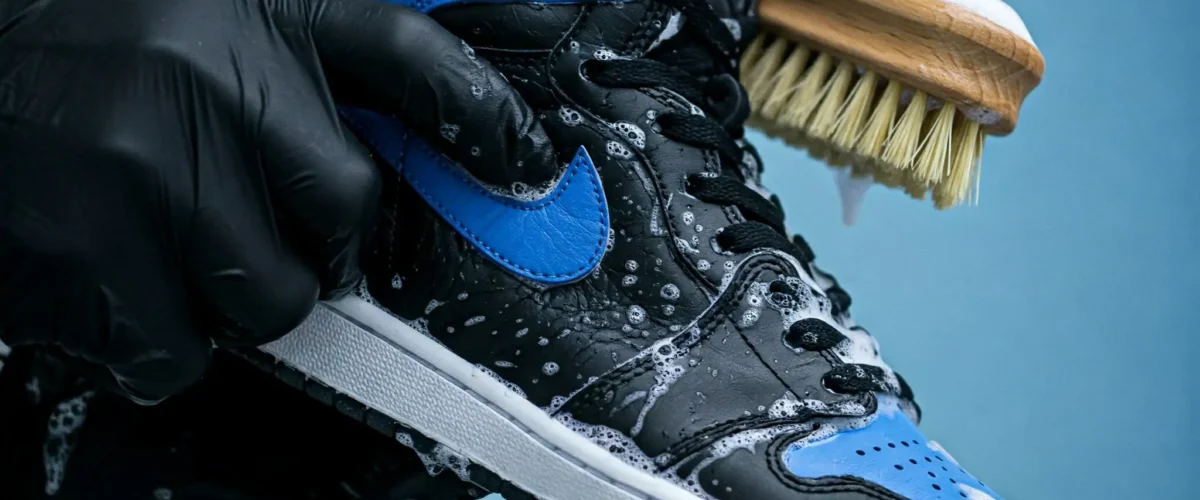
How to clean smooth leather
“Leather” is not a completely uniform category. There is finished, sealed, painted, and unsealed leather, along with constructions using different coatings.
For finished leather compatible with damp cleaning, the most conservative sequence is:
- remove loose dust;
- use a small amount of a compatible cleaner;
- apply it with an appropriate brush or cloth as the product instructs;
- do not saturate the material;
- remove excess foam and water;
- let it dry naturally.
Painted leather needs special care: cleaner, abrasion, and even an ordinary brush can alter the paint. If the cleaner’s manufacturer excludes painted leather, respect that restriction.
Unsealed leather may also absorb water and product unevenly, causing stains. Do not assume a cleaner that works on finished leather will work the same way.
How to clean synthetic or coated leather
Synthetic leather, vinyl, and PU-coated materials may resemble natural leather without reacting in the same way.
Do not automatically apply conditioners formulated for natural leather. Be cautious with solvents, abrasives, and excessive water as well, since coatings may lose their sheen, develop marks, or delaminate.
How to clean suede
Suede has short, raised surface fibers that give it a velvety feel. Excess water and aggressive brushing can flatten them or alter the texture.
The most conservative starting approach is:
- make sure the material is dry;
- brush gently to remove dust;
- use a suede eraser on localized dry marks;
- brush again to restore the surface nap;
- only if dry cleaning is insufficient, consider a compatible cleaner after a discreet spot test;
- use minimal moisture;
- do not soak the material;
- let it air-dry completely;
- brush the nap after drying, if needed.
Dyed suede can release color when exposed to water or cleaner. This migration, called bleeding, can stain neighboring panels. If the manufacturer says to avoid water on that material, follow the restriction: a spot test does not authorize an application it advises against.
How to clean nubuck
Nubuck also has a velvety surface and needs similar care. Starting dry, controlling pressure, and using compatible tools is safer than immediately saturating the material.
Do not use a stiff outsole brush on nubuck. If damp cleaning is needed, test first and use the smallest necessary amount of water.
How to clean mesh
Dirt can penetrate mesh’s open structure, but that does not justify forceful scrubbing. A soft brush and mild solution usually offer more control.
- Remove dry dust before wetting;
- use light pressure;
- avoid pulling fibers;
- remove product with a clean cloth;
- do not leave detergent trapped in the mesh;
- air-dry completely.
How to clean knit
Flyknit, Primeknit, and other knitted uppers can fray or deform under excessive mechanical action.
Use a gentle approach, follow the direction of the knit where possible, and avoid bleach and intense heat. Do not treat knit like heavy canvas or a rubber outsole.
How to clean canvas
Canvas often tolerates damp cleaning better than suede, but it is not indestructible.
Colors can bleed, prints can fade, and the complete sneaker still contains adhesive and other materials. Test dyed or printed canvas first and avoid unnecessary saturation.
How to clean soles and rubber
Rubber outsoles generally tolerate more mechanical action than uppers. A firmer brush can be useful here for removing mud and dirt caught in the grooves.
That does not mean using the same brush along the entire side of a sneaker. Identify where the outsole ends and the midsole, paint, and other finishes begin.
How to clean painted midsoles
A painted midsole may look durable, but repeated abrasion can remove paint or alter its finish.
Use a compatible cleaner and a gentler brush than you would use on outsole rubber. If the paint is already cracking or flaking, do not try to compensate by scrubbing harder.
How to clean laces
Remove the laces when possible. That makes it easier to reach the tongue and eyelet area and lets you clean the laces separately.
Colored laces can also release dye. Avoid putting them together with white laces without checking colorfastness first.
How to clean insoles
If the insoles are removable, you can clean them separately. Remove surface dirt and use only as much moisture as necessary.
Let them dry completely before putting them back. Returning a damp insole lengthens drying time inside the shoe and may encourage odor.
How to dry sneakers without warping or sole separation
Drying is part of cleaning. A careful process through the brushing stage can still be undermined by excessive heat at the end.
- Let shoes air-dry;
- choose a well-ventilated location;
- avoid strong direct sunlight;
- as a general rule, do not use a dryer;
- do not use an oven;
- do not use a heat gun;
- avoid concentrated hot air from a hair dryer;
- put clean white paper inside only without excessive pressure;
- replace the paper if it becomes very damp.
There is no universal drying time. Material, water quantity, room temperature, ventilation, and construction all affect the process considerably.
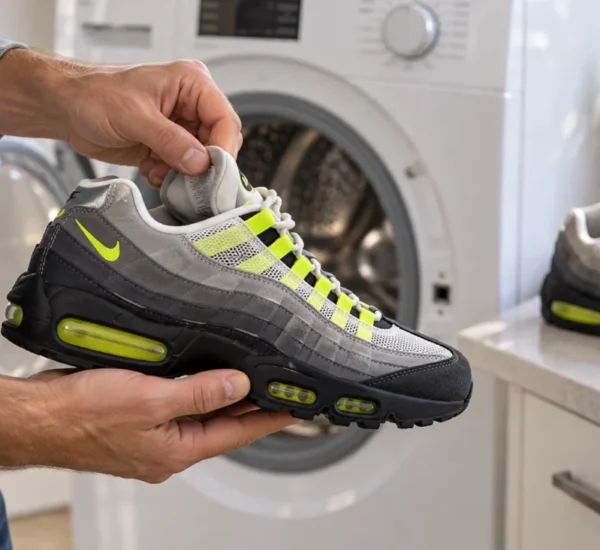
Can you put sneakers in the washing machine?
Follow the shoe manufacturer’s guidance first. Nike recommends hand-washing and air-drying at room temperature. Water, agitation, and impacts in a washing machine may deform the pair, cause dye bleeding, or affect finishes and adhesive bonds.
RESHOEVN8R sells its Signature Shoe Laundry Cleaning Kit for machine washing. That system does not override the sneaker manufacturer’s restrictions: if it advises against machine washing, choose manual cleaning.
Crep Protect: current products, strengths, and limitations

Crep Protect’s range includes cleaners, maintenance wipes, and protective sprays. Match the product’s purpose to your pair’s materials before choosing a kit.
Cure / Cure Travel Kit
The manufacturer presents Cure as a cleaner for various materials and states that its formula contains 98% natural ingredients. “Natural” does not mean safe for every finish.
Crep warns against soaking and advises careful brushing. For dyed suede that may bleed, its guidance is to avoid wetting; a spot test does not override that restriction.
Foam X
Foam X remains in Crep’s current catalog as a foam cleaner. That does not mean it should be applied without testing to any dyed, coated, or older material.
Wipes
Wipes are better suited to quick maintenance and surface dirt than deep cleaning. Do not use a wipe on suede without specific guidance just because it comes from the same brand.
Crep Protect Spray
This is a protective product, rather than a cleaner. The brand says it creates a hydrophobic layer that helps repel liquids and stains, and lists leather, nubuck, suede, and canvas among its applications.
That does not automatically make a sneaker waterproof. Seams, mesh, the tongue, and other interfaces are still present.
Use aerosols according to the label, including application, ventilation, drying, and safety instructions.
Jason Markk: current products, strengths, and limitations

Jason Markk’s catalog usefully separates cleaners, repellents, wipes, and tools. Current products include Deep Cleaning Solution, Essential Kit, Ready-To-Use Foam, Quick Clean Kit, Care Kit, Repel, Quick Wipes, and specialized suede tools.
Deep Cleaning Solution and Essential Kit
Jason Markk recommends Deep Cleaning Solution for various materials but excludes unsealed and painted leather. It also warns that dyed suede may bleed with any exposure to water.
Durables Cleaning Brush
This is the system’s firmer brush. The brand recommends it for finished full-grain leather, rubber, plastic, and other durable surfaces.
Delicates Cleaning Brush
This brush has softer bristles and is intended for delicate leather, suede, nubuck, cotton, knit, and other delicate materials.
Premium Suede Cleaning Kit
The Premium Suede Cleaning Kit combines a brush and eraser for dry cleaning. The brand advises starting without water and considering an appropriate foam only if necessary.
Repel
Repel is a repellent, rather than a cleaner. The brand positions it to help protect absorbent materials against liquids and dirt, with specific restrictions for certain leathers.
RESHOEVN8R: current products, strengths, and limitations

RESHOEVN8R takes a system-based approach: multiple brushes, solution, shoe trees, a laundry bag, suede tools, and protective products.
Essential Shoe Cleaning Kit
This option focuses more on brush cleaning and includes different bristle stiffnesses. That is useful because outsole rubber and suede, for example, should not receive the same mechanical force.
Signature Shoe Laundry Cleaning Kit
This adds the laundry system, including a laundry bag and shoe trees. RESHOEVN8R states that the kit can deliver a deep clean in a washing machine.
Read that claim alongside the shoe manufacturer’s guidance. If the sneaker brand specifies hand-washing only or advises against machine washing, the Signature Kit does not automatically authorize it.
All Material Shoe Cleaning System
The All Material Shoe Cleaning System combines cleaning solution, brushes of different stiffnesses, a microfiber cloth, internal supports, a laundry bag, and leather and suede tools. Check the kit’s contents before buying, since packaging and bundles may change.
It is a collection of products for varied shoe collections. That does not mean every item in the kit should be used on every sneaker.
OxiClean Sneaker + Hat Foam
OxiClean Sneaker + Hat Foam is marketed as a foam cleaner. Check the label’s restrictions before applying it to dyed suede, painted areas, or older materials; the product name does not guarantee compatibility with the whole shoe.
Water + Stain Repellent
This is the brand’s protective treatment. Reducing wetting and stains is different from making footwear waterproof.
Crep Protect vs. Jason Markk vs. RESHOEVN8R: which should you choose?
There is no universal winner. The choice depends on what you actually need.
- For conventional concentrated cleaning: Crep Cure and Jason Markk Deep Cleaning Solution are current options to consider based on compatibility.
- For ready-to-use cleaning without mixing a concentrate: Jason Markk Ready-To-Use Foam and foam options from Crep or RESHOEVN8R serve that purpose.
- For suede or nubuck: prioritize systems with dedicated brushes and erasers that start with dry cleaning.
- For collection care with multiple brushes: RESHOEVN8R offers particularly extensive kits.
- For repellent protection: all three brands offer specific products; do not confuse cleaner with repellent.
- For machine washing: RESHOEVN8R sells its own system, but whether to use it must be checked against the sneaker manufacturer’s instructions.
Do not choose based on the word “premium,” the price, or a brand’s popularity. Choose based on function and material compatibility.
Is a complete kit worth it?
It depends.
A complete kit may make sense if you have:
- several sneakers;
- suede, mesh, leather, and rubber in the same collection;
- a genuine need for different brushes;
- a regular sneaker-care routine;
- an interest in protection and maintenance beyond cleaning.
It may not make sense if you own one sneaker and only need a soft brush, microfiber cloth, and compatible cleaner.
Buying everything from one brand also does not automatically guarantee compatibility with your shoes. Products in the same line still have different functions and restrictions.
Do repellent sprays actually work?
Repellents encourage water to bead on the surface and reduce wetting on compatible materials. That effect does not replace cleaning or seal the shoe’s entire construction.
Keep in mind:
- the protection is not permanent;
- abrasion and use reduce its effect;
- compatibility must be checked;
- some treatments may slightly change suede or nubuck’s appearance;
- improper application may cause localized stains;
- a spray does not seal every seam and interface in the shoe.
Water-repellent, water-resistant, and waterproof are different
Water-repellent describes the ability to repel water at the surface.
Water-resistant usually indicates some resistance to water entry, with the level depending on construction.
Waterproof is a much stronger claim about preventing water entry under specified conditions.
Applying a repellent spray to a mesh sneaker does not automatically make the complete shoe waterproof.
Can you use household detergent to clean sneakers?
It is inaccurate to say any drop of household detergent destroys sneakers.
Nike allows small amounts of mild detergent in its cleaning method. Household products vary in formulation and concentration, however; that advice does not authorize using any degreaser on an upper.
If you use a household solution, it needs to be mild, compatible with the material, and applied sparingly. For rare, dyed, painted, or delicate materials, a product with documented compatibility is a more predictable choice.
Can you use baking soda?
Baking soda is not a universal sneaker-cleaning solution.
It can be used in some targeted methods and act as a mild abrasive, but it can also leave residue, increase abrasion, and be unsuitable for dyes, suede, coatings, and delicate finishes.
Do not treat it as an automatic substitute for cleaner.
Can you use vinegar?
That also depends on the material. Vinegar’s acidity can be useful in certain specific situations, but there is no reason to apply it indiscriminately to every sneaker.
Dyes, metals, finishes, and coatings can react differently. Look for specific guidance for the material and the problem you are trying to solve.
Can a Magic Eraser damage sneakers?
Magic Eraser and similar products typically use melamine foam, which cleans largely through microabrasion.
It may work on certain durable, light-colored surfaces, but it is neither magic nor risk-free.
- It can reduce shine;
- remove paint;
- alter coatings;
- leave a duller patch;
- wear away the material’s surface.
Do not treat it as a universal fix for uppers or painted midsoles.
Can you use bleach on white sneakers?
We do not recommend chlorine bleach as a universal whitener.
It can affect fibers, dyes, prints, metals, finishes, and other components, and it does not solve every kind of yellowing.
If the problem is aging or yellowing rather than dirt alone, see our guide to why sneakers turn yellow.
Why isn’t toothpaste a good idea?
Toothpaste is formulated for oral hygiene, not sneaker care. It may contain abrasives, flavors, dyes, and other ingredients that serve no purpose on shoe materials.
Even when it appears to work on a white surface, that does not establish compatibility with paint or coatings. More predictable options are available.
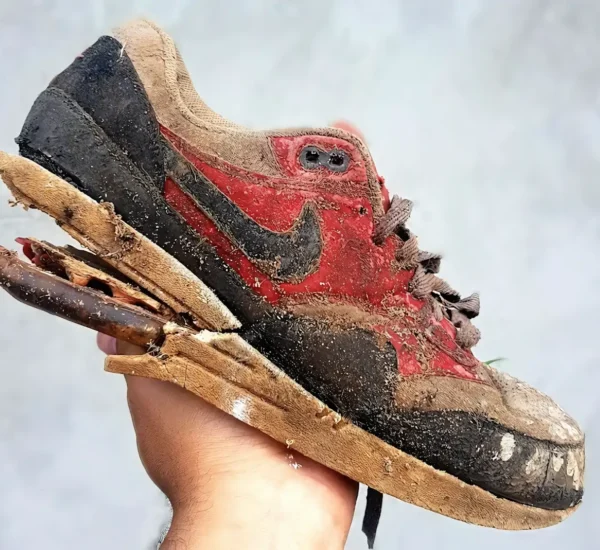
How to clean vintage sneakers
Before wetting an older sneaker, assess its structural condition.
- Is the midsole cracking?
- Is any material crumbling?
- Is the paint flaking?
- Is the coating brittle?
- Is there sole separation?
- Is the suede dried out or its dye unstable?
A degraded sneaker should not be “saved” simply through more cleaning. If you suspect midsole deterioration, first consult our guide to hydrolysis and sneaker degradation.
To understand the difference between a recent retro release and a genuinely old pair, see what makes a sneaker vintage.
How often should you clean sneakers?
There is no universal schedule.
Frequency depends on:
- how often you wear them;
- color;
- material;
- how dirty they get;
- climate;
- activity;
- how long dirt is allowed to accumulate.
Removing surface dirt early can prevent the need for harsher cleaning later. Repeated unnecessary cleaning, however, also adds abrasion and exposure to water and products.
For more on footwear materials, preservation, and construction, visit the Sneaker Lab. If your pair has a structural issue rather than dirt alone, such as a crumbling midsole, start with our guide to hydrolysis and sneaker aging.