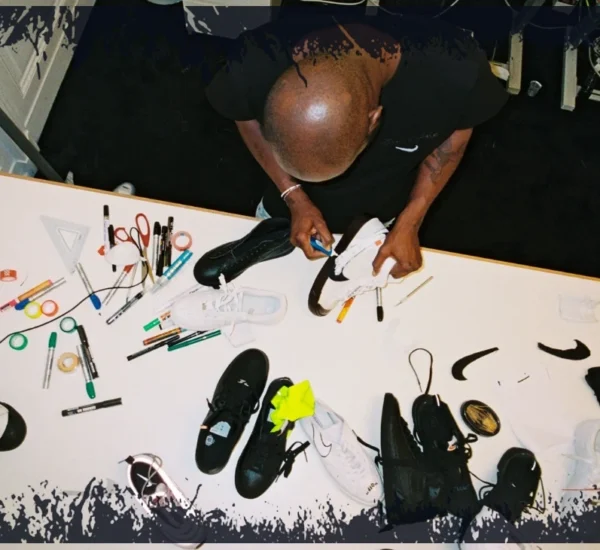
HTM brings together the names Hiroshi Fujiwara, Tinker Hatfield, and Mark Parker. The partnership debuted in 2002 with an Air Force 1 version and went on to explore other models and constructions, including the Sock Dart, Flyknit, and Kobe 9 Elite Low.
Hiroshi proposed the initials as a project codename. They identify the trio’s collaboration, rather than a technology, a luxury classification, or a rarity level.
What does Nike HTM mean?
HTM combines the first-name initials of Hiroshi Fujiwara, Tinker Hatfield, and Mark Parker.
In the official HTM oral history published by Nike in 2016, Fujiwara explains that he chose HTM as a codename for Hiroshi, Tinker, and Mark. It was a simple idea, and he did not imagine the abbreviation would become the project’s actual name.
HTM is therefore not short for “High Tech Material,” “High Tier Model,” or any hidden technical feature.
It represents three names.
For other abbreviations found in sneaker names, the Sneakerhead Dictionary offers related explanations.
Who are Hiroshi Fujiwara, Tinker Hatfield, and Mark Parker?
HTM worked precisely because it did not bring together three people with identical backgrounds.
The official history shows different approaches intersecting. Reducing them to “Hiroshi handled fashion, Tinker handled technology, and Mark handled business” would miss much of what made the partnership interesting.
Hiroshi Fujiwara
Hiroshi Fujiwara is a designer, musician, and influential figure in Japanese culture, as well as the founder of fragment design.
Nike itself documents a career spanning music, film, and fashion, and highlights his long involvement in collaborative projects with the brand.
Within HTM, his perspective was strongly connected to simplicity, proportion, wearability, and how a product could fit into daily life. That does not mean Hiroshi had a rigid role limited to “choosing colors.” The process was collaborative.
It is also important not to confuse projects: HTM is not the same as fragment design x Nike. Fujiwara is involved in both, but a fragment product does not automatically become an HTM product.
Tinker Hatfield
Tinker Hatfield already had an extensive history at Nike when HTM began. The Air Max 1, Air Trainer 1, and numerous Air Jordans are among the projects associated with the designer.
His work is also closely tied to the relationship between design, performance, and insights from athletes. Within HTM, he could bring that experience to ideas that did not always begin with the need to create a major commercial product.
This helps explain why the project’s history eventually extended to experimental constructions, new technologies, and performance products.
Mark Parker
Mark Parker may be the participant whose role is most often oversimplified.
When HTM began in 2002, Parker was co-president of the Nike Brand, a position he had held alongside Charlie Denson since 2001. He became president and CEO of NIKE, Inc. on January 23, 2006.
Parker’s background was not solely executive, either. He joined Nike in 1979, worked in footwear design, development, and leadership, and was directly involved in the evolution of numerous products and technologies.
In the HTM oral history, Tinker describes him as a designer, a developer, and someone particularly attentive to bringing people and ideas together.
How did the HTM project begin?
Nike’s oral history connects the partnership to Mark Parker’s trips to Japan, his friendship with Hiroshi, and the work Parker and Tinker were already doing together.
When the three met, conversations about products and design led to the project’s first ideas.
Parker describes the partnership as growing organically out of genuine connections.
That explains HTM better than the idea of a new corporate division. HTM was an ongoing collaboration between three people with unusual freedom to experiment.
2002: the first Air Force 1 HTM
The starting point was a classic.
Nike’s official DNA Artifacts: Air Force 1 HTM (2002) archive identifies the Air Force 1 Low HTM as the debut of the collaborative partnership between Hiroshi Fujiwara, Tinker Hatfield, and Mark Parker.
The version documented by Nike featured:
- Premium black leather;
- Contrasting white stitching;
- An HTM logo on the footbed;
- HTM branding on the eyestay, the panel alongside the lace eyelets.
Nike also provides an unusually specific production figure: 1,500 pairs.
That 1,500-pair run applies to the Black/White version documented by Nike. It is not a standard quantity for other HTM releases.
The contrast helps explain the original idea: a silhouette that began in basketball and had already become a streetwear icon received an exceptionally restrained treatment with refined materials. The model’s full story is in our history of the Air Force 1.
Was HTM a collab, a design lab, or a Nike line?
The most accurate description is an ongoing collaboration or creative partnership between Fujiwara, Hatfield, and Parker.
Nike itself has used terms such as collaborative partnership, collaborative series, and design collective to describe HTM.
The participants’ accounts emphasize the freedom to experiment: the trio could test materials, constructions, and ideas without the same commercial expectations attached to a high-volume release.
In practice, HTM gave the three a space to experiment with ideas, reconsider existing products, and explore technologies with greater freedom and speed.
It was not a sub-brand, a luxury certification, or a department ranked above other Nike abbreviations.
For a broader explanation of creative partnerships, see what a collab is.
What was the relationship between HTM and Nike Flyknit?
Flyknit may be the best example of how HTM came to mean more than special treatments of classic shoes.
In the official oral history, Nike highlights the HTM Flyknit Racer and HTM Flyknit Trainer+ as products that helped introduce the public to the possibilities of the new construction.
Hiroshi also describes an interesting visual contribution: in early prototypes, the knit structure was not always immediately apparent. Combining different yarn colors helped make the upper’s construction visible.
Tinker describes HTM as an opportunity to introduce a disruptive technology, learn from its launch, and draw attention to possibilities that could later expand.
That is the best way to describe the project’s role:
HTM helped explore and introduce Flyknit. It did not invent Flyknit on its own.
Did HTM invent Nike Flyknit?
No. Nike developed Flyknit and introduced it in 2012. HTM helped explore and demonstrate the possibilities of knit construction through the Flyknit Racer and Flyknit Trainer+, without being solely responsible for the technology.
How many Nike HTM releases are there?
In the oral history published in 2016, Nike counted 32 HTM releases since 2002. That is a count from that moment, rather than a definitive total for the project’s entire history.
Is every HTM a limited edition?
HTM should not automatically be treated as a synonym for a limited production run.
Some HTM releases clearly had small-scale distribution. The inaugural Air Force 1 is the strongest example because Nike itself reports 1,500 pairs.
But the letters HTM do not contain a production quantity.
To determine whether a particular product had restricted circulation, research that release: its market, stores, disclosed quantities, and launch context.
A confirmed number is information. “Every HTM is ultra-limited” is a generalization.
Is HTM rarer than QS, SP, PE, or SE?
There is no universal hierarchy that allows a blanket “yes.”
HTM identifies the Hiroshi–Tinker–Mark partnership.
QS, SP, PE, and SE are other designations with their own histories and uses. Placing them in a vertical ranking mixes different kinds of information.
There is no reliable scale such as:
SE < QS < SP < HTM.
A particular HTM can be extremely hard to find. A particular QS or SP can be, too. Rarity needs to be established for the release, rather than inferred from its imagined position in a pyramid.
Was HTM the same thing as NikeLab?
No.
At certain times, HTM products and content appeared within the NikeLab world, and Hiroshi also worked on NikeLab x fragment projects.
That does not make HTM and NikeLab the same entity.
HTM identifies the three-person collaboration. NikeLab provided another setting for Nike innovation, distribution, and product presentation.
How do you correctly identify an HTM release?
The best approach is to establish the product’s identity rather than guess from its appearance.
- Official name: look for an actual association between HTM and the release.
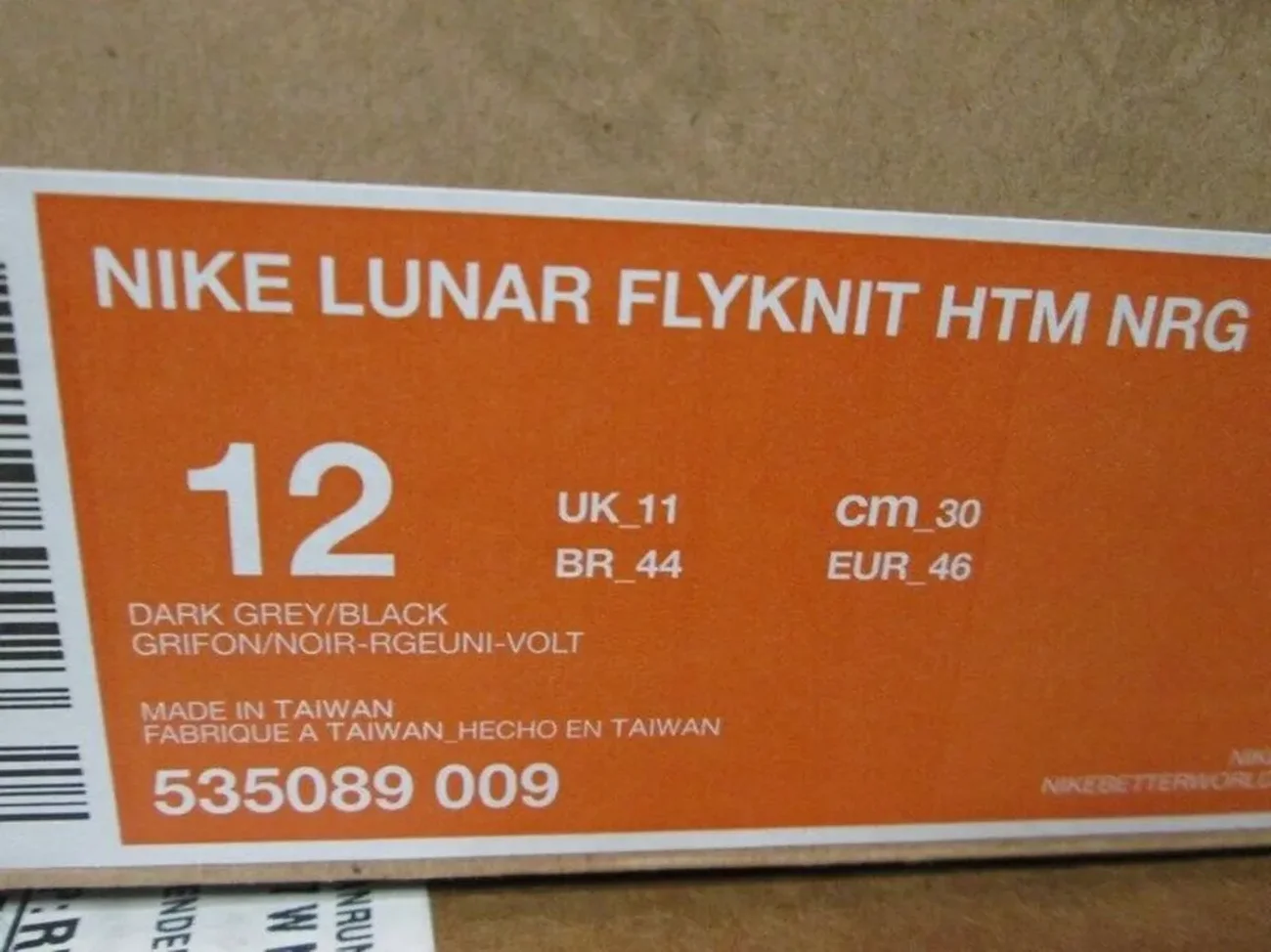
- Style code: confirm the exact product and colorway you are researching.
- Year: distinguish historical versions, reissues, and similar-looking products.
- Nike/SNKRS archive: prioritize preserved official documentation.
- Specific details: compare the branding, materials, and construction documented for that release.
Branding varies, too.
For the inaugural Air Force 1 HTM, Nike documents the logo on the footbed and eyestay. On the Converse Jack Purcell Modern HTM, it is embossed on the tongue.
There is therefore no universal position where “HTM always appears.”
Does HTM on the tag or box prove authenticity?
No.
Identifying which release should exist is different from authenticating the physical pair in front of you.
A counterfeit can reproduce:
- The HTM logo;
- The style code;
- The box label;
- Colors;
- Stitching;
- Visually similar materials.
It is also unsafe to authenticate an HTM simply because “the leather looks premium.”
If the question is whether a physical pair is legitimate, see what a Legit Check is.
Does HTM affect resale prices?
Some historical HTM releases attract strong demand on the secondary market, but HTM is not a price forecast.
Resale value can depend on:
- The model;
- The actual production quantity;
- The release market;
- Size;
- Age;
- Condition;
- Current demand.
HTM’s historical significance does not depend on what someone is asking for a used pair 20 years later.
And HTM should not be treated as an investment.
From basketball to Converse
The 2014 Kobe 9 Elite Low HTM brought the partnership into performance basketball. Nike’s oral history distinguishes the trio’s involvement from the Nike Basketball team’s creation of the Kobe 9 with Eric Avar, and records Kobe Bryant’s collaboration on the project.
In 2016, the Converse Jack Purcell Modern HTM extended that history. The edition’s product description lists textured leather, Hyperfuse, a Phylon midsole, and HTM embossed on the tongue. The model belongs to Converse, even though the trio is associated with Nike.
To explore the silhouette that started this partnership, see the history of the Air Force 1. For other sneaker designations, consult the Sneakerhead Dictionary. And for more chapters where design, sport, and culture meet, explore Sneaker History and Culture.