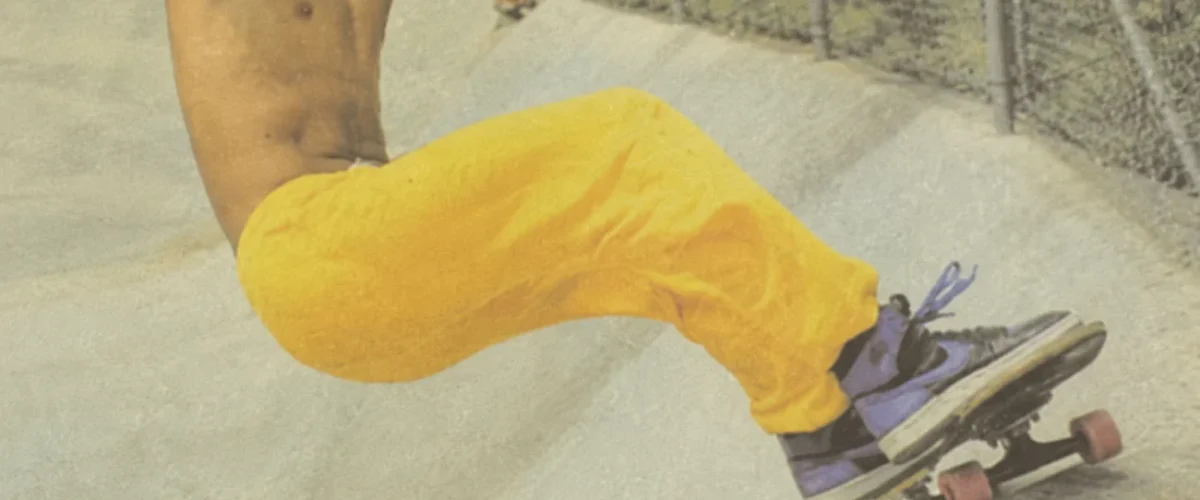
The Air Jordan 1 became part of skateboarding before it became an official Nike SB collaboration. Skaters took a basketball shoe into another setting, used it on their own terms, and helped create a history that the brands would later celebrate. That sequence matters: the 2014 releases recognized an existing connection rather than inventing it.
Our history of the Air Jordan 1 covers its 1985 basketball origin. Its skate story asks a different question: what happens when a product’s users give it a purpose beyond the one its designers initially intended? The answer runs through videos, personal memories, mismatched pairs, and finishes that make wear part of the design.
Why basketball footwear could find another purpose
The Jordan 1 offered leather panels, ankle coverage, and a substantial sole construction that some skaters found useful in the period. Those features should not be turned into a claim that every basketball shoe was ideal for skating, or that a high collar guarantees injury prevention. They help explain a possible practical fit within a specific historical context.
Skating also tests a shoe differently from walking. Grip tape repeatedly contacts parts of the upper, while individual stance and technique influence where wear appears. A worn lateral panel and a creased toe tell different stories. Our sneaker anatomy guide is useful for reading those areas precisely rather than treating every mark as generic damage.
On a skated pair, the contrast between intact leather and abraded edges records where the activity changes the object. Later collaborations would make that relationship between a surface and its wear an intentional design feature, using coatings that expose another color underneath.
The importance of seeing Jordans in skate footage
The Nike SB archive identifies Lance Mountain’s 1987 video appearance as an important part of the Jordan 1’s skate legacy. The shoe was visible inside the activity well before a formal SB release. It was being used, scuffed, and styled by skaters rather than introduced through a later collaboration announcement.
That distinction helps explain the power of footage. A product photograph isolates a shoe; a skate video connects it with movement, a person, and an approach to a spot. Viewers can absorb the entire look, including lacing, mismatched colors, and the relationship between the shoe and the rest of an outfit.
Slam City specifically points to The Search for Animal Chin as a reference for Mountain’s collaboration. The 1987 Powell-Peralta production places the shoes within the Bones Brigade’s visual record, giving the later project a concrete piece of skate media to look back to.
What the $24.99 story actually tells us
Nike SB’s August 2019 Eric Koston Jordan 1 Low turned a personal memory into a design detail. Koston remembered a pair priced at $24.99 in 1986 that he could not take home. The number appeared inside the tongue of the later release. It is a specific recollection, not a universal price history for the Jordan 1.
Clearance stories can help explain how a shoe reached people outside its original audience. They cannot, on their own, explain every purchase or the model’s lasting appeal. Separating an individual memory from a claim about the entire market preserves what makes the anecdote interesting without making it carry more evidence than it can support.
2014: the official crossover catches up
Craig Stecyk belongs at the beginning of the release sequence
Contemporary coverage of Craig Stecyk’s Nike SB x Air Jordan 1 places its launch on March 15, 2014. The shoe featured an iridescent treatment and AJ One SB lettering. It preceded the Lance Mountain editions later that year, an important detail when the more familiar painted pairs are casually described as the first collaboration.
Stecyk’s involvement also makes the crossover about more than applying two brand identities to a shoe. Visual culture is part of the connection: lettering, art, and the way skateboarding represents itself all belong in the story. The project acknowledged a long relationship between the shoe and that world.
Lance Mountain made change over time part of the product
The Slam City Skates announcement from May 2014 documents Mountain’s June 7, 2014 release in black-coated and white-coated versions. Under the surface were mismatched black-based shoes with red and blue accents. Use exposed the colors underneath, recalling painted and mismatched footwear rather than presenting a permanently pristine finish as the only intended look.
The concept challenges a familiar collecting habit. An unworn pair preserves the starting state, but a worn pair reveals another part of the design. Neither photograph tells the entire story alone. The release makes the transition between those states something the wearer can see.
That does not mean every kind of deterioration is intentional. Surface color wearing away belongs to the concept; structural damage still affects the condition of the individual shoe. Nor is there one mandatory pattern of wear. Different contact points and routines produce different visible results.
LA to Chicago adds a geographical layer
The 2019 LA to Chicago release brought another interpretation of a changing upper. Atlas’s contemporary release description records purple and gold panels revealing red and black underneath. The color transition connected the city references in the name with the physical experience of wearing the shoe.
The in-between stages are particularly revealing. Color can emerge around edges while the original surface still dominates elsewhere. That makes a used pair visually different from both the untouched starting point and a fully exposed lower layer. It is an interaction between a prepared design and an individual wearing pattern.
The Low releases associated with Koston in the same period show that a Jordan skate story does not have to depend on a high-top or a paint-away finish. A small interior reference can carry personal history. Silhouette, proportion, and color can do the storytelling without reproducing the exact mechanism of the Mountain release.
A Jordan used for skating is not automatically a Jordan SB
The distinction is chronological and practical. Skaters wore Jordan 1s before the official SB collaborations, so it is misleading to apply the later product label retroactively to every early pair. Nike SB has a particular brand and product context, explained in our guide to what Nike SB means.
The same care applies when comparing Jordan 1s with SB Dunks. Their histories intersect through users and scenes, but they remain different models. Claims about cushioning, sockliners, padding, or other modifications need to be checked for the actual edition. A feature found on one SB shoe cannot simply be assumed on every collaboration carrying those initials.
This is especially important if the historical question becomes a practical shopping question. A release’s connection to skate culture does not tell you how a decades-old individual pair has aged or how it will feel under your feet. Historical significance and present condition require different kinds of evidence.
Read the shoe as a record of three different moments
First comes the original basketball design. Next comes its adoption and alteration by skaters. Later comes a commercial release that interprets that history. A shoe somebody painted decades ago and a new shoe designed to recall that practice are connected, but they are not the same category of object.
Keeping those moments separate makes visual analysis more useful. Ask whether a color treatment is a factory feature or an owner’s modification. Ask whether a tongue label belongs to an official collaboration or whether the shoe predates it. A photograph can supply clues, but it needs a date and context before it can establish a detailed story.
Why this history still matters
The lasting lesson is about use, not simply limited releases. A community can reshape a product’s meaning, and a brand can later build new products around the memory of that reshaping. The Jordan 1’s skate legacy makes that process unusually visible because wear and customization became part of the later design language.
Explore our sneaker history and culture hub for other examples of footwear moving between settings. Here, the most meaningful evidence is often the least pristine: a scuffed panel, an unexpected color underneath, or two shoes that do not match. Those details record a relationship that existed before it had an official release calendar.
Sources and documents
Nike SB Vault: LA to Chicago; Nike SB Vault: $24.99; Hypebeast: Nike SB x Air Jordan 1 by Craig Stecyk; Slam City Skates: Nike SB x Air Jordan 1, May 2014; Atlas: Nike SB Air Jordan 1 High OG.