Nike Shox reached the market in 2000 and made cushioning an explicit part of a shoe’s appearance. Exposed heel columns, later extended through other areas on certain models, gave the line an instantly recognizable identity. In Brazil, the nicknames 4 molas and 12 molas, referring to four and twelve springs, entered sneaker vocabulary.
The Shox story brings together engineering, basketball, running and local cultural adoption. It connects Vince Carter, Brazilian funk and designers who treated the columns as a fashion element. To understand that journey, separate how the system works, the image built around it and the experiences of the people who made the shoes their own.
R4: when structure became a signature
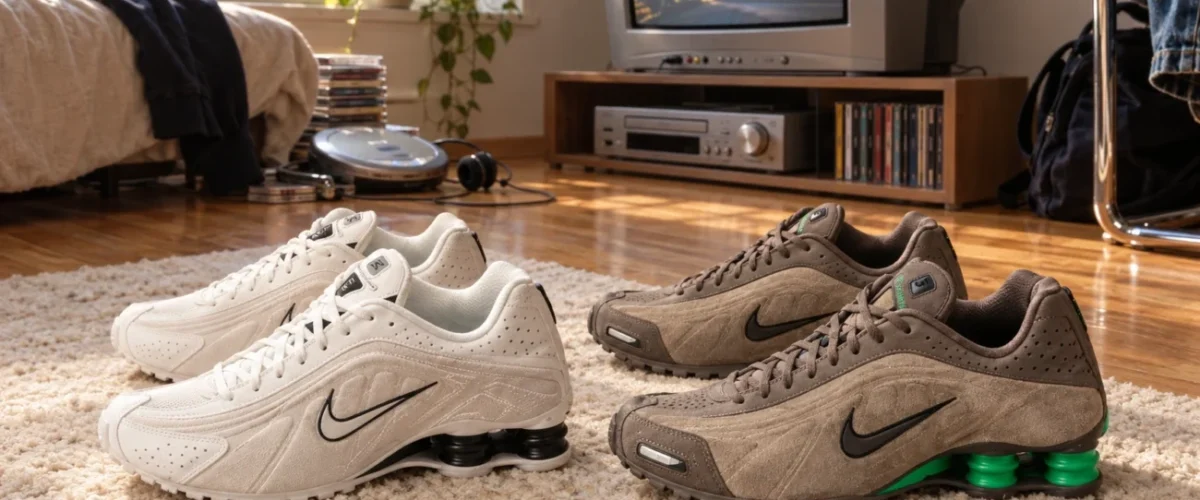
Nike dates the Shox R4’s debut to 2000, describing four heel columns and an upper influenced by astronaut equipment. Relatively smooth surfaces above an exposed mechanism made the side profile immediately legible.
The R4 offers a distinctive visual interpretation of speed. Its upper lines seem to flow backward, while four supports interrupt the space below the heel. Cushioning no longer appears to be a continuous layer hidden inside the midsole. Even at rest, the shoe suggests a working assembly.
That appearance followed a development process. In an ELLE Brasil interview, executive Gustavo Viana traces the project to experiments beginning in 1984. The gap before release helps distinguish an experimental idea from a product ready to manufacture, wear and sell.
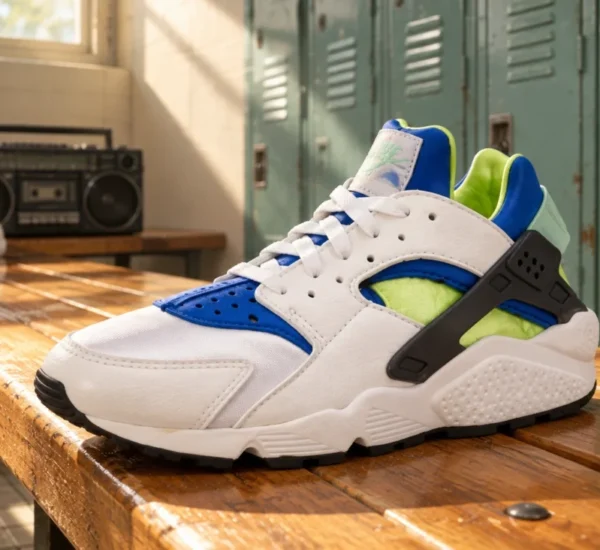
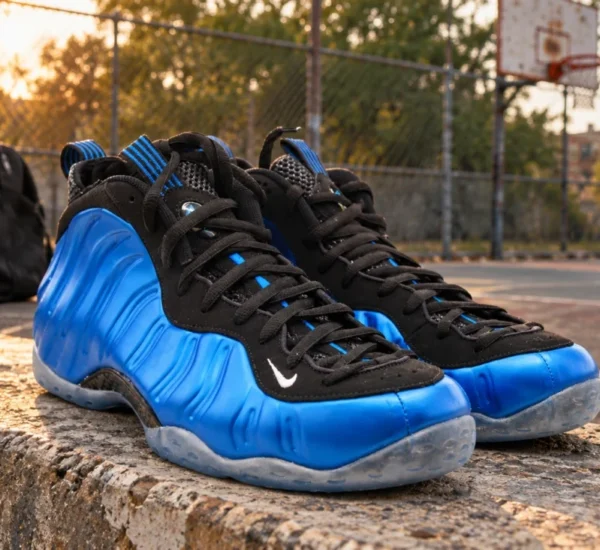
That underfoot emphasis distinguishes Shox from the Huarache, recognizable through its bootie and clip, and the Foamposite, defined by a molded shell. They offer three different ways to make a construction decision immediately visible.
Are they springs? What the columns do
Springs is an understandable nickname, but the visible structure is not the same as a metal coil spring. In its Shox TL technical description, Nike explains the system as columns that compress and recover their shape while working with stabilizing plates. The assembly matters, not just each cylinder in isolation.
When a structure deforms under load and returns toward its previous shape, it can store and return part of the energy it received. It does not create energy. That description also cannot establish how much faster someone will run or how much higher they will jump. A specific performance claim requires an appropriate test with defined conditions and comparisons.
Column height, geometry, positioning and connecting components influence the system’s behavior. More visible elements do not automatically mean twice the cushioning. Counting them can help identify models; it cannot substitute for performance measurement.
Comfort is another separate question. A structure that looks elastic may feel firm to a particular wearer. Weight, pace, surface, shoe shape and individual preference affect the experience. In sneaker anatomy, cushioning, stability and fit are related but distinct functions.
Vince Carter and the image of an extraordinary jump
Vince Carter’s dunk over Frédéric Weis at the 2000 Sydney Olympics made the Shox BB4 part of a historic basketball image. In Aaron Cooper’s account of the VC line’s development, the BB4 and subsequent VC1 appear as different chapters. That distinction prevents a shoe worn by the athlete from being confused with his first signature model.
The power of the image is not a laboratory result. The dunk records Carter’s ability at an extraordinary moment, while the shoe becomes part of its visual memory. Turning that association into proof that the columns produced the play confuses advertising, athletic performance and causation.
During VC1 development, Cooper recalls that a tiny change in column position altered the assembly’s behavior. Flat-bottomed prototypes failed testing and were replaced by rounded forms. His design account also dates the VC1 release to late 2001 and the full-length Shox VC2 to the following year. The line evolved through geometry testing as well as changes in appearance.
The TL extended the columns across the base
Nike’s Shox TL product archive identifies the 2003 model and describes its full-length column arrangement, mesh and plastic overlays. Visually, the TL spreads the feature concentrated at the R4’s heel across almost the entire base.
That changes the whole composition. The eye meets a sequence of supports, while the upper’s surrounding structure matches their intensity. An R4 and TL share the Shox name but communicate different proportions and surfaces. One concentrates the effect at the rear; the other turns the base into a continuous visual rhythm.
The Brazilian Shox collection page records the four-spring and twelve-spring nicknames and includes the NZ among models important in the country. Local vocabulary is useful when accompanied by the full model name. A request for a four-spring Shox does not necessarily identify one specific product.
In Brazil, funk became part of the story
ELLE Brasil’s reporting on Shox includes accounts connecting the shoe with funk and personal style in peripheral urban communities. That context explains why its Brazilian meaning cannot be understood only through the careers of American athletes.
Communications professional Rachel Oliveira names MC Tikão and MC Frank when discussing the model’s presence in Rio de Janeiro. The report also connects Shox, NBA jerseys and the city’s charme culture. Those names and combinations place the sneaker within a local network of images, music and consumption rather than treating it as an imported trend that arrived unchanged.
Sneaker history and culture becomes more complete when it follows these local paths. With Shox, popular nicknames, clothing combinations and musical circulation help explain its persistence as much as a list of colorways does.
Skepta connected different places
In the official SK Shox TL interview, Skepta recalls seeing young people wearing Shox in northern England and links the collaboration to his Nigerian roots. The shoe brings a street reference he encountered into conversation with a personal history of belonging.
For the 2019 collaboration, Skepta brought an isiagu print into the insole, relating it to his experience of receiving a chieftaincy in Nigeria. A Manchester street reference met a symbol of family history inside the shoe. The collaboration brings those geographies into one product.
Martine Rose turned the columns into fashion proportions
The 2022 Nike x Martine Rose release introduced the Shox Mule MR4 through an observation about women’s football travel clothing. The R4 became a mule, with proportions that brought the sneaker closer to a formal shoe.
In 2023, Nike documented the US women’s national team arriving for a match in the collaboration’s tailoring and MR4 footwear. It offers a concrete chapter in Shox’s expansion beyond training, with heel structure participating in a different approach to dress.
The design effect matters. The columns are read as more than cushioning markers: they organize the height and visual stance of the shoe. A recognizable component makes a silhouette from another category possible. The collaboration explores that flexibility while keeping the athletic origin visible.
Shox Z: another chapter for the line
The 2025 Shox Z announcement documents another development, with a lower profile and sportswear intent. The line’s continuity therefore includes both reissues of familiar shapes and new projects. Not everything called Shox tries to reproduce an old R4 or TL.
Also distinguish Shox from Nike Air. Columns identify the Shox system, while Air names another technology. Some projects can combine solutions, but a family name does not authorize assigning every model the same internal construction.
A technology with local accents
That story belongs in Nike’s athletic archive and in the memories of people who first saw a pair at a dance event, on a court or in the street. Understanding the differences between those settings makes the design more rewarding without relying on myths about what its famous springs can do.
Sources and references
- Shox R4 Black and Metallic Silver
- Das quadras às ruas: a história do Nike Shox
- Tênis Nike Shox TL, AV3595-004
- The Nike Shox VC1 With Aaron Cooper
- Nike Shox TL, CN0151-003
- Nike Shox: Brazilian Model Guide
- Behind the Design: SK Shox TL Skepta
- Behind the Design: Air Max Tailwind V x Skepta
- Nike and Martine Rose Rewrite the Rules of Pre-Match Fashion
- The Nike x Martine Rose Collection Redefines Women’s Football Styling
- Nike Unveils the Shox Z