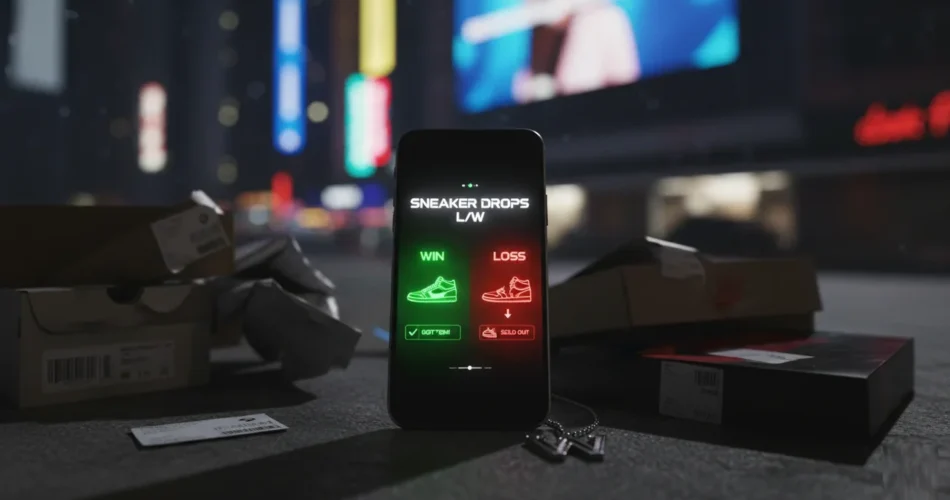
The screen refreshes. If you were selected, you got the W. If the message was the polite version of “not this time,” you took the L. In sneaker culture, W means win and L means loss.
The definition is simple; what happens behind those letters is not always simple. Depending on the release, a W can mean the right to purchase, a reservation for pickup, a completed checkout, or a confirmed order. An L can mean you were not selected in a raffle, your size sold out, or inventory disappeared before payment.
Those two letters also tell a bigger story about how sneaker buying changed. Getting shoes once meant mostly walking into a store and seeing what was on the shelf. Today, some releases involve calendars, notifications, digital queues, raffles, draws, and a few minutes of waiting that can feel like the fourth quarter of a close game.
What Do W and L Mean in Sneakers?
W is short for win. In a sneaker drop, it means you got a positive result from your attempt to secure the pair.
L is short for loss. It means that particular attempt did not end with the result you wanted.
It is more accurate to talk about the result of the attempt than simply “bought” or “didn’t buy.” If a skate shop selects people who earn the right to pay for and pick up a pair, being selected can already count as a W. On another site, people may not call it a W until checkout and order confirmation are complete.
The same applies to an L. You can take an L in one raffle even if the sneaker is still available at another store, in another region, or in another size. The letter describes the outcome of that attempt; it does not declare the sneaker unavailable everywhere.
Did W and L Start in Sneaker Culture?
No. W and L have much older associations with results: win and loss are commonly abbreviated in sports records, standings, and statistics. Online slang expanded those meanings even further. A W became a shorthand for a good result or success; an L became a failure, defeat, or bad outcome.
Dictionary.com, for example, documents W as slang for a win across social media and L as slang for loss. Sneaker culture did not invent the language; it found an almost perfect use for it. Competitive drops often produce binary-looking outcomes: selected or not selected, order confirmed or sold out.
There is no single well-documented date when sneakerheads began using W/L for releases. The supported point is broader: the letters are used for wins and losses in sports and online conversation, and sneaker communities use them for release attempts. That does not establish a precise route or first adopter.
How W and L Became Part of Modern Sneaker Drops
Sneakers have always been distributed in different ways. There have been (and still are) ordinary retail sales, physical lines, in-store lists, campouts, reservations, raffles, and first-come-first-served launches. Forums, blogs, and group chats helped spread release information; apps and push notifications made the flow almost instant.
Platforms such as SNKRS brought release calendars, editorial content, alerts, and different access mechanisms into one environment. Buying a high-demand sneaker could now involve multiple steps: register interest, choose a size, submit an entry, wait for selection, and receive the result.
That is when W/L stops feeling like random shorthand. The language follows the ritual. The result lands on your screen, turns into a screenshot, and seconds later is already in chats and social feeds. The W is one letter; the celebration can take up the entire conversation.
For more terms that gained new meanings in this environment, the Sneakerhead Dictionary covers the language of sneaker culture without separating the words from the stories behind them.
What Is a W in Practice?
A W is a positive outcome, but the concrete result depends on the mechanism used for the release.
W in a Raffle
A raffle is a selection process among people interested in purchasing a product. Some stores raffle the right to buy; others pre-authorize payment and charge the people who are selected; others require pickup and payment in-store within a specified window.
That is why “I won the raffle” usually does not mean “I won a free pair of sneakers.” It normally means your entry was selected within that acquisition system. Free entry and free product are very different things.
The rules matter more than the slang. Before entering, check whether selection triggers automatic payment, gives you a later right to purchase, creates a reservation, or requires in-person pickup. Entering at several retailers can lead to several paid orders. Set a budget for that possibility and read the cancellation and return terms.
W in a SNKRS Draw
Nike’s current U.S. SNKRS Draw guidance says members enter during a limited window, choose the product and size, and keep payment information current so Nike can pre-authorize the purchase if they are selected. Nike says you are charged only if selected, and the result is communicated after the countdown ends.
Nike’s current SNKRS Draw Rules also state one submission per person per launch product. In sneaker conversation, selection is the W and non-selection is the L. Nike itself uses the official language “selected” and “not selected”; W/L is the community shorthand.
Policies can change, and other retailers use different systems. Always read the rules for the specific U.S. launch instead of assuming every raffle works like SNKRS.
W in an FCFS Release
FCFS means First Come, First Served: inventory is sold in arrival or checkout order while stock lasts. There is not necessarily a later selection stage. If you complete the purchase before the inventory is gone, you can call that a W.
Timing, queues, and availability can matter directly in FCFS. In a draw with a defined entry window and selection after it closes, entering in the first second does not automatically mean you have better odds. The strategy has to match the mechanism.
What Is an L? When the Attempt Does Not Work Out
Take an L, took an L, or simply “got an L” means the attempt ended without the result you wanted. In sneaker releases, that can happen in several ways:
- your entry was not selected in the raffle or draw;
- your size sold out;
- inventory disappeared before checkout was completed;
- payment or the order was not confirmed;
- the launch window ended without a successful purchase;
- you did not secure a reservation or pickup through that channel.
In a selection-based system, an L does not necessarily mean you did anything wrong. You can enter correctly, meet the deadline, and still not be selected. Completing the steps makes your entry valid; it does not make selection guaranteed.
An L also describes the outcome, not the quality of the sneaker or the taste of the person who tried to buy it. The pair may still be available elsewhere, and you can still have taken an L in that specific raffle.
Raffle vs. Draw vs. FCFS vs. Drop
Drop is the release or availability event itself. It can happen through ordinary retail, FCFS, raffle, draw, reservation, or another system. For the broader concept, see what a sneaker drop means.
Raffle is a broad term for selecting participants connected to the opportunity to acquire a pair. Draw literally means a drawing or selection and is also used for specific systems such as SNKRS Draw. In everyday conversation, raffle and draw often overlap, but the rules of each release determine what actually happens.
FCFS is not a raffle. It is first-come-first-served selling while inventory remains. Any of these formats can produce Ws and Ls; the path to the letter is what changes.
W/L vs. Cop or Drop: What Is the Difference?
Cop or Drop expresses intention or opinion: are you trying to buy the release, or are you passing? W/L describes the result of an attempt.
The shortest example is also the clearest:
- before release: “Cop.”;
- after the raffle, if selected: “W.”;
- after the raffle, if not selected: “L.”
There is another common online use too. Saying “that colorway is a W” means you think the design is a success. Saying “I got a W on SNKRS” usually means you successfully secured the release. Context solves the puzzle.
My Experience With Ws and Ls
In my experience following releases, some Ws stuck with me precisely because they did not all happen the same way. There were also far more Ls than a collection photo usually reveals. That mix is part of the real story when you choose to participate in competitive drops.
The W on the Nike SB Dunk Low x StrangeLove
I managed to get the Nike SB Dunk Low x StrangeLove on the original release. Nike SB’s official archive documents the collaboration with StrangeLove Skateboards, the Bright Melon/Gym Red/Soft Pink colorway, and a February 2020 release. The shoe used crushed velvet underlays, embroidered StrangeLove branding, and a translucent outsole filled with heart confetti.
The point is not to turn that personal result into a success formula. It was a W for that release, in that context, one of those moments when the confirmation appears and you read the screen twice just to make sure.
Sean Cliver: Selected for the Right to Buy
The Nike SB Dunk Low x Sean Cliver worked differently for me. I entered a skate-shop raffle through Instagram and was selected for the right to purchase. That is a perfect example of why W does not universally mean “payment already completed.”
Nike SB officially records the model as the Cliver Dunk Low and “Sean Cliver x Nike SB Holiday Dunk,” with local skate-shop availability on December 18, 2020, followed by SNKRS on December 19. My W was the store selection; the purchase came next.
Air Jordan 1 Skyline: A W Does Not Require an Ultra-Rare Collab
Another W for me was the Air Jordan 1 Retro High OG “Skyline”, style DX0054-805. The 2023 release used colorful gradient overlays inspired by the famous Michael Jordan skyline image and launched in the U.S. at a $180 retail price.
That pair breaks a common misconception: W is not a title reserved for an ultra-limited collaboration. If you wanted the sneaker and got the positive result you were trying for, that is a W. Sneaker culture does not require a rarity certificate before you are allowed to celebrate.
The Ls Along the Way
I also took Ls on almost every attempt I made for Nike x Off-White projects, several Yeezys, and the Nike SB Dunk Low x Ben & Jerry’s “Chunky Dunky.” Nike SB’s official archive dates the Chunky Dunky to May 2020 and documents its cow-print overlays, cloud graphics, and dripping Swoosh.
Those personal results do not reveal odds or prove a rule about other releases. They reveal something more human: you can do everything within the rules and still finish with an L. Maybe that is why certain Ws remain so vivid in memory.
Why Are Some Sneaker Releases So Hard to Get?
There is no universal success percentage. Brands and stores often do not publish total quantities, entries by size, or regional allocations. Without those numbers, an exact “chance of a W” is usually more guess than calculation.
Several factors can increase competition:
- small supply compared with the number of eligible participants;
- demand concentrated in certain sizes;
- regional distribution or allocation to only a few stores;
- popularity of the model, colorway, athlete, or collaboration;
- the rules and technical capacity of the sales channel;
- improper automation or bots where they exist in that ecosystem.
Bots are part of the historical debate around fairness in online sneaker launches, but they do not explain every L. In a legitimate draw, you can simply not be selected. In FCFS, inventory can run out. At a local store, your size may have received only a few pairs. The mechanism matters.
“Global competition” is not an automatic explanation either. Many drops are national, regional, local, or limited to eligible customers. The real participant pool depends on the rules of that release.
Can You Improve Your Chances of Getting a W Legitimately?
There is no trick that guarantees selection. What you can do is avoid losing an opportunity because your account was incomplete, you missed the deadline, or you ignored the rules:
- follow official brand and retailer release calendars;
- create your account before launch and verify shipping, size, and payment details;
- enable notifications where they are offered;
- read the rules so you understand selection, charging, and pickup;
- submit the entry inside the stated window;
- enter legitimate raffles from different authorized retailers when each set of rules allows it;
- for FCFS releases, be ready for the announced time and checkout flow.
Entering different legitimate raffles is not the same as creating multiple entries in the same draw. Nike’s current U.S. SNKRS Draw rules allow one submission per person per launch product. Do not use fake accounts, duplicate identities, or other methods to get around entry rules.
In a draw where selection happens after the entry window closes, arriving in the first second does not automatically increase your odds. Take enough time to verify your size, because a W in the wrong size has a special talent for becoming extra work.
What Should You Do After an L?
First: do not let an L create the feeling that you now have to pay any price on the secondary market. Sometimes “not this time” is simply the end of that attempt.
If you still want the pair, you can:
- check whether other authorized U.S. retailers still have a release scheduled;
- watch for a possible restock without treating it as a promise;
- compare reputable resale platforms rather than buying from the first unknown seller you find;
- consider the resale market only if price, authenticity, and your budget make sense;
- run a current price check using recent comparable sales;
- let the release go and keep the money for another sneaker.
A restock can happen, but it is not guaranteed. Resale prices can rise, fall, or stay close to retail. W/L records what happened in your previous attempt; it does not predict the market.
How Two Letters Became Part of Sneaker Culture
W and L work because they compress an entire story. Anyone who sees the screenshot understands the wait, the result, and the urge to tell somebody. Forums, group chats, Discord servers, and social media turned an individual confirmation into a collective conversation: celebration, jokes, frustration, and sometimes consolation.
That does not mean everyone who likes sneakers participates in raffles. The sneakerhead community is much bigger than release calendars. Still, for people who follow competitive launches, W/L became an informal scoreboard for the week.
The appeal is how much fits into one letter. A W or L can start a conversation about the shoe, the release, and what someone hopes to try next, without defining the whole experience of collecting.
W and L Sneaker FAQ
What Does W Mean in Sneakers?
W comes from win and means a positive result. Depending on the release, it can mean you were selected, earned the right to buy, secured a reservation, or completed the order.
What Does L Mean in Sneakers?
L comes from loss and means that particular attempt did not work out. It can be non-selection, a sold-out size, unsuccessful checkout, or inventory disappearing before purchase.
What Does “Take an L” Mean?
Take an L means taking a loss or defeat. “I took an L on SNKRS” normally means the person tried for that release on SNKRS and did not get the result they wanted.
What Does “Catch a W” or “Got a W” Mean?
Both expressions mean getting a positive result. In sneaker drops, that can mean raffle selection or a successful purchase depending on the format.
Does Winning a Raffle Mean the Sneakers Are Free?
Usually, no. In sneaker raffles, “winning” normally means you were selected for the opportunity to purchase the product. Payment may happen automatically or may need to be completed afterward, depending on the rules.
Does a W Mean the Purchase Is Guaranteed?
It depends on the stage and the platform. A selection can still depend on valid payment, accurate information, pickup deadlines, or release rules. Treat the order or reservation as confirmed only when the retailer officially confirms it.
What Happens if I Am Selected in a SNKRS Draw?
Nike’s U.S. guidance asks you to keep payment information current so it can pre-authorize the purchase if you are selected; only selected participants are charged. Nike then sends purchase information and order confirmation after the Draw closes. The rules can change, so always read the current launch terms.
Does Entering First Improve My Odds in a Raffle?
Not necessarily. In a draw with an entry window and selection after it closes, entering earlier does not automatically create priority. In FCFS, however, timing and inventory can matter directly.
Can I Enter the Same SNKRS Draw More Than Once?
Nike’s current U.S. rule is one submission per person per launch product. Separate Draws can have separate entries where you are eligible, but do not create duplicate submissions for the same product.
What Is the Difference Between W/L and Cop or Drop?
Cop or Drop communicates intention or opinion before or around the purchase decision. W/L communicates the outcome of the attempt: success or failure.
Can I Increase My Chance of Getting a W?
You can reduce avoidable errors by keeping account and payment information current, reading the rules, entering on time, and following authorized retailers. None of that guarantees selection. Do not create multiple accounts or duplicate entries to bypass the rules.
Are W and L Exclusive to Sneaker Culture?
No. W and L come from win and loss and are used in sports, gaming, social media, and everyday online slang. Sneaker culture adapted the terms to drops, raffles, and purchase attempts.
Sources and References
- Nike Help: How Can I Join a SNKRS Draw?
- Nike Help: SNKRS Draw Rules and Terms and Conditions
- Nike SB Vault: StrangeLove Dunk Low
- Nike SB Vault: Cliver Dunk Low
- Nike SB Vault: Chunky Dunky Dunk Low
- Dictionary.com: W as slang for win
- Dictionary.com: L as slang for loss
- StockX: Air Jordan 1 Retro High OG “Skyline” release details
- 90Sneakers: Sneakerhead Dictionary