
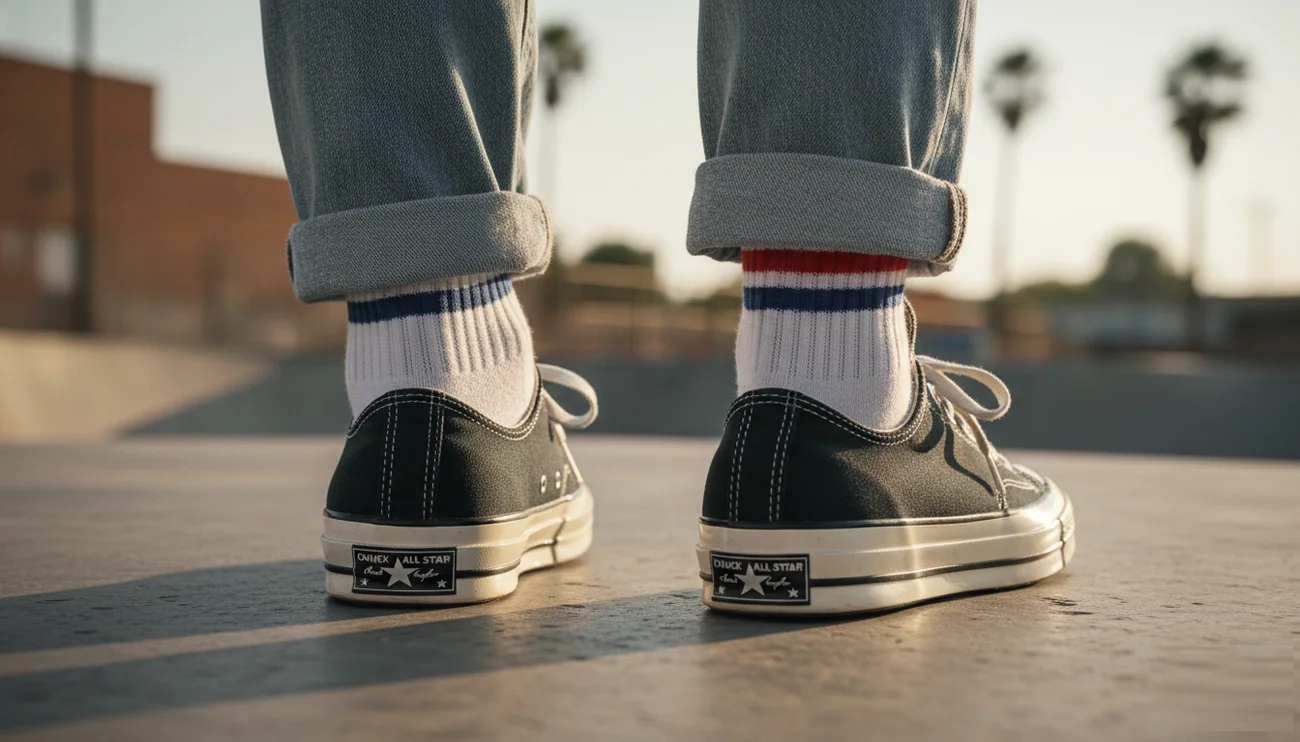
A vintage sneaker is, in general, a physical pair that was actually manufactured in an earlier era. The object itself has aged. A newly made shoe with an old design, factory-yellowed midsole, faded colors, or nostalgic packaging may have a vintage look, but that does not make the pair physically vintage.
There is no universally accepted minimum age used by every brand, store, marketplace, and collector. The most useful question is simpler: when was this specific pair manufactured? Once you know that, it becomes much easier to separate vintage from retro, OG, used, and deadstock.
That distinction matters for value, authenticity, wearability, restoration, and storage. A 30-year-old sneaker is not just a design reference; it is an aging object made from foams, rubber, adhesives, leather, textiles, and synthetic materials that can change even when the shoe has never been worn.
What Does “Vintage” Mean in Sneakers?
In sneaker culture, vintage primarily describes the age and production era of the physical pair. A sneaker made decades ago can be vintage even if it was originally a mass-market release with no famous collaboration, no limited production, and no major resale premium.
That means a sneaker does not have to be rare, expensive, culturally revolutionary, or part of a silhouette’s first release to qualify as vintage in normal collector usage. Those factors may increase interest, but they are separate from the basic idea.
Age and authenticity are also different questions. A pair can be old and authentic, old and restored, or even an old counterfeit. “Vintage” is not an automatic Legit Check result. For more terminology, see the Sneakerhead Dictionary.
The Age of the Design and the Age of the Pair Are Different
The age of a design tells you when a silhouette entered history. The age of the pair tells you when the physical sneaker in front of you was produced. Confusing those two ideas is one of the most common causes of misleading vintage listings. Think about the difference this way:
- Design age: the history of the model or silhouette.
- Pair age: the production history of that specific physical object, including its label, materials, box, and manufacturing period.
The Converse Chuck Taylor All Star makes the distinction easy to see. Converse’s official history dates the Non-Skid to 1917, the All Star name to 1919, Chuck Taylor joining the company to 1922, and his signature being added in 1934. A Chuck Taylor manufactured in 2026 is still a modern pair even though the design lineage is more than a century old.
A Chuck Taylor actually manufactured decades ago can be vintage. An old design does not give retroactive age to a newly made object.
A Vintage Look Does Not Make a New Sneaker Vintage
Brands often release new sneakers with pre-aged midsoles, washed canvas, intentionally faded colors, distressed finishes, oxidized-looking rubber, or packaging inspired by an earlier decade. Those products can have a strong vintage aesthetic while remaining completely modern in physical age.
The same principle applies to heritage-oriented models. A current shoe can celebrate an older construction, color palette, or historical period without becoming an artifact from that period. “Vintage-inspired” and “vintage” are not interchangeable descriptions.
How Old Does a Sneaker Have to Be to Be Vintage?
There is no universal sneaker rule that says a pair becomes vintage at exactly 10, 20, 25, or 30 years. In broader fashion and resale culture, roughly 20 years is often used as a practical convention, but that is not a legal or technical standard for sneakers.
Context matters. In 2026, pairs from the 1980s and 1990s are obvious vintage examples, and many early-2000s releases are increasingly described that way too. The boundary naturally moves forward with time, which is why stating the actual production year or decade is more informative than relying only on the label.
What Is the Difference Between Vintage and Retro?
Vintage describes a physically old pair. Retro usually describes a later edition, reintroduction, or re-release of a design that existed before.
A newly manufactured Air Jordan 3 Retro is retro but not vintage as a physical object. A retro produced many years ago can eventually become vintage because that later edition has itself aged.
Retro also does not mean “exact copy” or “improved version.” Materials, molds, shape, branding, colors, tooling, and construction can change between editions. See what retro sneakers are and our comparison of retro vs. vintage vs. OG sneakers.
What Is the Difference Between Vintage and OG?
Vintage and OG can describe the same pair, but they are not synonyms. OG points toward “original” or origin and can refer to the original release, an original colorway, a historical configuration, or even part of the commercial name of a modern product.
Imagine a silhouette that debuted in 1985 and received another release in 1994. A physical pair from 1985 may be both an original-release pair and vintage today. A physical pair from 1994 may also be vintage because of its age, but it is not automatically the first release from 1985.
So an old OG release can fit both descriptions, while many vintage sneakers are not OG. See what OG means in sneakers for the full terminology.
Is Vintage the Same as Used or Deadstock?
No. Used and deadstock describe condition or wear history; vintage describes the age and production period of the physical product.
- A recently produced sneaker can be heavily used without being vintage.
- A vintage sneaker can be heavily worn, lightly worn, restored, or never worn at all.
- An unworn old pair may be described in the market as vintage deadstock or vintage DS, depending on the seller and marketplace vocabulary.
Deadstock is not a time machine. A pair stored for 20 or 30 years can remain unworn while the foam, glue, rubber, coatings, leather, or synthetic materials continue to age. “Never worn” does not mean “chemically unchanged.”
How Can You Identify What Era a Sneaker Is From?
There is no single label format, country of manufacture, stitch pattern, or code that works for every brand and every decade. Identification becomes more reliable when several independent details point to the same release.
- Model, colorway, and release: identify the exact edition, not just the silhouette name.
- Style code or SKU: compare it with brand archives, catalogs, release records, and period documentation.
- Internal label: check dates, size grid, typography, formatting, and country of manufacture against examples from that era.
- Box and accessories: box labels, tissue, extra laces, hangtags, inserts, and packaging can help, although any of them may have been replaced.
- Construction and materials: compare stitching, logos, molds, outsole details, insoles, and finishing with the correct release.
- Provenance: receipts, old photographs, ownership history, and documentation can add confidence for important or rare pairs.
No single SKU, tag, or country-of-origin mark proves age or authenticity by itself. Counterfeits can copy identifiers, and genuine vintage pairs may have replacement components. High-value examples deserve comparison with period documentation and someone familiar with that exact generation.
Can You Still Wear Vintage Sneakers?
Some vintage sneakers can still be worn casually; others are better treated as collection pieces. The answer depends on the model, materials, physical age, storage history, and structural condition. A clean upper in a photograph does not reveal what is happening inside an old midsole.
Before wearing an older pair, inspect it gently. Avoid aggressively flexing components that already feel brittle. If you see crumbling, deep cracks, loose sections, severe hardening, or clear loss of structure, do not wear the pair until you understand what has failed.
Midsole
Look for cracking, deformation, softness that has turned powdery, sticky areas, or material that begins to crumble under very light pressure. Certain polyurethane foams are vulnerable to hydrolysis and other aging processes even when the shoes were rarely worn. EVA and other foams age differently and may compress, harden, or lose resilience without necessarily collapsing in the same way.
Glue and Bonded Areas
Inspect the joins between upper, midsole, and outsole for lifting, dried adhesive, previous repairs, or gaps. Adhesives can lose performance over time. A simple separation can sometimes be repaired, but “it only needs glue” is not a structural diagnosis—the materials underneath still need to be sound.
Rubber Outsole
Check for extreme hardness, cracks, loss of grip, deformation, and separation. Rubber formulations can oxidize and change with age, storage, ozone, heat, and light. An outsole can look visually complete and still be too hard or slick to trust for normal wear.
Upper, Lining, and Insole
Leather can dry and crack; synthetic coatings can peel; canvas and textiles can weaken; internal foams can deteriorate; printed graphics can transfer or flake. Mold, persistent odor, sticky surfaces, and color transfer should be treated as condition issues rather than romanticized as “patina.”
Why Can Old Sneakers Deteriorate Without Being Worn?
Materials continue reacting with moisture, oxygen, light, heat, pollutants, and their own additives while sitting on a shelf. The Canadian Conservation Institute notes that plastics and rubbers have different vulnerabilities: some are more sensitive to oxidation, others to light, additive migration, heat, or hydrolysis. Storage can slow deterioration, but it does not stop time.
Hydrolysis is a chemical reaction involving water or moisture and is especially relevant to certain polyurethane materials. It should not be used as a catch-all term for every old sneaker failure. Glue separation, rubber hardening, leather drying, oxidation, and synthetic coatings peeling can involve different mechanisms.
Recent conservation research on naturally aged polyurethane shoe soles also confirms that hydrolysis-related deterioration can develop after decades of storage. For a sneaker-focused explanation, see our guide to sneaker crumbling and hydrolysis.
Conservation and Restoration Are Not the Same Thing
In professional cultural-heritage terminology, conservation includes examination, documentation, treatment, preventive care, and strategies intended to preserve an object for the future. Restoration is a type of treatment aimed at improving integrity or appearance while respecting the object and its history.
In sneakers, restoration may include reglue work, repainting, sole swaps, replacement insoles, replacement laces, reconstructed foam, or substituted components. A repair does not automatically make a pair fake, but interventions should be disclosed because they can affect originality, wearability, collector interest, and value.
How Should You Clean and Store Vintage Sneakers?
The safest general approach is minimum intervention: identify the materials and their condition first, then choose the least aggressive method. A cleaner that works perfectly on a modern sneaker can stain old fabric, remove aged finishes, attack adhesive, or make brittle coatings fail.
- Remove loose dust gently and avoid aggressive abrasion.
- Test any cleaning method on a small, inconspicuous area first.
- Avoid soaking the pair; stop if color transfers, surfaces become sticky, or material begins lifting.
- Keep old sneakers away from intense heat, prolonged sunlight, and excessive humidity.
- Support the shape without forcing brittle materials into tension.
- For rare, fragile, or historically important pairs, consider a conservator or restoration specialist familiar with old footwear.
Good storage can reduce some deterioration risks, but it cannot freeze chemistry. Keeping sneakers in a box may protect them from dust and light, yet poor ventilation, heat, or trapped humidity can create other problems. Storage should be treated as risk management, not a promise of permanent preservation.
How to Buy Vintage Sneakers More Safely
Buying vintage usually requires more questions than buying a current release. Before paying, decide whether your goal is collecting, displaying, restoring, or wearing the pair, because the acceptable condition can be very different for each purpose.
- Identify the release: model, colorway, size, approximate year, style code, and market of origin.
- Request detailed photos: labels, box, stitching, midsole, outsole, insole, heel, and bonded areas.
- Ask about interventions: sole swaps, repainting, reglue work, replacement parts, and cleaning should be disclosed.
- Evaluate structure, not just cosmetics: a clean upper cannot compensate for a failing sole.
- Consider provenance: receipts, period photos, ownership history, and documentation can matter on rare releases.
- Compare completed sales: use the same release, size, and condition whenever possible; an active listing is not proof of market value.
- Check return and buyer-protection rules: photos cannot always reveal odor, brittleness, hidden repairs, or structural weakness.
For U.S. buyers, eBay can be useful because eligible sneakers can enter Authenticity Guarantee whether they are new or pre-owned, and the service checks the item against the listing before forwarding it to the buyer. Eligibility still depends on category, brand, price, location, and other program rules. For valuation, use comparable completed sales and our sneaker price-check guide.
Are Vintage Sneakers Always Rare or Expensive?
No. Age is not price. A sneaker can be 30 years old and still have limited demand, incomplete packaging, replacement parts, severe deterioration, or very little collector interest. A much newer sneaker can sell for far more because of demand and scarcity.
Vintage value depends on the exact model, release, size, condition, originality of components, rarity, provenance, restoration history, packaging, and the number of buyers interested at that moment. None of those variables creates guaranteed appreciation.
Why Do People Collect Vintage Sneakers?
For many collectors, the attraction is a direct connection to a period: materials and construction methods that changed, colorways that never returned, sports history, street culture, music, fashion, personal memory, or simply the research involved in identifying the pair.
A period-original object can preserve details that a later retro does not reproduce. That does not automatically make the older shoe “better.” Vintage collecting is one path among many, and there is no contradiction in appreciating original-era pairs, modern retros, collaborations, and everyday sneakers at the same time.
My Experience With a Vintage Converse Chuck Taylor
One of my most memorable experiences in sneaker culture was buying a vintage Converse Chuck Taylor. It was not a flashy release, there was no hype around it, and it was not a limited collaboration. What made the pair interesting was its history as an object.
Holding it in my hands, I noticed construction details that felt different from the current versions I knew. On that particular pair, the canvas felt more substantial, the sole clearly showed its age, and several small details reflected another manufacturing period.
Wearing it created the feeling of carrying a small piece of sneaker history. That is an observation about one pair, not a rule about every old Chuck Taylor. Converse construction, materials, factories, markets, and specifications have changed across decades, so personal experience should never replace release-specific research.
Is It Better to Buy Vintage or Retro?
There is no universal winner. The better choice depends on why you want the sneaker.
- For collecting: vintage can offer period production, historical originality, provenance, and the enjoyment of research.
- For frequent wear: a recent retro usually has far less physical age and may be more practical, although fit and construction still need to be evaluated model by model.
- For preservation: condition and originality may matter more than whether the pair can still be worn.
- For investment: neither vintage nor retro guarantees appreciation, profit, or liquidity.
If your goal is daily wear, choosing a new retro and allowing a fragile vintage pair to rest is not “less authentic” sneaker fandom. Sometimes respecting sneaker history means knowing when not to ask an old pair for one more trip around the block.
Vintage Sneaker FAQ
What Does “Vintage Sneaker” Mean?
It generally means a physical pair that was manufactured in an earlier era. The age of the object is the key idea; an old design or factory-aged finish on a new product is not enough.
How Old Does a Sneaker Have to Be to Be Vintage?
There is no universally accepted sneaker minimum. Around 20 years is often used as a practical fashion convention, but brands, sellers, and collectors may use different thresholds. The production year or decade is more informative than the label alone.
Is Every Old Sneaker Vintage?
“Old” and “vintage” overlap, but vintage usually communicates that the actual product belongs to a past period relevant to the category. Because the boundary is subjective, a specific year is better than a vague claim whenever possible.
What Is the Difference Between Vintage and Retro?
Vintage describes the physical age of the pair. Retro describes a later edition or reintroduction of an earlier model. A newly made retro is not vintage, but a retro produced decades ago can eventually become vintage.
Are Vintage and OG the Same Thing?
No. An original-release pair can be vintage, but many vintage sneakers are from later editions. OG can also describe an original colorway, original configuration, or commercial naming depending on context.
Can a Vintage Sneaker Be Deadstock?
Yes. An old pair can remain unworn. That does not prevent foam, adhesive, rubber, leather, coatings, and synthetic materials from aging.
Does Vintage Mean Authentic?
No. Old counterfeits exist, releases can be misidentified, and genuine pairs can contain replacement parts. Age, authenticity, and originality of components have to be evaluated separately.
Can You Wear Vintage Sneakers?
Sometimes. Inspect the midsole, adhesive, outsole, upper, lining, and structural condition first. Do not wear a pair showing crumbling, deep cracking, severe hardening, loose components, or other signs of structural failure.
Can Old Sneakers Crumble Even if They Were Never Worn?
Yes. Certain polyurethane materials can lose integrity through hydrolysis and other aging processes while stored. Other components may harden, separate, crack, oxidize, or peel through different mechanisms.
Are Vintage Sneakers Always Rare or Expensive?
No. Price depends on demand, model, release, size, condition, originality, provenance, rarity, restoration history, and the number of buyers. Physical age by itself does not determine value.
How Can You Tell What Year a Sneaker Is From?
Combine the style code, internal label, production dates, box, construction details, period catalogs, brand archives, and provenance. Identification systems change over time, so no single element should be treated as conclusive by itself.
What Really Defines a Vintage Sneaker
A vintage sneaker is interesting because the physical object itself has traveled through time. It may preserve period materials, construction methods, signs of wear, packaging, and historical context that a newly manufactured retro cannot possess. At the same time, vintage does not automatically mean OG, rare, expensive, authentic, complete, or safe to wear.
When in doubt, return to the useful questions: When was this pair manufactured? Which release is it? What has been replaced or restored? How are the materials aging? That is where nostalgia becomes documentation—and where collecting an old sneaker becomes understanding it.
Sources Consulted
- Converse — official brand and Chuck Taylor All Star history.
- Nike Department of Nike Archives — Air Jordan 1 original-release documentation.
- Canadian Conservation Institute — caring for plastics and rubbers.
- American Institute for Conservation — conservation terminology and practice.
- eBay — Authenticity Guarantee for eligible sneakers.