
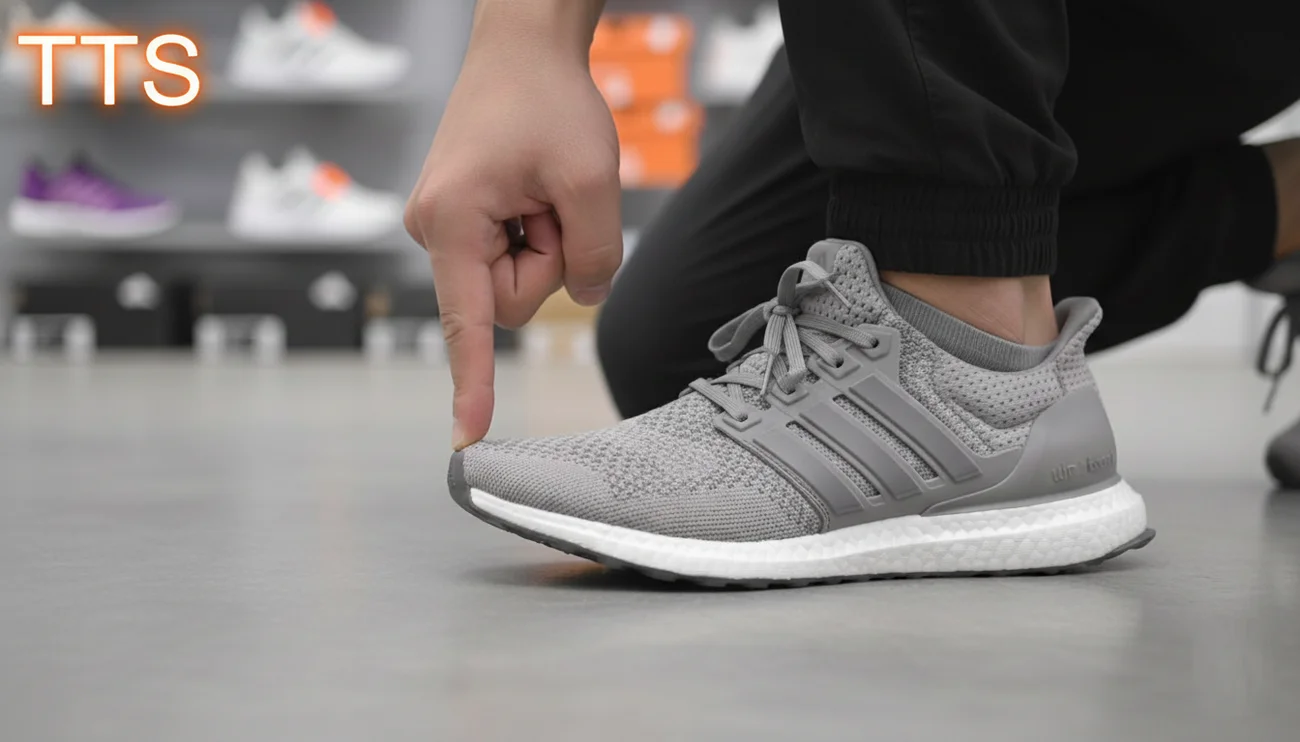
You read a sneaker review and see one recommendation: “TTS.” It sounds simple—just buy your normal size. There is only one important question: normal compared with what?
TTS means True to Size. When someone says a sneaker is TTS, they usually mean the model tends to fit as expected relative to the size that normally works for that person in the relevant brand, category, or sizing system.
TTS is useful guidance, not a promise of perfect fit. It does not know your foot width, instep height, sock thickness, orthotics, or whether you like a snug or roomy feel. The acronym is simple. Feet—and sneaker lasts—are not.
What Does TTS Mean in Sneakers?
True to Size describes a shoe that fits close to the wearer’s expected reference size. In reviews, retail pages, and sneaker communities, “go TTS” usually means “start with the size that normally works for you in this context.”
That reference might be:
- your usual Nike size;
- your usual adidas size;
- the size that normally works for you in lifestyle sneakers;
- your established size in a specific product line;
- or the size recommended by your measured foot length in the brand’s official chart.
That is why TTS is an informal fit description, not a certification or international standard. A review that says only “TTS” gives you a clue; a review that also gives the reviewer’s usual size, foot width, tested size, and fit preference gives you context.
Does TTS Mean You Should Always Buy the Same Number?
No. The meaning of TTS stays the same, but the reference size can change between brands, categories, and models. You may wear one US size in a Nike sneaker and another in an adidas model without either brand being “wrong.”
A size printed on a box is a label inside a sizing system. Your foot experiences the actual internal shape and volume of the shoe. Two sneakers can carry similar size labels and still feel very different once you put them on.
Read a TTS recommendation this way: “This model tends to work in your established reference size.” If you do not yet know that reference in a brand, measure your feet and check the official size chart instead of guessing from another sneaker.
Why Can Two Sneakers in the Same Size Fit Differently?
Fit is not only length. A sneaker can have enough room from heel to longest toe and still pinch at the sides, press on the instep, or let the heel move. Fit comes from the interaction of shape, proportions, materials, padding, and construction.
Length
Length is the heel-to-toe measurement and is usually the starting point in footwear size charts. It matters, but it cannot describe how the rest of the shoe wraps around your foot.
Width
A wide foot may feel pressure in a model that most reviewers describe as TTS. A narrow foot may feel extra space in that same pair. That does not automatically mean the review was wrong; it means the reviewer does not have your foot.
Volume and Instep Height
Two feet with similar length and width can still have different volume. A higher instep takes up more vertical space and can change pressure from the upper, tongue, and lacing system. Thick socks, replacement insoles, and orthotics also change internal volume.
Toe Box and Heel
The toe box is the area that houses your toes. A roomy toe box can make a sneaker feel large even when the length is correct; a low or narrow toe box can make the same numbered size feel small. At the back, heel shape, collar padding, and lacing affect lockdown. Heel slip can be caused by size, construction, lacing, or a combination of all three.
Last, Materials, and Construction
The last is the three-dimensional form around which footwear is built. It helps define width, volume, curvature, and forefoot shape. Nike’s current sizing guidance also emphasizes measuring the actual foot rather than relying only on the number printed on an older pair.
Structured leather, knit, mesh, suede, lining, and padding all occupy and give space differently. Some materials soften with use, but that is not a reason to buy an obviously painful size and hope the upper performs a miracle later. To identify the toe box, upper, heel, midsole, and other parts mentioned here, see our sneaker anatomy guide.
TTS, Size Up, and Size Down: What Is the Difference?
These expressions exist because the reference size does not always produce the preferred fit in every model:
- TTS / go TTS: choose your established reference size.
- Size up: choose a larger size than your reference.
- Half size up: move up one half-size step in the sizing system being discussed, such as US 9 to US 9.5.
- Size down: choose a smaller size than your reference.
- Half size down: move down one half-size step.
- Runs big: the model tends to feel larger or roomier than expected.
- Runs small: the model tends to feel shorter, tighter, or more restrictive than expected.
- Snug fit: a close, secure fit that does not necessarily mean the shoe is too small.
- Roomy fit: a more spacious feel that may be intentional.
- Wide fit: can describe a wider last or a dedicated Wide version, depending on the product.
A “half size up” recommendation only makes sense when you know which scale is being used. In the U.S., reviews most often refer to US Men’s or US Women’s sizing, but UK and EU sizes can also appear in international content.
Is Size Conversion the Same Thing as TTS?
No. Conversion and fit answer different questions:
- Conversion: which size in one system corresponds to another system?
- TTS: how does this specific model fit relative to my reference size?
A size chart can help map US Men’s, US Women’s, UK, EU, and foot-length measurements, but it cannot tell you by itself whether the toe box is narrow or the upper presses on your instep. Nike’s current U.S. size charts, for example, provide separate foot-length measurements alongside US, UK, EU, and CM/JP values.
US Men’s and US Women’s are not the same scale, and youth sizing uses its own notation. Big Kids or GS products can also use different proportions and construction from adult versions. See our guide to what GS means in Nike sizing for that distinction.
How Do You Find Your Reference Shoe Size?
Start with your foot, not with the memory of the last shoebox you owned. Nike’s current U.S. size chart tells shoppers to measure both feet on a hard, flat surface and use the longer measurement when comparing against the chart.
- Wear the type of socks you expect to use with the shoes.
- Place paper on a hard, flat surface so it cannot move.
- Stand with your weight evenly balanced.
- Mark the longest toe and the outermost point of the heel.
- Measure both feet and keep the longer measurement.
- Compare that result with the correct brand, gender, and product-category chart.
If your foot falls between sizes, follow the brand’s current guidance for that chart and then check the exact model’s Size & Fit notes. Measurement gives you a stronger starting point; model-specific guidance completes the decision.
How Can You Tell Whether a Sneaker Is Really TTS?
The most useful first source is usually the official product page’s Size & Fit section. Then add model-specific information. The more generic the advice, the less it knows about the exact shoe you plan to buy.
- Check the official product page. Look for fit guidance, size range, Wide options, and explicit sizing notes.
- Confirm the exact version. Materials, padding, tooling, and construction can change across editions of the same silhouette.
- Read contextual reviews. Give more weight to reviewers who state their normal size, foot width, tested size, and fit preference.
- Use community consensus as supporting evidence. Disagreement can reveal that the shoe reacts differently to wide, narrow, or high-volume feet.
- Check the return policy. Online sizing is never perfectly predictable, so flexible exchanges reduce the cost of being wrong.
Do not automatically transfer an adult review to GS, a lifestyle Dunk review to an SB Dunk, or one collaboration’s fit advice to every version of the silhouette. Familiar names can hide meaningfully different builds.
Is the Nike Air Force 1 True to Size?
The current Nike Air Force 1 ’07 should not be treated as a generic TTS example. Nike’s U.S. product page currently says the model fits large and recommends ordering half a size down.
That official guidance is more useful than repeating an old rule from memory. It also illustrates why “I wear a 10 in Nike” is not enough: the Air Force 1 can fit differently from other Nike silhouettes, and specialty versions can use different materials or construction.
In 2026, Nike also introduced the SB Air Force 1 with a skate-specific fit and modified construction, another reminder that the full model name matters when discussing sizing.
Is adidas Ultraboost True to Size?
It depends on the generation, and adidas provides an unusually useful official example. The company’s current Ultraboost sizing guide describes the Ultraboost 1.0 as TTS for most people while recommending half a size up for wider feet.
The same guide says the Ultraboost 5 runs true to size, and current U.S. product pages for Ultraboost 5 variants continue to recommend ordering your usual size.
That teaches more than a list of “TTS sneakers.” Even within one family, knit structure, support, and construction can change enough that the exact generation matters. Intended use matters too: a runner may prefer a different amount of space and lockdown than someone wearing the same shoe casually.
Does TTS Work for Wide, Narrow, or High-Volume Feet?
It works as a starting point, not as an automatic answer. A model considered TTS can squeeze a wide foot, feel loose on a narrow foot, or press on a high instep. Going up or down in size changes length as well as other dimensions, so it may not perfectly solve width or volume.
When dedicated Wide or Extra Wide versions exist, compare them with simply sizing up. A wider construction is designed to change shoe geometry; sizing up changes several dimensions at once. For narrow feet, do not adopt the opposite universal rule of “always size down”—heel shape, lacing, volume, and personal preference still matter.
Is TTS the Same Thing as Comfort?
No. TTS describes relative sizing; comfort involves much more. Shape, cushioning, support, flexibility, lining, seams, socks, insoles, and intended use all affect the experience.
Two people can agree that a sneaker is TTS and completely disagree about comfort. They may also choose different sizes because one prefers a snug fit while the other wants more toe room. TTS does not guarantee fewer blisters, better performance, or zero pressure points.
Some materials soften or adapt with wear, but do not rely on “they will break in” to correct a clearly wrong size. If your feet are already filing a formal complaint in the fitting room, listen to them.
Why Do Sneaker Sizing Reviews Disagree?
Because reviewers do not share the same feet, reference size, or fit preference. Before following a random “half size up” comment, check:
- the reviewer’s usual size and which brand or model they use as the reference;
- whether they describe their feet as wide, narrow, or high-volume;
- which version, generation, and size category they tested;
- whether the size quoted is US Men’s, US Women’s, UK, or EU;
- whether they prefer a snug or roomy fit;
- which socks or insoles they used;
- whether the sneaker was evaluated for lifestyle wear, running, basketball, or another activity.
Community consensus can reduce uncertainty, but it cannot guarantee your fit. Sometimes disagreement is not noise—it is useful evidence that the model is especially sensitive to foot shape.
How to Buy Sneakers Online With Less Sizing Risk
- Measure both feet and update the measurement periodically.
- Use the brand’s official size chart and the correct gender or youth category.
- Check the exact product page’s Size & Fit section.
- Separate international size conversion from fit recommendations.
- Look for reviews from people who describe their foot shape and tested size.
- Do not generalize an entire silhouette from one edition.
- Consider socks, insoles, orthotics, and intended use.
- Read the exchange and return policy before buying.
TTS can remove part of the uncertainty, but it cannot eliminate individual foot shape. When you can try the exact shoe on, that remains the most direct test.
TTS Sneaker FAQ
What Does TTS Mean in Sneakers?
TTS means True to Size. It indicates that a model tends to fit as expected in the wearer’s established reference size for that brand, category, or context.
Does TTS Mean I Should Buy My Normal Size?
It means you should start with the correct reference size for that context. It does not mean the same US, EU, or other numeric label will fit identically across every brand and model.
Are “True Size” and “True to Size” the Same Thing?
People sometimes say “true size” informally when they mean TTS, but the established footwear expression is True to Size.
Is TTS the Same Across Every Brand?
No. The acronym means the same thing, but brands use different lasts, product categories, size charts, and constructions. There is no universal TTS size that transfers perfectly everywhere.
Will a TTS Sneaker Fit Every Foot Perfectly?
No. Width, instep height, overall volume, toe shape, socks, insoles, and personal preference can change the fit even when the length is correct.
What Does “Size Up” Mean?
Size up means choosing a larger size than your reference. “Half size up” usually means moving one half-step in the sizing system being discussed, such as US 9 to 9.5.
What Does “Size Down” Mean?
Size down means choosing a smaller size than your reference. A half size down means moving one half-step smaller in that sizing system.
What Do “Runs Big” and “Runs Small” Mean?
Runs big means the shoe tends to feel larger or roomier than expected. Runs small means it tends to feel shorter, tighter, or more restrictive than expected.
Is the Nike Air Force 1 TTS?
Nike’s current U.S. Air Force 1 ’07 product guidance says the model fits large and recommends ordering half a size down, so it should not be used as a universal TTS example.
Is Ultraboost TTS?
Many Ultraboost versions are described by adidas as true to size, including Ultraboost 5. Some generations include additional guidance for wider feet, so check the exact version.
Does TTS Work for Wide Feet?
TTS can be a starting point, but a wide foot may need a dedicated Wide version or a different size depending on the model. Sizing up changes more than width, so it is not always the best solution.
Is Size Conversion the Same as TTS?
No. Conversion maps one sizing system to another. TTS describes how the shoe fits relative to your expected size. A conversion chart cannot tell you whether the toe box or upper will feel tight.
Should You Trust TTS Reviews?
Use them as evidence, not as guarantees. Reviews become much more useful when the reviewer gives the exact model, usual size, foot shape, tested size, and fit preference.
TTS Is a Starting Point, Not the End of the Conversation
The most useful way to understand TTS is also the simplest: it tells you where to begin. Measure your feet, identify the correct U.S. size scale, check the exact model’s official guidance, and then use real-world reviews to understand width, volume, and feel.
If a sneaker is TTS, that is helpful. If it runs large like the current Air Force 1 ’07 or needs generation-specific guidance like Ultraboost, that is helpful too. Good sizing advice is not about forcing every shoe into one rule—it is about giving your feet the best possible chance of meeting the right pair.