
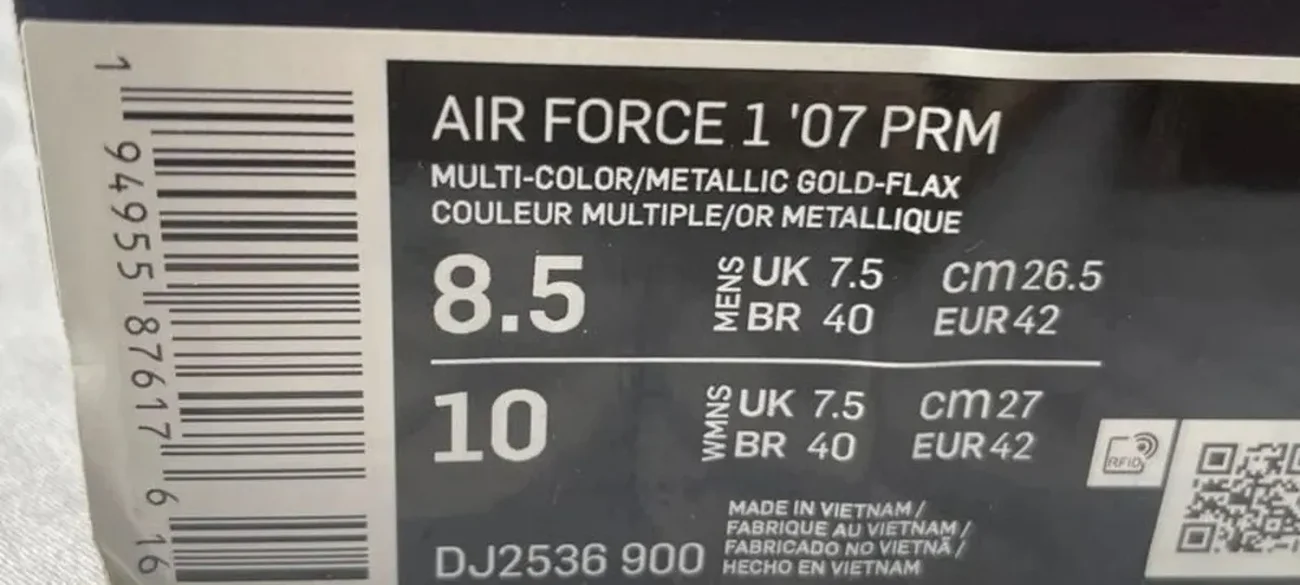
PRM is widely understood in Nike product naming as an abbreviation for “Premium.” That is the short answer to “What does Nike PRM mean?” The more important answer is that those three letters are not a complete technical specification compressed into the end of a sneaker name.
A Nike PRM release may use distinctive materials, a special color treatment, a particular theme, or other details that separate it from another version of the same model. But PRM alone does not guarantee leather, better construction, greater comfort, a higher price, rarity, limited production, or even a lifestyle-focused product.
In 2026, Nike still uses PRM on shoes built for actual competition, including models such as the Vapor 12 PRM and GP Challenge 1.5 PRM. The abbreviation therefore travels across more product categories than many sneaker shoppers expect.
The most useful rule is simple: PRM tells you something about the naming of that specific execution. To know what actually changed, you still have to inspect the specific product.
What Does PRM Mean at Nike?
PRM is associated with Premium in Nike product naming.
There is an important precision point here. Nike does not currently maintain a public universal glossary that says, in one official sentence, “PRM means Premium.” It would therefore be misleading to present that exact wording as a formal corporate definition.
The usage is still well established, and current Nike product pages support the relationship. On Nike’s U.S. site, the Nike Tennis Classic CS PRM is presented as a special execution of the classic silhouette, using pony hair over genuine leather.
That lets us answer the search intent without inventing a corporate rule: in Nike naming, PRM is widely understood as the abbreviated form of Premium.
For other suffixes and abbreviations that appear in Nike names, boxes, and sneaker listings, continue with the Sneakerhead Dictionary.
Is PRM a Nike “Premium Seal”?
It is better not to call PRM a certification or seal.
The word “seal” suggests testing, inspection, or a uniform technical standard. Nike product pages do not support that interpretation.
It is more accurate to treat PRM as a product-naming suffix or designation for a particular execution. On one release, the important difference may be materials. On another, it may be color, graphics, storytelling, or a combination of features.
PRM may point toward “Premium,” but the three letters do not award the sneaker a universal diploma of superiority.
What Changes on a Nike PRM?
The most accurate answer is: it depends on the release.
This is where broad claims such as “every PRM uses better leather” break down. Nike applies PRM to products with very different purposes and constructions.
Materials Can Change
Some PRM releases clearly emphasize unusual or distinctive material combinations. The current Nike Tennis Classic CS PRM is one of the easiest examples to verify.
For the White/Black/White version, style JA8560-100, Nike describes the upper as pony hair over genuine leather. The shoe also uses a foam midsole, rubber outsole, and full cupsole stitch.
That is a strong example of PRM being attached to a specific material execution.
But there is a huge difference between saying “this Tennis Classic CS PRM uses these materials” and saying “every PRM uses genuine leather and pony hair.” The first statement comes from the official product page; the second would be an invented rule.
Textures and Finishes Can Be Part of the Execution
Depending on the product, a PRM version may also involve texture, surface treatments, metallic details, overlays, lining changes, graphics, or other visual elements.
Those details should be described exactly as Nike documents them for that release. If Nike calls a material “premium leather,” we can say Nike describes that product that way. That does not independently prove the material is objectively superior to every non-PRM alternative.
The same caution applies to suede. Suede does not automatically become “better” because it appears on a PRM, and a shoe does not become PRM merely because it uses suede.
Colorways and Release Themes Can Matter
Some PRM executions are built around a particular colorway, tournament, event, or visual story. Current Nike tennis products make this especially clear, with PRM versions tied to special themes while remaining fully performance-oriented.
In other words, the difference should not always be reduced to “they used more expensive leather.” The entire release has to be evaluated.
Does PRM Mean Higher Quality?
Not in a universal sense.
“Premium” is part of the naming convention, but that does not establish one technical quality standard that applies to every Nike PRM.
The suffix does not tell you by itself:
- the grade of the leather;
- the strength or precision of the stitching;
- the manufacturing-defect rate;
- the expected life of the outsole;
- the abrasion resistance of the upper;
- the quality-control standard applied to every individual pair;
- how long that specific shoe will last.
Two PRM products can be very different because they were designed for completely different uses.
Does Every Nike PRM Use Premium Leather?
No.
This is one of the easiest generalizations to make because many PRM releases have become known for leather, suede, or other visually distinctive materials.
Current Nike products show why that rule does not hold.
The Nike Vapor 12 PRM, style IM3793-300, is a hard-court performance tennis shoe. Nike documents engineered mesh, a firm midfoot support structure, a traction system, and Air Zoom cushioning.
That construction makes sense for what the shoe needs to do during a tennis match. Replacing technical mesh with natural leather simply to make the product feel “more premium” could actually work against the intended performance in some sports.
Natural material is not automatically superior material. “Is this material appropriate for the intended use?” is the more useful question.
Does PRM Mean Better Construction or Finishing?
You cannot assume that from the abbreviation alone.
A PRM execution may include construction details that differ from another version, but those differences need to be shown in the product documentation or in a direct comparison.
PRM is not automatic proof of:
- more precise stitching;
- superior quality control;
- a lower chance of manufacturing defects;
- more careful hand assembly;
- structurally superior construction.
If adding PRM to the end of a product name proved all of those things, analyzing sneaker construction would be much easier than it actually is.
Is Nike PRM More Comfortable or More Durable?
Neither one is guaranteed.
Comfort depends on the last, midsole, cushioning, flexibility, upper stiffness, ventilation, weight, and the anatomy of the person wearing the shoe.
Durability depends on construction, materials, use frequency, playing or walking surface, climate, care, storage, and the purpose the shoe was designed for.
A different material can improve one characteristic while making another less suitable. A more structured upper feels different from lightweight mesh; suede and leather require different care from technical textiles. The PRM suffix does not solve that equation by itself.
If terms such as upper, midsole, outsole, and heel counter are still confusing, our sneaker anatomy guide breaks down each part before you compare constructions.
Is Nike PRM Only for Lifestyle Sneakers?
No—and that is one of the most important things to understand about PRM today.
In 2026, Nike sells multiple PRM products that are clearly intended for sport. The current U.S. tennis assortment includes models such as the Vapor 12 PRM, Vapor Pro 3 PRM, GP Challenge 1.5 PRM, and GP Challenge Pro PRM.
So PRM does not mean “Premium lifestyle edition.”
The designation can appear on a sneaker that now lives mainly in everyday style, and it can also appear on footwear built for acceleration, stopping, lateral cuts, and match play.
That is also why PRM should not be confused with Nike NSW. NSW means Nike Sportswear; PRM is a separate naming convention that can appear outside Sportswear.
Why Are There Nike Vapor and NikeCourt PRM Shoes?
Because adding PRM to a particular execution does not erase the model’s original purpose.
Look at the Nike Vapor 12 PRM. Nike continues to present it as a hard-court tennis shoe, with heel Air Zoom, herringbone traction, a supportive midfoot structure, engineered mesh, and elements designed for lateral movement.
None of that sounds like a performance shoe that suddenly became lifestyle-only because three letters were added to its name—because it did not.
The same logic applies to the Nike GP Challenge 1.5 PRM. Nike describes it as a hard-court shoe with Air Zoom cushioning and side-to-side stability.
That is a useful reminder: PRM modifies the naming of a particular execution; it does not automatically redefine the product category.
Two Real Nike PRM Examples Explain the Term Better Than a Huge Checklist
Nike Tennis Classic CS PRM: Distinctive Materials for Everyday Wear
The current Nike Tennis Classic CS PRM shows the side of “Premium” that shoppers often expect intuitively.
Nike describes the shoe as using pony hair over genuine leather and presents the court-born silhouette as reimagined for everyday wear. The White/Black/White version uses style JA8560-100.
Here, material choice and the shift from court heritage to lifestyle use are central parts of the release story.
Nike Vapor 12 PRM: Premium Without Leaving Performance
The Nike Vapor 12 PRM shows the other side of the same naming convention.
Style IM3793-300 remains a hard-court performance tennis shoe. Nike documents Air Zoom cushioning, engineered mesh, supportive structures, and traction components designed for aggressive movement.
That is direct evidence that PRM does not define lifestyle, leather, or casual use.
Both products carry PRM in the official name, yet they answer completely different needs. That is exactly why the specific product matters more than any generic PRM checklist.
Does PRM Mean Limited, Rare, or Exclusive?
No.
PRM does not automatically tell you:
- how many units were produced;
- how many retailers received the release;
- how long the product will remain available;
- whether Nike will restock it;
- which countries will receive it;
- whether it will have strong demand on the secondary market.
One PRM release may become difficult to find over time. Another may remain available, go on sale, or never attract strong collector interest.
Rarity belongs to the history of the specific release—not to the three letters.
Is Every Nike PRM a Collaboration?
No. PRM does not mean collab.
A collaboration could use PRM naming on a specific product, but the presence of PRM does not prove that another designer, artist, store, or brand participated in the project.
Likewise, PRM is not automatically a synonym for hype, exclusivity, or investment value.
Are Nike PRM Shoes More Expensive?
There is no universal pricing rule.
One PRM execution may launch at a different MSRP from another version. Another may be priced similarly. After launch, promotions, markdowns, and remaining inventory can change the comparison again.
In 2026, Nike’s own store lists PRM tennis models at different prices. The Vapor 12 PRM is currently listed at $190 in the U.S., while other PRM tennis shoes sit at different price points. That alone is enough to show why “PRM always costs more” is a poor rule.
Price is a commercial decision tied to the model, market, release, and moment. The suffix does not contain a built-in dollar value.
Are PRM and “Premium” Written Out Exactly the Same Thing?
They should not be merged automatically into one naming system.
Nike currently sells products where the word Premium is part of the model name itself.
Two important examples are the Nike Pegasus Premium and the Nike Vomero Premium.
Pegasus Premium is a current road-running shoe combining ZoomX foam, a sculpted full-length Air Zoom unit, and ReactX foam. Vomero Premium is also a current running shoe, using ZoomX and dual Air Zoom units.
In those cases, “Premium” is part of the commercial identity of the model itself. We should not casually rename them “Pegasus PRM” or “Vomero PRM,” or assume they follow exactly the same naming logic used when PRM appears as a suffix on another release.
Similar words do not authorize us to invent a product taxonomy Nike has not published.
What Is the Difference Between Nike PRM and SE?
PRM and SE appear as different naming conventions on Nike products, but they should not be arranged in a ladder where one is automatically “above” the other.
The correct comparison is release by release: what is the official name, what materials does Nike list, how is the shoe built, what is it for, what colorway is used, and what actually distinguishes the version?
There is no solid basis for saying “PRM means higher quality while SE only changes the design.” They are different designations, not school grades for sneakers. For the other term, see what Nike SE means.
What About PRM vs. QS or SP?
The same caution applies to QS, SP, and other abbreviations Nike has used across different eras.
There is no reason to create a universal ladder such as SE < PRM < QS < SP and assume that moving upward means better materials, higher quality, fewer units, or greater value.
These labels need to be understood in their own historical and commercial contexts. A single memorized hierarchy is simple—but that simplicity is exactly why it can be misleading. See our guides to Nike QS and Nike SP for those terms separately.
How Do You Identify a Nike PRM Correctly?
The strongest evidence is the official product name.
- Look for the complete product name. Current examples include “Nike Tennis Classic CS PRM” and “Nike Vapor 12 PRM.”
- Confirm the name on an official Nike page or reliable release documentation rather than classifying a shoe because it simply looks expensive.
- Use the style code to identify the exact release and separate similar colorways or versions.
- Read the product specifications. That is where materials, cushioning, intended surface, construction, and other real differences are documented.
What does not work well is trying to identify PRM only by looking at the shoe.
A sneaker can use leather, suede, unusual textures, or luxury-looking details and still have no PRM designation. Materials do not prove the naming.
Does PRM Appear on the Size Tag?
PRM can appear as part of the product name in listings, internal commercial systems, boxes, or release references. The exact presentation can vary by era and product.
What we should not claim is that every Nike PRM must have “PRM” printed in one fixed location on the internal size tag.
For identification, the combination of official name, style code, and release documentation is far more reliable than inventing a universal tag rule.
Is There a SKU Code That Means PRM?
There is no documented universal formula.
Consider two official products:
- Nike Tennis Classic CS PRM White/Black/White — style JA8560-100;
- Nike Vapor 12 PRM Camo Green/Metallic Gold/Black/Pure Platinum — style IM3793-300.
The style code is extremely useful for identifying the release you are researching. The mistake would be trying to extract PRM from one number or letter sequence as if every Nike SKU contained a secret universal PRM decoder.
Does PRM Prove a Nike Shoe Is Authentic?
No.
A counterfeit can copy the product name, PRM suffix, style code, packaging, label, and other visible details from a genuine release.
Finding “PRM” on a box, tag, or listing therefore does not authenticate the pair. Authenticity is a separate investigation.
If that is your concern, our Legit Check guide explains the difference between product identification and evaluating whether a physical pair is genuine.
Is a Nike PRM Worth Buying?
It can be—if that particular execution makes sense for you.
Instead of buying because three letters supposedly mean “the best Nike,” ask:
- What materials does this release actually use?
- Do you genuinely like this colorway or theme?
- Does the model fit the way you plan to use it?
- Do the fit and construction make sense for your feet?
- Does the current price make sense compared with the alternatives?
For someone considering the Tennis Classic CS PRM, pony hair and genuine leather may be the main attraction. For someone shopping the Vapor 12 PRM for court use, stability, traction, fit, and response matter much more.
PRM does not choose the best product for you. It identifies an execution that deserves a closer look.
Nike PRM FAQ
What Does PRM Mean at Nike?
PRM is widely understood in Nike naming as an abbreviation for Premium. Nike officially uses PRM in many product names, although there is no current public corporate glossary that defines the abbreviation in one universal sentence.
Does PRM Mean Premium?
Yes, that is the established expansion used in sneaker terminology. Current Nike product naming and product descriptions reinforce the association.
Is Nike PRM Better?
Not in an absolute sense. A PRM execution may offer details you prefer, but the suffix does not certify superiority in every aspect. Compare the specific product.
Does Every Nike PRM Use Leather?
No. Some PRMs use leather, while current performance PRM shoes can use technical uppers such as engineered mesh.
Does PRM Mean Better Materials?
Not as a universal rule. PRM can accompany a release with different or distinctive materials, but the actual composition has to be checked. “Different” also does not automatically mean “better” for every use.
Is Nike PRM More Comfortable?
Not necessarily. Comfort depends on fit, cushioning, upper stiffness, breathability, weight, intended use, and the individual wearer.
Does Nike PRM Last Longer?
The suffix does not guarantee greater durability. Construction, materials, outsole design, playing or walking surface, care, and frequency of use matter much more.
Does Nike PRM Mean Limited Edition?
No. PRM by itself does not tell you production quantity, availability window, distribution, or restock plans.
Are Nike PRM Shoes Rare?
Not because of the suffix. A specific release can become rare because of age, production, demand, or availability, but PRM does not guarantee rarity.
Does PRM Mean Collaboration?
No. A PRM can be collaborative or non-collaborative. The abbreviation alone does not prove another designer, artist, retailer, or brand participated.
Is Every PRM a Lifestyle Sneaker?
No. In 2026, Nike uses PRM on performance tennis shoes including the Vapor 12 PRM, Vapor Pro 3 PRM, and GP Challenge PRM models.
Are Nike PRM Shoes More Expensive?
There is no universal rule. Pricing depends on the model, release, market, materials, and timing. PRM products can also receive markdowns or promotions.
Are PRM and SE the Same Thing?
No. They are different naming conventions. There is also no basis for saying PRM is universally “above” SE in quality.
Does PRM Appear in the SKU?
The style code helps identify the release, but there is no documented universal sequence that lets you derive PRM from the code by formula.
Does PRM Prove the Shoe Is Authentic?
No. Product names, abbreviations, style codes, packaging, and labels can be copied. PRM is not an authentication result.
PRM Tells Part of the Story, Not the Whole Story
Understanding Nike PRM becomes much more useful once we abandon the idea that “Premium” simply means “the same sneaker, only better.”
PRM is a naming convention associated with Premium. It can appear on distinctive versions of familiar silhouettes, in material-focused executions, in themed colorways, or even on footwear that remains clearly performance-driven.
The Tennis Classic CS PRM shows a court-rooted silhouette reworked for everyday wear with a very particular material story. The Vapor 12 PRM shows the other side: a current competition shoe that still carries PRM in its official name.
That variety is far more informative than treating the suffix as a magic quality seal.
Nike can take silhouettes, technologies, and design ideas from different eras and reinterpret them in many ways. Sometimes the change is material. Sometimes it is color. Sometimes it is context. And sometimes performance remains at the center of the product.
So after learning what PRM means, the best next question is: “What changed on this specific product?”
For more Nike suffixes and sneaker terminology, continue with the Sneakerhead Dictionary. For the broader history of how sports products move through different eras of sneaker culture, explore Sneaker History & Culture.