A wheel, an announcement and a brief contest can change the rhythm of a retail visit. Shoe Carnival made that rhythm part of its identity, turning a family shoe purchase into something with the pacing of a small show. Its history follows the relationship between practical selection and participation, then asks how a recognizable store concept travels into digital channels and a company with several banners.
A concept takes shape in Evansville
The business began with David Russell’s Shoe Biz in Evansville, Indiana, in 1978. Historical accounts describe an approach combining accessible merchandise with energetic promotion. The local beginning matters because the later national identity grew from a specific retail idea: price and assortment could be presented through an atmosphere that actively invited customers to take part.
The company’s fortieth-anniversary report gives that evolution a visual timeline: Shoe Biz in 1978, The Carnival in 1987 and Shoe Carnival in 1993. Later logos show the name continuing to change its appearance. These milestones separate the business’s origin from the arrival of its familiar banner and reveal identity as something developed over time.
The company’s fortieth-anniversary timeline
The fiscal 2025 report describes upbeat music, a prize wheel and microphone-led games. These elements make participation part of the documented format, though any particular visit has its own atmosphere.
The fiscal 2023 filing describes a physical-store-first approach connected to online shopping, with national brands for athletics, daily life and special occasions. The performance surrounds a broad family assortment. Its meaning depends on that combination: the audience can be looking for quite different shoes while sharing the same promotional moment on the floor.
Taking the store’s personality online
The e-commerce launch reported in October 2011 included a virtual version of the store’s discount wheel and the ability to return online purchases to a branch. Those details are more revealing than a simple website date. The company was translating a recognizable shopping device into a screen while keeping a practical route back to the physical store.
In a September 2015 earnings call, management described Shoes2U, launched that June. Staff could use the point-of-sale system to find a style or size beyond the local assortment and complete the purchase. The initiative addressed a limit of the individual store: an appealing display still needs a way to reach the pair a customer actually requires.
These developments show two different kinds of connection. A virtual wheel carries a piece of the store’s personality; access to wider inventory helps solve an ordinary fitting or selection problem. Their value to the historical narrative is the relationship between them. Entertainment attracts attention, but the practical work of locating a usable pair remains central to the shopping experience.
A familiar banner in a changing company
On December 3, 2021, Shoe Carnival announced its first acquisition: substantially all Shoe Station assets. The transaction introduced an established regional retail identity into the company.
A second regional business followed in February 2024, when the company acquired Rogan’s Shoes, with 28 locations in Wisconsin, Minnesota and Illinois. The announcement connected its integration to Shoe Station’s growth. Expansion was now also a matter of bringing different retail traditions under one organization, rather than simply adding doors carrying the Shoe Carnival name.
The parent became Shoe Station Group on June 12, 2026. Its announcement retained Shoe Carnival in a multi-banner strategy, distinguishing corporate naming from the identity of individual stores.
September 2026 results reported 21 conversions to Shoe Station that fiscal year and no further conversions expected before year-end. Earlier expansion targets should therefore be read as superseded plans.
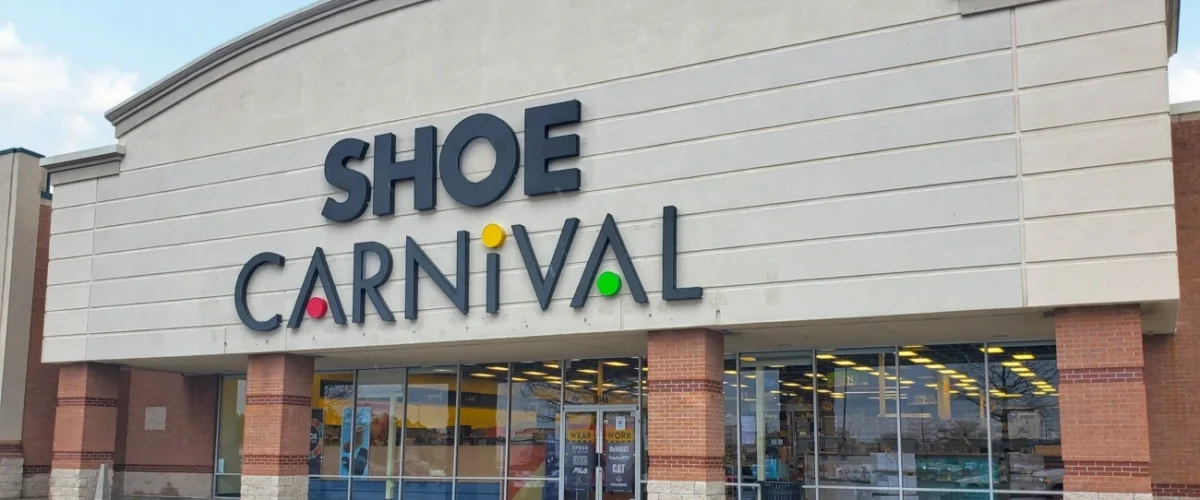
The October 13, 2026 official listing still identified Towne Centre at 805 North Green River Road in Evansville as Shoe Carnival. That current branch provides a geographic link to the chain’s beginnings without being presented as its original premises. It also demonstrates why the store banner needs to be checked separately from the parent company’s name.
The corporate name change and multi-banner strategy
The current Shoe Carnival Towne Centre listing
Shoe Carnival’s distinctive contribution to this history is the integration of shopping and a modest public performance. The customer is invited to listen, respond and join a shared moment, even while comparing ordinary footwear needs. Digital tools and corporate changes have altered the setting around that idea. Keeping the concept, the storefront and the parent company distinct makes it possible to follow both its continuity and its transformation.
Shoe Station Group: second-quarter 2026 results and conversion update
Related store histories
Explore sneaker history and culture
Frequently asked questions
Who started Shoe Carnival and what was its original name?
The business began with David Russell’s Shoe Biz in Evansville, Indiana, in 1978. Historical accounts describe an approach combining accessible merchandise with energetic promotion.
When did the Shoe Carnival name appear?
The company’s fortieth-anniversary report gives that evolution a visual timeline: Shoe Biz in 1978, The Carnival in 1987 and Shoe Carnival in 1993.
Why is Shoe Carnival known for a prize wheel and games?
The fiscal 2025 report describes upbeat music, a prize wheel and microphone-led games. These elements make participation part of the documented format, though any particular visit has its own atmosphere.
When did Shoe Carnival launch online shopping?
The e-commerce launch reported in October 2011 included a virtual version of the store’s discount wheel and the ability to return online purchases to a branch.
Did the Shoe Station Group name replace every Shoe Carnival store sign?
The parent became Shoe Station Group on June 12, 2026. Its announcement retained Shoe Carnival in a multi-banner strategy, distinguishing corporate naming from the identity of individual stores.