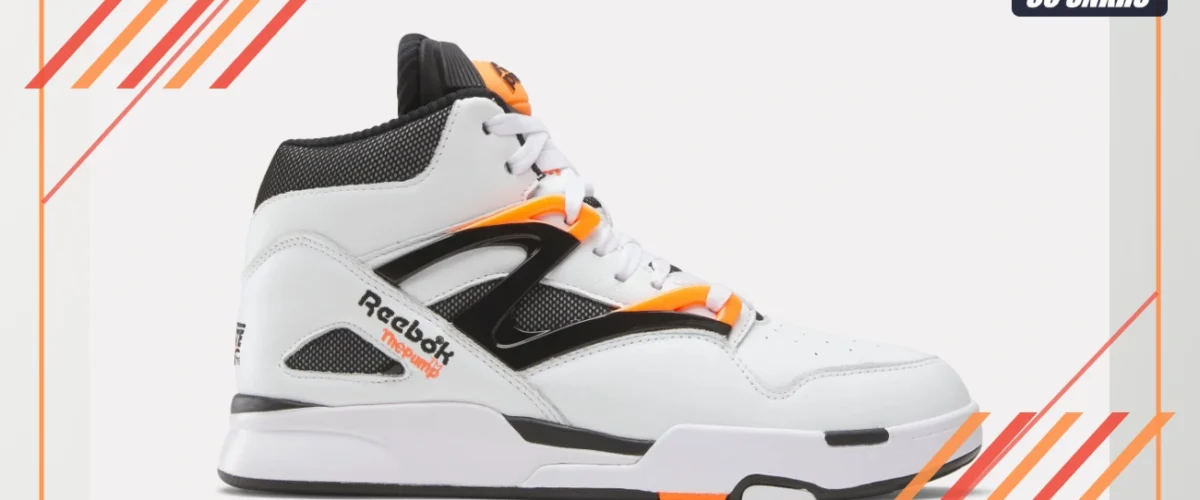
The Reebok Pump arrived in 1989 with a proposition people could demonstrate themselves: press a button to inflate chambers in the upper and change how the shoe fits around the foot. The original idea concerned fit. It was not a way to inflate the outsole and make the wearer jump higher, even though that misunderstanding became part of the technology’s popular image.
Pump also grew into a system used across multiple products. Separating the technology, the individual models, and the famous sporting moments is essential to understanding the original basketball shoe, Dee Brown’s pair, and the Instapump Fury. In sneaker history, this is a particularly clear case of user interaction becoming part of a product’s identity.
The fit problem came before the famous button
Mass-produced shoes are built around standardized lasts, while feet vary. Two people wearing the same size can have different instep and ankle volumes. Laces adjust part of the relationship between foot and upper, but they do not turn a standardized shoe into individually made footwear.
Pump sought to add another way to occupy space between the foot and the shoe. That customizable-fit brief is central to Paul Litchfield’s Counter Kicks interview, preserved by Retrobok. Basketball was the initial focus.
A design intention should not be inflated into a universal promise. An adjustable chamber does not automatically change the length of the shoe, the width of its base, or its complete geometry. The correct size and shape still matter. The system offered an additional adjustment rather than an exemption from ordinary fit considerations.
How the original Pump works
Manual pressure on the pump sends air into a flexible chamber integrated into the upper. As the chamber expands, it changes the contact around selected parts of the foot. A release valve lets air out. Reebok’s description of Pump technology locates the inflatable fit system in the upper.
That location is crucial. Changing how a shoe wraps the foot is different from managing impact beneath it. A model can combine Pump with separate midsole technologies, but those components should be identified on their own terms. Our sneaker anatomy guide explains the difference between the upper, sockliner, midsole, and outsole.
A team developed the system and its visual language
In his Sneaker Freaker interview, Litchfield describes work involving Reebok and Design Continuum. He also credits Paul Brown with the basketball-shaped button’s visual solution. The result involved engineering, development, and design rather than one person working alone.
The button mattered because it made the function discoverable. Instead of asking users to trust an invisible feature, the shoe showed them where to act. The basketball shape also linked the interaction to the initial sporting context.
That simple experience depended on less visible work. An inflatable chamber must hold air, fit within the upper, and expand in a useful place. The action a customer could understand in seconds was supported by a construction that a side-view photograph could not fully explain.
Recognizing this collaboration produces a better history than calling every participant the sole inventor. It also makes the object more interesting: its success as an interface and its feasibility as footwear were related but distinct design problems.
1989 marks the beginning, not every Pump model
Reebok Japan’s official Classic history places the initial Pump in late 1989 and records its expansion into other sporting categories. The launch of the system should therefore be separated from the later public profile of particular silhouettes.
The original basketball Pump is not automatically the Omni Zone II or the Instapump Fury. Those names identify their own designs within the wider technology story. Saying Pump may be enough in casual conversation, but it is usually insufficient for identifying an individual collectible pair.
The sneakerhead dictionary can help organize terms for models, editions, and releases. In practice, the complete product name and reference remain the best starting point. A technology label tells you something about a shoe, not everything about it.
Court Victory required a different kind of Pump
The Court Victory Pump brought the system to tennis in 1990 with Michael Chang. In Litchfield’s Forbes interview, he explains the need for a revised chamber suited to the lower cut, with extensions directing fit around the ankle. An electronic pressure-gauge prototype was dropped before the final version.
That development explains why shared technology did not mean identical construction. A basketball high-top offered one arrangement of space; the tennis brief demanded another. A tennis-ball-shaped button made the change of sport readable while retaining the familiar act of pumping.
Dee Brown made the interaction part of the show
Boston Celtics guard Dee Brown won the 1991 NBA dunk contest, with the act of pumping his Reeboks becoming part of the memorable performance. Reebok’s Omni Zone II history connects that model with the occasion. It was a chapter after the 1989 launch, not the debut of the original system.
In his Nice Kicks interview, Brown remembers improvising the pumping gesture to engage the crowd. His account is different from assuming the entire moment was scripted by Reebok.
Brown completed the image with the dunk in which he covered his eyes with his arm, remembered as the no-look dunk. Pumping the shoe gave the camera a visible action; covering his face made the finish instantly identifiable. The combination explains the strength of the memory without treating the performance as evidence of a mechanical boost in jumping.
Instapump Fury was a different design chapter
Reebok’s Instapump Fury 94 history identifies 1994 and designer Steven Smith. The shoe removes conventional laces, opens large areas of the upper, and uses a split sole connected by a GraphLite bridge. Reebok’s archive account describes that open construction, far removed from the 1989 basketball high-top. Its official lineage description also identifies the laceless design.
On the Fury, the inflatable fit structure helps organize the upper’s appearance. The visible separation between forefoot and heel reinforces the stripped-back effect. These concrete changes explain why it represents another expression of Pump rather than merely another color of the first shoe.
Shaq Victory combines two different archives
Reebok’s Shaq Victory Pump description identifies a hybrid of the Shaq Attaq upper and Court Victory Pump sole. It is a later combination, not the name of the first Pump or a direct reproduction of Chang’s shoe.
This gives the family a concrete map: The Pump marks the starting point; Omni Zone II connects with Dee Brown; Court Victory takes the system into tennis; Fury changes its visual expression; Shaq Victory combines references. Adjustable fit supplies continuity, while each design retains an identity worth naming.
Why the Pump remained memorable
The system brought together a fit function, a recognizable interface, and an action performed by the wearer. Many footwear technologies are felt underfoot or explained on a label. Pump invited direct, visible participation, making the hands part of the experience of putting on the shoe.
Its history is clearest when the layers stay separate. The 1989 launch establishes the beginning. Dee Brown supplies a defining cultural moment. The Fury demonstrates how the concept could develop into another design language. Pump does not need a myth about impossible jumping ability to matter: it made adjustable fit visible, physical, and memorable.
Sources and further reading
Retrobok: archived Counter Kicks interview with Paul Litchfield.
Reebok: Pump collection history.
Sneaker Freaker: Paul Litchfield interview, 2009.
Reebok Japan: Classic history.
Reebok Japan: Pump Omni Zone II.
Nice Kicks: Dee Brown interview, 2013.
Reebok Brazil: Instapump Fury 94.
Forbes: Paul Litchfield interview on the move to tennis.
Reebok Brazil: Shaq Victory Pump.
Reebok press release: Instapump Fury Boost, 2019.
Reebok press release: Needles Instapump Fury, 2024.
Frequently asked questions
When was the Reebok Pump first released?
The Reebok Pump arrived in 1989 with a proposition people could demonstrate themselves: press a button to inflate chambers in the upper and change how the shoe fits around the foot. The original idea concerned fit. It was not a way to inflate the outsole and make the wearer jump higher, even though that misunderstanding became part of the technology’s popular image.
How does Reebok Pump work, and does it inflate the sole?
Manual pressure on the pump sends air into a flexible chamber integrated into the upper. As the chamber expands, it changes the contact around selected parts of the foot. A release valve lets air out. Reebok’s description of Pump technology locates the inflatable fit system in the upper.
Who developed Reebok Pump?
Pump resulted from teamwork involving Reebok and Design Continuum. Paul Litchfield’s account describes that development and credits Paul Brown with the basketball-shaped button’s visual design, rather than attributing the whole system to one person.
Which Reebok Pump did Dee Brown wear in the 1991 dunk contest?
Boston Celtics guard Dee Brown won the 1991 NBA dunk contest, with the act of pumping his Reeboks becoming part of the memorable performance. Reebok’s Omni Zone II history connects that model with the occasion. It was a chapter after the 1989 launch, not the debut of the original system.
Is the Instapump Fury the original 1989 Pump?
Reebok’s Instapump Fury 94 history identifies 1994 and designer Steven Smith. The shoe removes conventional laces, opens large areas of the upper, and uses a split sole connected by a GraphLite bridge. Reebok’s archive account describes that open construction, far removed from the 1989 basketball high-top. Its official lineage description also identifies the laceless design.