The PUMA Suede story begins with the 1968 Crack and develops through different names, markets, and cultural settings. Basketball, Tommie Smith’s Olympic podium protest, and New York breaking culture all belong to that history. They do not, however, make Suede, Clyde, Basket, and States perfectly interchangeable names for one unchanging shoe.
Understanding the relationships is more useful than memorizing a simplified family tree. A historical lineage can be broader than the name printed on a particular pair. Within the wider history of sneaker culture, the Suede demonstrates how a recognizable design can carry several kinds of memory at once.
Start with the Crack, not a modern product label
PUMA’s Suede archive story identifies the Crack, launched in 1968, as the starting point. The name referred to sporting excellence. When the company now dates the Suede’s heritage to that year, it is tracing a lineage through the identity that later became most familiar.
That is different from saying every historical object should be cataloged under the exact name of a modern retail shoe. A period advertisement, museum label, or original box deserves its own terminology. The current family name helps readers navigate the story; the contemporary name helps locate the object within it.
What the 1968 podium moment actually means
Tommie Smith and John Carlos protested racial discrimination on the Olympic 200-meter podium in 1968. PUMA’s company timeline places the gesture within its sporting history. The event was a political and human statement, not simply a footwear promotion.
PUMA’s 2020 tribute to Smith specifically describes shoes beside him on the podium. That detail matters. It does not support saying that Smith won the race in a casual Suede, or that he wore the shoes throughout the raised-fist gesture. Track equipment and footwear present at a medal ceremony are different objects with different roles.
The association became part of the shoe’s cultural memory, but symbolism should not replace description. Keeping the distinction clear improves the footwear history while leaving the athletes and their statement at the center of the event.
A commemorative edition is another layer again. It reflects how a later brand and audience remember a moment; it is not the physical shoe from that moment. Historical influence does not require those objects to be identical.
Clyde belongs in the story, with a separate identity
Walt Frazier connects this family to basketball and a distinctive public image. PUMA’s 2023 celebration of the Clyde’s fiftieth anniversary establishes 1973 as the reference year for the signature shoe. That date should not be confused with the family’s 1968 origin.
The company’s accounts are not uniform about every earlier commercial step. The broad Suede archive mentions an earlier agreement, while its Frazier interview and Clyde anniversary material point to 1973. An initial relationship, a design lineage, and a product anniversary need not be collapsed into one event.
PUMA Japan’s Clyde OG history identifies two Frazier-related changes to the Crack foundation: a wider fit than earlier PUMA shoes and a new basketball-suitable sole. The Clyde therefore involved product decisions for the athlete, not just different lettering on the side.
The later Air Jordan 1 story offers a useful comparison of athlete identity and product. The Clyde does not need an unsupported claim to being the first signed shoe of all time for its place in that development to matter.
Basket is a related model, not a universal alternate name
PUMA’s 2015 annual report describes the Basket as a leather-clad sibling of the Suede. The family resemblance explains why the names are often mixed up: low profiles, court references, and the side Formstrip can make the products look closely related.
Nevertheless, the Basket has its own name and editions. A material rule alone cannot identify every release. It would be unreliable to label every low PUMA in smooth leather a Basket or every napped-leather upper a Suede without checking the actual reference.
There is also a language trap. Lowercase suede names a material. Capitalized Suede can name PUMA’s model family. A product description may mention suede without referring to the PUMA Suede at all. Separating the material from the proper name resolves many confusing searches and listings.
Why the States name matters
PUMA’s archive explains States as a name used for the shoe in Britain in the early 1990s, linked to its American cultural associations. This is a reminder that product identity can change with territory and marketing context, not only with a new construction.
Different names therefore do not automatically mean unrelated shoes. The reverse also applies: a historical connection between names does not prove that two releases from different decades share every dimension and component. Market, date, and edition remain essential evidence.
For collectors, regional naming is part of the object’s history rather than an inconvenience to erase. It can explain why a catalog and a later retrospective use different words without requiring one of them to be fraudulent or meaningless.
Breaking gave the shoe another cultural life
PUMA’s seventy-fifth-anniversary retrospective places the Suede in New York breaking circles and in the 1984 film Beat Street. That adoption adds a story beyond the athlete endorsement: users incorporated the shoe into a visual and physical culture of their own.
The design offers room for that reinterpretation. Broad panels make color contrasts visible, while the Formstrip organizes the side profile. Laces and clothing combinations can change the overall impression without removing the recognizable foundation. These observations help explain visual flexibility; they do not establish a single reason an entire community chose the shoe.
2018: fifty years, thirty-seven collaborations
PUMA’s 2018 product report records thirty-seven collaborations for the Suede’s fiftieth anniversary. Its examples include MCM, Pepsi, Barbie, Hello Kitty, and Swarovski crystal treatments. That range shows a sports-derived shoe engaging with luxury, characters, and consumer brands.
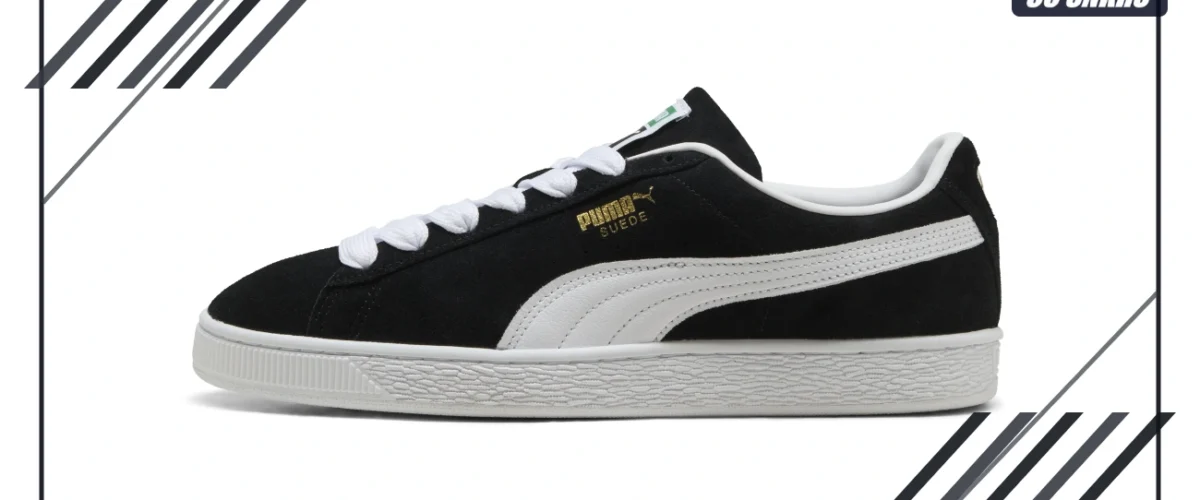
The recognizable construction supplied a foundation for intervention. The vocabulary in the sneaker anatomy guide helps locate those changes: upper surfaces, side branding, and finishing details can be reinterpreted while the model remains readable as a Suede.
2023: Fat Lace and the memory of hip-hop
For hip-hop’s fiftieth anniversary, PUMA introduced the Suede Collector’s Edition and Suede Fat Lace. The former drew on 1970s varsity jackets; the latter revisited the broad laces associated with 1980s styling.
These are more specific examples than simply labeling the Suede a street shoe. They show cultural styling returning to the catalog as product decisions. Neither the anniversary collaboration nor the Fat Lace edition replaces Crack, Clyde, or States in the history. Each adds an identifiable chapter to the family.
A connected history with useful distinctions
Crack locates the early lineage. Clyde brings Frazier’s signature identity into focus. States reveals a regional context. Basket identifies a close relative. Suede carries the family’s broad sporting and street-cultural memory. Keeping those relationships visible gives readers a more accurate picture than using one name for everything.
The lasting appeal lies in that ability to connect settings while remaining recognizable. The Suede’s story is not about a product frozen in 1968. It is about a design language that met new users and meanings over time. Getting the names right makes that history richer, rather than less compelling.
Sources and further reading
PUMA Archive: History of Suede.
PUMA Timeline.
PUMA: Tommie Smith legacy, 2020.
PUMA: Clyde’s Closet 50th anniversary, 2023.
PUMA: Daddy Cool, Walt Frazier interview.
PUMA Japan: Clyde OG 50th anniversary.
PUMA Annual Report 2015: Basket and Suede.
PUMA: 75th anniversary history.
PUMA Annual Report 2018: Product.
PUMA: Suede editions for hip-hop’s 50th anniversary, 2023.
Frequently asked questions
What year does the PUMA Suede date back to?
PUMA’s Suede archive story identifies the Crack, launched in 1968, as the starting point. The name referred to sporting excellence. When the company now dates the Suede’s heritage to that year, it is tracing a lineage through the identity that later became most familiar.
What is the PUMA Suede’s connection with Tommie Smith?
Tommie Smith and John Carlos protested racial discrimination on the Olympic 200-meter podium in 1968. PUMA’s company timeline places the gesture within its sporting history. The event was a political and human statement, not simply a footwear promotion. PUMA’s 2020 tribute to Smith specifically describes shoes beside him on the podium. That detail matters. It does not support saying that Smith won the race in a casual Suede, or that he wore the shoes throughout the raised-fist gesture. Track equipment and footwear present at a medal ceremony are different objects with different roles.
How is the PUMA Clyde related to the Suede?
Walt Frazier connects this family to basketball and a distinctive public image. PUMA’s 2023 celebration of the Clyde’s fiftieth anniversary establishes 1973 as the reference year for the signature shoe. That date should not be confused with the family’s 1968 origin. PUMA Japan’s Clyde OG history identifies two Frazier-related changes to the Crack foundation: a wider fit than earlier PUMA shoes and a new basketball-suitable sole. The Clyde therefore involved product decisions for the athlete, not just different lettering on the side.
Are PUMA Basket and Suede the same shoe?
PUMA’s 2015 annual report describes the Basket as a leather-clad sibling of the Suede. The family resemblance explains why the names are often mixed up: low profiles, court references, and the side Formstrip can make the products look closely related. Nevertheless, the Basket has its own name and editions. A material rule alone cannot identify every release. It would be unreliable to label every low PUMA in smooth leather a Basket or every napped-leather upper a Suede without checking the actual reference.
Why was the PUMA Suede called States in Britain?
PUMA’s archive explains States as a name used for the shoe in Britain in the early 1990s, linked to its American cultural associations. This is a reminder that product identity can change with territory and marketing context, not only with a new construction.