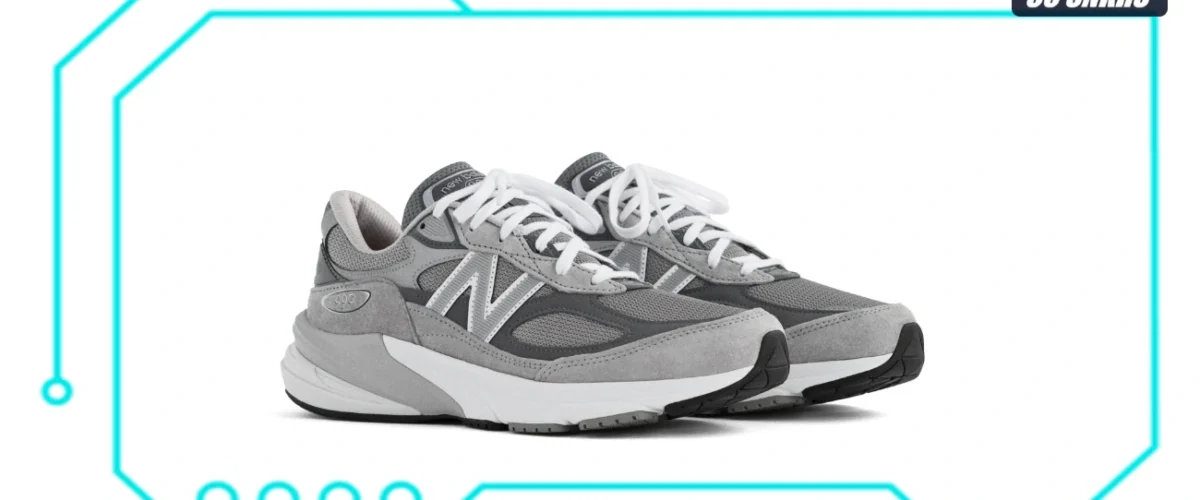
The New Balance 990 has carried the same number through decades of changing footwear design. A prominent side N, layered construction and a strong association with gray make the family recognizable. Under those familiar details, however, the shoe has changed considerably. Compare the 1982 original with the 2022 990v6 and the relationship between the upper, branding and sole becomes a story of its own.
Rather than ranking generations by looks or declaring one universally more comfortable, this guide follows the design decisions you can actually compare. Where does the N sit? How much mesh remains visible? Does the midsole quietly support the upper or become the dominant part of the profile? Keep our sneaker anatomy guide nearby if you want a reference for the individual components.
Understanding the 990 within the wider 99X family
The original 990 arrived in 1982 as a premium running shoe. New Balance’s historical archive records its $100 price, emphasis on stability and the introduction of the 990v2 in 1998. Those sixteen years did not represent a pause in the wider family. Other numbered models developed their own identities between the first two 990 generations.
A 991, 992, 993, 996 or 997 is therefore not an alternative label for a 990v1, v2 or v3. These are related designs with distinct names. A higher three-digit number is not a reliable guide to release order, either. When comparing shoes, identify the full model, generation and specific product code before drawing conclusions about their age or construction.
Our selected sequence is the 1982 v1, 1998 v2, 2012 v3, 2016 v4, 2019 v5 and 2022 v6. This is a historical comparison of six generations, rather than a claim about the newest shoe currently available in every market. Reissues also mean that several generations can appear in stores during the same period.
990v1: a comparatively clear starting point
Viewed from the side, the v1 presents relatively broad, continuous areas. Its rounded forefoot, lace-area overlays and large side N are easy to separate visually. The midsole establishes a base without competing for attention as strongly as the platform does in later versions. There is a clear hierarchy between the shoe’s main shape and its smaller details.
Textile areas and suede-like surfaces introduce contrast even when their colors remain close. Mesh gives the eye an open texture; suede produces softer edges and a less reflective surface; the N provides a firm graphic reference. This makes the v1 a useful lesson in how material changes can organize a design without a dramatic color palette.
A vintage pair from 1982 and a later v1 reissue should still be treated as different objects. A generation name preserves a recognizable design, but it does not certify that every last shape, material supplier, component and finish matches every earlier production run. Reissue photographs are useful for studying the visual language. They cannot establish all the manufacturing details of an original pair.
990v2: a more sculpted 1990s vocabulary
The v2 gives the eye a more articulated route around the shoe. Upper curves, the transition from forefoot to heel and the shaping of the sole create a deeper, more technical appearance. New Balance’s archive associates this generation with a visible expression of ABZORB cushioning. Technology becomes part of the profile’s visual explanation, as well as a component inside the shoe.
Compared with the v1, there are more places for your attention to pause. A seam, contrasting insert or change of material redirects the eye toward another section. Close tonal colors emphasize depth and texture. Strongly contrasting colors can make those same pieces appear almost like a graphic assembled from separate blocks.
This is why the v2 is useful for understanding the visual language of 1990s running footwear. It retains a legible construction of layered pieces while giving the platform more character. Calling every large or conspicuous element decoration misses the way a performance product can combine structure and visual expression in the same component.
990v3 and v4: reading the smaller changes
Comparing the 2012 v3 with the 2016 v4 takes more attention than comparing the v1 with the v6. The official v4 launch record places these generations in sequence. New Balance’s v4 product description also frames the later shoe as a refinement of the v3’s mesh-and-pigskin-suede construction.
Follow the edges of the panels
The tongue provides a concrete distinction: the v3 uses a diamond-patterned panel, while the traditional gray v4 changes that treatment to a mesh tongue with a separate badge. A visual history of the series documents the v3’s diamond treatment; the official gray v4 listing and images show its MADE in USA identification. This difference is visible without examining the sole.
Materials should also be identified by edition. The official listing for a MADE 990v3 specifies pigskin suede, nubuck and mesh, while the gray v4 specification emphasizes pigskin suede and mesh. Nubuck’s finer buffed surface creates a different transition from the more visibly fibrous suede. Underfoot, the original v4 announcement specifies ENCAP combining PU with ACTEVA LITE foam. These are concrete construction details, rather than a claim that every collaboration uses an identical material package.
Shared technology names do not establish identical feel
ENCAP appears across generations of the family, but a shared label does not make every shoe interchangeable. Geometry, materials, sockliners, width and condition also matter. Historical construction can be explained from documents; individual comfort still requires trying the specific pair. Our sneakerhead dictionary also clarifies terms such as retro, OG and colorway, which are often mixed together in listings.
990v5: familiarity with a recognizable side detail
The v5’s 2019 introduction is documented in contemporary release coverage. Visually, it continues the layered running-shoe language. A particularly helpful identifying feature is the TPU Power Strap beside the collar. Its more definite surface interrupts the softer-looking textile and suede sections, giving the rear portion another point of emphasis.
That detail illustrates how a new generation can become identifiable without replacing the whole silhouette. Someone familiar with the line notices the relationship between the collar, overlays and branding. A casual observer still sees a 990. Balancing recognition against visible change is a recurring design challenge for a product with a long-established audience.
Gray is helpful for studying these relationships because it reduces the distraction of a dramatic color story. It is not the only valid expression of the model. A collaboration may highlight a normally quiet panel and change the impression of the whole shoe while leaving the underlying generation unchanged.
990v6: changing the direction of the upper
The v6 launched in 2022, as recorded by New Balance’s announcement. Its official product description identifies two important construction changes: removal of the traditional midfoot saddle and the addition of FuelCell cushioning alongside ENCAP. These are useful explanations for the visual shift, rather than simply new names printed on familiar parts.
Without the same central saddle organizing the side, the overlays appear to travel farther along the shoe. The visual movement follows the length of the foot. Meanwhile, the midsole’s volume and curved surfaces occupy a larger share of the profile. Together, those elements can suggest forward motion even in a still photograph. That is a design interpretation, not a measured claim about speed or energy return.
The v1 makes an especially revealing comparison. Its identity rests on broad surfaces and relatively direct proportions. The v6 elongates its lines and gives the base a more expressive role. Their family resemblance survives because recognition can come from relationships between elements, rather than from retaining every individual piece unchanged.
Materials, editions and condition: compare the right objects
Suede, leather, mesh and synthetic components do not appear in the same combination on every edition. A product specification applies to its particular style code, not automatically to every collaboration using the model name. Small branding revisions should be approached with similar care. An isolated label difference is not enough to establish a new generation or prove a counterfeit.
For a useful comparison, match the viewing angle, confirm the product codes, separate external shape from internal fit and read each edition’s material specification. Also consider age. A decades-old pair with deteriorating components may no longer represent the experience its design delivered when new. Condition is part of the object you are examining.
Seen within the wider history and culture of sneakers, the 990 illustrates several scales of evolution. Sometimes the significant change is a more assertive platform. Sometimes it is the boundary of one panel. Following both helps explain how a shoe can retain a familiar identity while repeatedly reorganizing the way that identity is built.
Sources and further reading
- New Balance: The New Balance Story
- OPUMO: Icons, the New Balance 990
- New Balance: MADE 990v3
- New Balance: Gray 990v4 U990GR4
- GQ: How and Why New Balance Updated the 990v5
- New Balance: Made in USA 990v4
- New Balance: Made in USA 990v6
- New Balance Japan: Made in USA 990v6 launch, 2022
- New Balance Japan: 990v4 launch, April 2016
- House of Heat: New Balance 990v5, 2019
Frequently asked questions
When did the New Balance 990 launch, and what did it originally cost?
The original 990 arrived in 1982 as a premium running shoe. New Balance’s historical archive records its $100 price, emphasis on stability and the introduction of the 990v2 in 1998. Those sixteen years did not represent a pause in the wider family. Other numbered models developed their own identities between the first two 990 generations.
What are the release years of the 990v1 through 990v6?
Our selected sequence is the 1982 v1, 1998 v2, 2012 v3, 2016 v4, 2019 v5 and 2022 v6. This is a historical comparison of six generations, rather than a claim about the newest shoe currently available in every market. Reissues also mean that several generations can appear in stores during the same period.
Are the New Balance 991, 992 and 993 versions of the 990?
A 991, 992, 993, 996 or 997 is therefore not an alternative label for a 990v1, v2 or v3. These are related designs with distinct names. A higher three-digit number is not a reliable guide to release order, either. When comparing shoes, identify the full model, generation and specific product code before drawing conclusions about their age or construction.
How can you visually distinguish the 990v3 from the 990v4?
The tongue provides a concrete distinction: the v3 uses a diamond-patterned panel, while the traditional gray v4 changes that treatment to a mesh tongue with a separate badge. A visual history of the series documents the v3’s diamond treatment; the official gray v4 listing and images show its MADE in USA identification. This difference is visible without examining the sole.
What changed in the New Balance 990v6?
The v6 launched in 2022, as recorded by New Balance’s announcement. Its official product description identifies two important construction changes: removal of the traditional midfoot saddle and the addition of FuelCell cushioning alongside ENCAP. These are useful explanations for the visual shift, rather than simply new names printed on familiar parts.