A Converse store faces an unusual challenge: finding a fresh way to present a shoe that many people feel they already know. Some of its most expressive retail projects answered through participation. Rather than relying only on a familiar silhouette, the experience invited visitors to choose colors, alter details and establish a relationship with the object of their own.
Two addresses help trace that retail story: New York’s SoHo at the beginning of the 2010s and Boston’s Lovejoy Wharf from 2015. Neither represents the entire store network. Together, however, they show how Converse turned customization and cultural creation into reasons to enter a branded shop.
SoHo made customization part of service
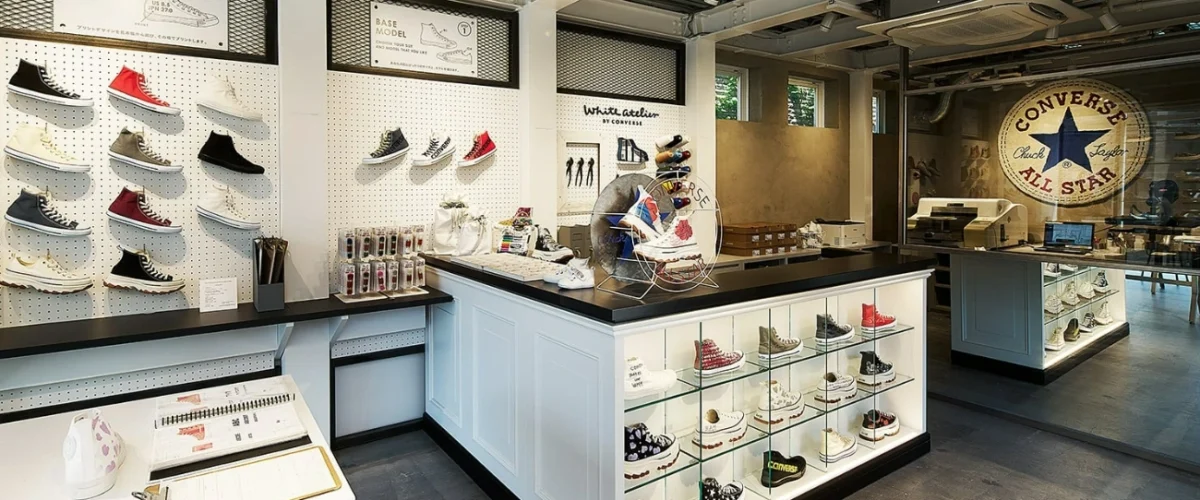
The store at 560 Broadway opened on November 26, 2010, a few weeks after a specialty location on Boston’s Newbury Street. The SoHo announcement emphasized printing graphics on products and one-to-one assistance from staff described as Customization Maestros.
The title helps explain the intended experience. Placing a machine in a corner was only one part of the proposition. Someone needed to discuss an idea and help translate a visual choice into a result. The store incorporated a creative stage into service, giving visitors a role beyond selecting a size and model.
That approach suits a product with a recognizable appearance. When the base is familiar, a small change becomes legible. A detail can matter precisely because the rest remains identifiable as Converse. Customization operates within that relationship between a shared symbol and an individual decision.
Lovejoy Wharf brought the store close to the brand’s home
Converse opened its Lovejoy Wharf headquarters in May 2015, with the flagship opening to the public on May 15. The development was introduced with public waterfront access and a Rubber Tracks studio project. The shop became connected to the company’s Boston presence rather than standing as a retail address far from its working base.
That proximity creates a particular reading. The flagship is a part of the brand’s home that people can enter as customers. It does not amount to unrestricted access to offices or archives. Even so, the address gives retail a physical relationship with the place where the company works and creates.
In its published July 2015 visit, Sneaker Freaker described the retained exterior and furniture using wood reclaimed from the old wharf. Those details brought the building’s past into conversation with its new use. History appeared in the material of the setting, as well as through graphics or displayed objects.
The combination also gave the store a reason to belong at that address. A headquarters shop could easily become a generic presentation of corporate identity. Traces of the waterfront offered another frame, connecting the commercial space to the place surrounding it.
A local collaboration found a specific address
Later in 2015, the Boston relationship took a concrete form through Converse’s collaboration with Bandulu. Boston Magazine described a Chuck Taylor All Star ’70 featuring embroidery resembling paint splashes, announced for exclusive sale at Lovejoy Wharf from November 20.
The episode illustrates one useful role for a flagship: giving a collaboration a location. The meeting between two brands was accompanied by a place connected to the scene behind it, bringing authorship, product and retail together.
The kind of intervention matters as well. A paint-like effect produced through embroidery asks viewers to look again at the surface. The footwear is no longer read only through its silhouette. A material detail communicates something about the people who helped create it and the visual language they selected.
Making a choice together
Lovejoy Wharf’s current page continues to list in-store customization at 1 Lovejoy Wharf, alongside footwear, clothing and collaborations. That is the relevant present-day confirmation. Processes, turnaround times and options described in older launches should not be assumed to remain identical.
The service suggests continuity in a retail idea: a conversation can lead to a visual decision. For the customer, that creates space to discuss a reference, understand a possibility and recognize a limitation before choosing. The experience can matter even when the finished change is understated.
These stores offer a particular perspective on sneaker culture. The center of attention does not have to be the contest for the rarest pair. It can be the passage from a widely recognized object to something a person has chosen to wear in a particular way. Between SoHo, Lovejoy Wharf and a local collaboration such as Bandulu, Converse made retail a place where that passage could take shape.
Converse: the 2010 SoHo store announcement
SGB: the Lovejoy Wharf opening
Boston Magazine: Converse and Bandulu
Converse Lovejoy Wharf: official page
Related store histories
Explore sneaker history and culture
Frequently asked questions
When did the Converse SoHo store open?
The store at 560 Broadway opened on November 26, 2010, a few weeks after a specialty location on Boston’s Newbury Street. The SoHo announcement emphasized printing graphics on products and one-to-one assistance from staff described as Customization Maestros.
When did the Converse Lovejoy Wharf flagship open?
Converse opened its Lovejoy Wharf headquarters in May 2015, with the flagship opening to the public on May 15. The development was introduced with public waterfront access and a Rubber Tracks studio project.
How did the Lovejoy Wharf interior preserve the waterfront’s history?
In its published July 2015 visit, Sneaker Freaker described the retained exterior and furniture using wood reclaimed from the old wharf. Those details brought the building’s past into conversation with its new use.
What was the Converse x Bandulu collaboration sold at Lovejoy Wharf?
In 2015, Converse and Bandulu created a Chuck Taylor All Star ’70 with embroidery resembling paint splashes. It was announced for exclusive sale at Lovejoy Wharf from November 20.
Does Converse Lovejoy Wharf list in-store customization?
Lovejoy Wharf’s current page continues to list in-store customization at 1 Lovejoy Wharf, alongside footwear, clothing and collaborations. That is the relevant present-day confirmation. Processes, turnaround times and options described in older launches should not be assumed to remain identical.