PUMA’s retail history becomes more interesting when the focus shifts to what its stores invite people to do. Trying on a shoe is the starting point. Customizing something, playing a game or taking part in a sporting activity expands the relationship with the product. Across the brand’s projects, the store repeatedly appears as a place for action, combining sport with entertainment.
That story did not begin with the Fifth Avenue flagship in 2019. An October 2006 company announcement already introduced a new Union Square store and referred to locations in Meatpacking and SoHo. It credited Paolo Lucchetta of RetailDesign with the New York project.
Union Square: sport meets everyday style
The vocabulary of the 2006 announcement was sportlifestyle. Its named collections brought together references including Pelé, Evisu and Clyde, placing different worlds within one assortment. The store presented PUMA as a brand capable of moving between sporting activity and urban life.
The juxtaposition tells us more than a list of products considered separately. A store lets those references be seen as parts of the same conversation. Someone can arrive through an interest in sport and encounter a different expression of clothing or footwear nearby. The setting allows the eye to move without requiring a change of brand.
That archival material also calls for care with the word flagship. PUMA has used it at different times and in different contexts. The large project announced in 2019 should therefore be understood as a milestone in format and scale, rather than evidence that the company had no significant American retail presence beforehand.
Fifth Avenue invited customers to participate
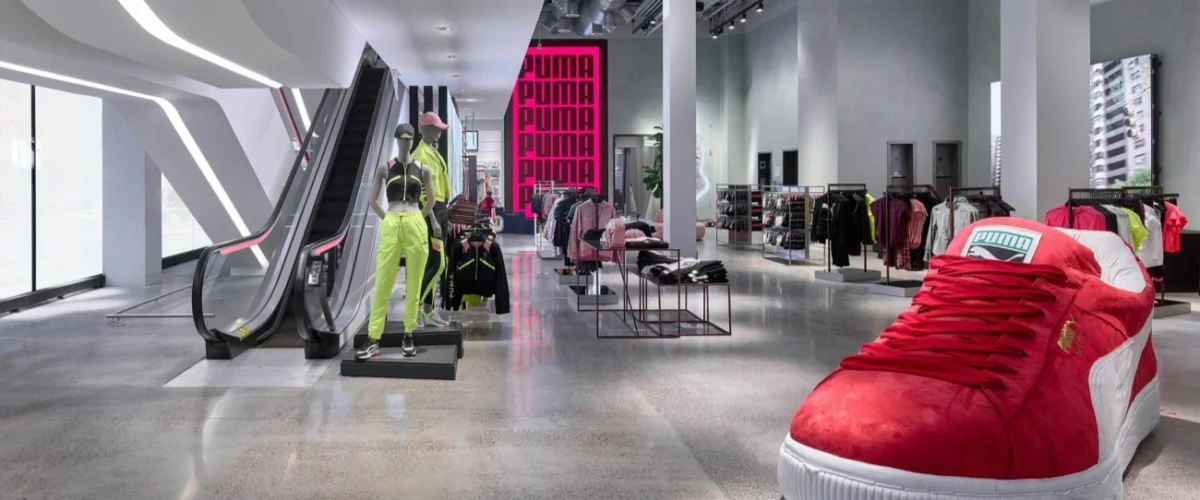
The store at 609 Fifth Avenue opened on August 29, 2019. Its announcement described two floors, interactive zones and the PUMA x YOU studio. Launch activities included customization with artists and a program developed with Chinatown Market.
Participation took a specific form. A garment or a pair of shoes could become the starting point for a visual decision, instead of only a finished object selected from a shelf. A workshop created a reason to spend time in the store and watch other people work.
That approach connects with a familiar part of sneaker culture: interest in how something is worn and altered. A product does not need to become a rare edition to feel personal. Color, an application or a finishing detail can record a small decision that matters to the wearer.
The workshop also changes where attention goes. Instead of concentrating exclusively on the finished display, visitors can observe the process of changing an object. In a retail setting, making becomes something to discuss, not merely something that happened elsewhere before delivery.
Las Vegas brought motorsport forward
In November 2024, PUMA introduced its flagship at BLVD Las Vegas. The three-story project included a Formula 1 simulator, an arcade and customization. The motorsport connection became an experience visitors could activate, alongside the references visible in products and imagery.
The choice matched the language of Las Vegas. In an entertainment environment, retail competes for time as well as attention. A simulator creates anticipation, an attempt and a result. Other people can watch the performance and decide to take part. A sporting reference becomes a shared activity within the shop.
The project also helps explain PUMA’s breadth. Motorsport, basketball and lifestyle can attract different interests. A flagship arranges them so they can be understood as parts of one brand. The challenge is to keep products readable within the experience, allowing entertainment to add context rather than overwhelm the visit.
History and operating status need separate attention
At the October 2026 check, PUMA’s official New York page described the Fifth Avenue location as temporarily closed. That does not establish permanent closure or a reopening date. Las Vegas remains in the official locator, identifying the flagship at BLVD.
The distinction between a historical record and current operation matters. Photographs from 2019 still document a stage in PUMA’s retail development, but do not prove that the store is receiving visitors today. Similarly, activities described in an opening announcement need confirmation before being promised as present-day services.
From Union Square to Las Vegas, the thread is the use of retail to connect worlds: sport and fashion, product and intervention, competition and play. PUMA developed a retail language through those meetings. Its stores make more sense when we follow the activities proposed at each moment, rather than looking only at the size of the windows.
PUMA: the 2019 New York flagship
PUMA: the Las Vegas opening
PUMA NYC: current status
Related store histories
Explore sneaker history and culture
Frequently asked questions
Did PUMA have New York stores before its 2019 flagship?
That story did not begin with the Fifth Avenue flagship in 2019. An October 2006 company announcement already introduced a new Union Square store and referred to locations in Meatpacking and SoHo. It credited Paolo Lucchetta of RetailDesign with the New York project.
When did PUMA’s Fifth Avenue flagship open?
The store at 609 Fifth Avenue opened on August 29, 2019.
What was the PUMA x YOU studio at the New York opening?
At the August 2019 New York opening, PUMA x YOU was the customization studio. Launch activities included work with artists and a program developed with Chinatown Market.
What did PUMA’s Las Vegas flagship include at launch?
In November 2024, PUMA introduced its flagship at BLVD Las Vegas. The three-story project included a Formula 1 simulator, an arcade and customization. The motorsport connection became an experience visitors could activate, alongside the references visible in products and imagery.
What was the status of PUMA Fifth Avenue in October 2026?
At the October 2026 check, PUMA’s official New York page described the Fifth Avenue location as temporarily closed. That does not establish permanent closure or a reopening date. Las Vegas remains in the official locator, identifying the flagship at BLVD.