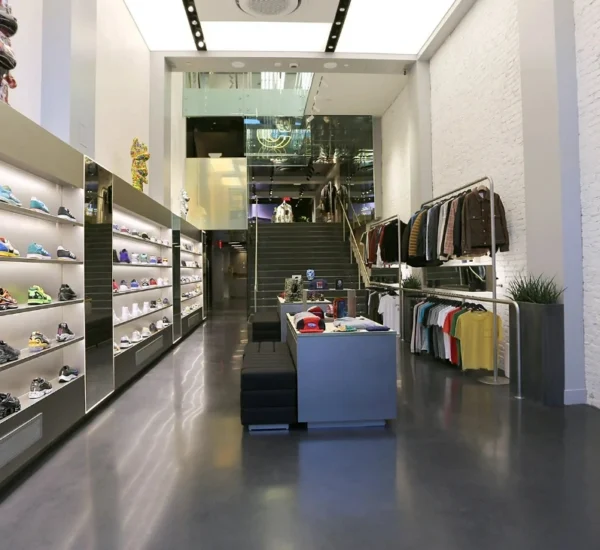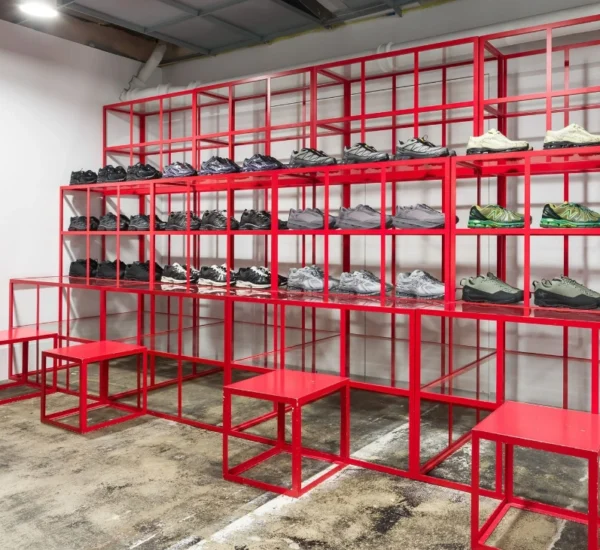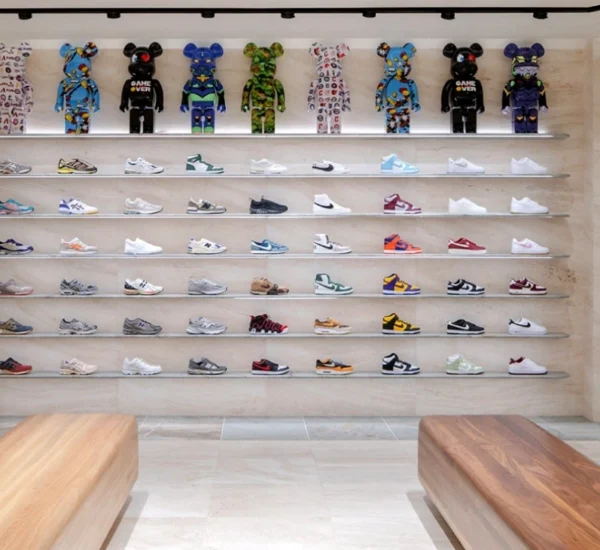
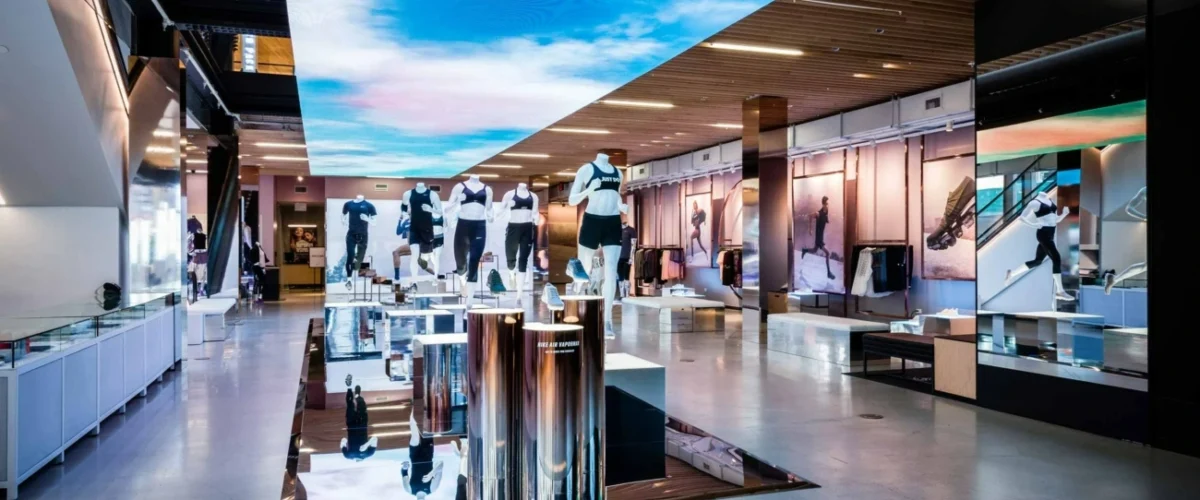
A sneaker wall arranges products. A major Nike store tries to arrange the way people see them. That difference makes New York’s House of Innovation 000 an interesting chapter in sneaker culture: the building participates in the story rather than simply providing a setting for a transaction. Its scale gets attention, but the question behind the project is familiar. What is still worth doing in person when almost everything can be selected on a screen?
The address helps frame the answer. At 650 Fifth Avenue, Nike occupies an avenue where storefronts compete with the city itself. The audience might include someone following releases, someone looking for running shoes and someone who recognizes the Swoosh without knowing a single model name. A flagship has to accommodate those different readings while maintaining a recognizable identity.
The store as an interface
House of Innovation 000 opened on November 15, 2018, across six levels. Its launch concept brought together a sneaker laboratory, customization and app-connected services. Those are documented features of the opening project, rather than a promise that every installation remains unchanged today.
That ambition has earlier roots. Nike unveiled Niketown Portland in November 1990. Contemporary UPI reporting described a combination of technology-assisted selling and sports memorabilia. Long before the smartphone entered the story, the company was turning sport into an environment and bringing exhibition closer to commerce.
Niketown provides a useful measure of the change in scale. Footwear could be presented alongside athletes and objects that gave sport a physical presence. Buying was surrounded by references the audience already recognized from competition and advertising. The store became a bridge between performances seen from a distance and products that visitors could examine for themselves.
A laboratory at flagship scale
Several months earlier, in July 2018, Nike introduced its Nike Live concept through Nike by Melrose in Los Angeles. The company said that member activity across its digital services informed the location and product assortment. This earlier project helps explain why the New York flagship brought spectacle and convenience into the same conversation.
The approach raises a useful question: what makes a store local? An assortment suited to the neighborhood is one answer. Relationships with people who return are another. Data can identify patterns, while people interpret individual situations. For a global company, a store is where that tension becomes tangible. The campaign may travel worldwide; the conversation about fit happens between two people looking at the same shoe.
Portland’s story continued at a different address. According to Nike, its Kress Building location opened in 2011; following renovations begun in 2023, it reopened in November 2025. The updated project emphasized running and local sport. It provides a concrete reminder that the company’s retail history also involves reworking existing stores, rather than only introducing new concept names.
Customization and the desire for something personal
Customization adds another layer. Its appeal does not have to rest on commercial exclusivity. A small choice can matter simply because it means something to the wearer. In this setting, authorship means participating in the appearance of the finished object. The customer does more than choose between existing options; a decision becomes something they can wear.
That gesture fits sneaker culture, where the way a shoe is worn can be as expressive as its origins. A flagship can provide tools for participation, but the meaning belongs to the person using them. A customized pair does not need to become a collectible for the experience to have value.
There is also a useful distinction between attention and attachment. A dramatic display can make someone stop. A satisfying interaction can make the object feel relevant long after the display changes. The strongest reading of this retail concept is that both deserve space, even when they operate at very different scales.
What the address represents now
Nike continues to list House of Innovation 000 in its official directory. That supports the store’s current presence; services, opening hours and availability should be checked separately. Flagship status does not guarantee access to every release or size.
Its significance becomes clearer when the focus moves beyond the number of boxes. The store shows how a sports company translates digital convenience, human service and personal expression into physical space. Its contribution is the attempt to give one address several purposes. Buying is one of them. Understanding a product, testing a choice and developing a more personal connection with a pair belong in the story too.
UPI: Niketown Portland opens
Nike: the renewed Portland store
Nike NYC: store information
Related store histories
Explore sneaker history and culture
Frequently asked questions
When did Nike House of Innovation 000 open?
House of Innovation 000 opened on November 15, 2018, across six levels. Its launch concept brought together a sneaker laboratory, customization and app-connected services. Those are documented features of the opening project, rather than a promise that every installation remains unchanged today.
Where is Nike House of Innovation 000?
Nike House of Innovation 000 is at 650 Fifth Avenue in New York City.
When did Niketown Portland open?
Nike unveiled Niketown Portland in November 1990. Contemporary UPI reporting described a combination of technology-assisted selling and sports memorabilia.
What was the first Nike Live store?
Nike introduced Nike Live through Nike by Melrose in Los Angeles in July 2018. The company said activity across its digital membership services informed the location and product assortment.
When did Nike’s renovated Portland store reopen?
Portland’s story continued at a different address. According to Nike, its Kress Building location opened in 2011; following renovations begun in 2023, it reopened in November 2025. The updated project emphasized running and local sport.