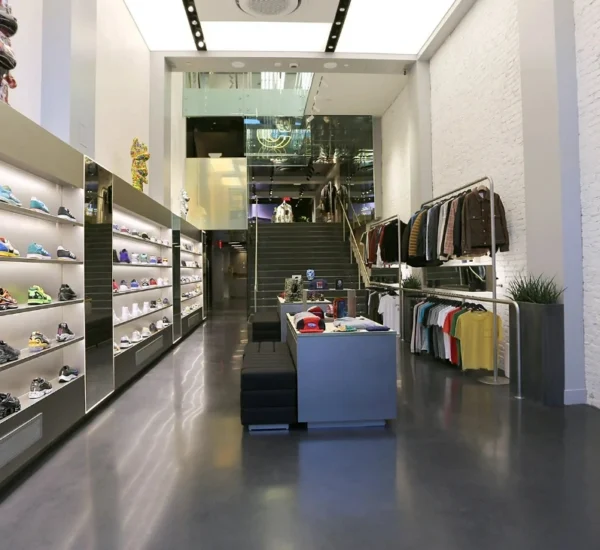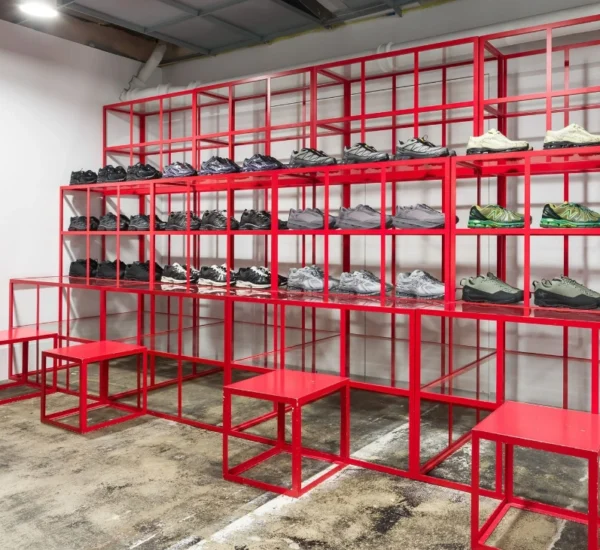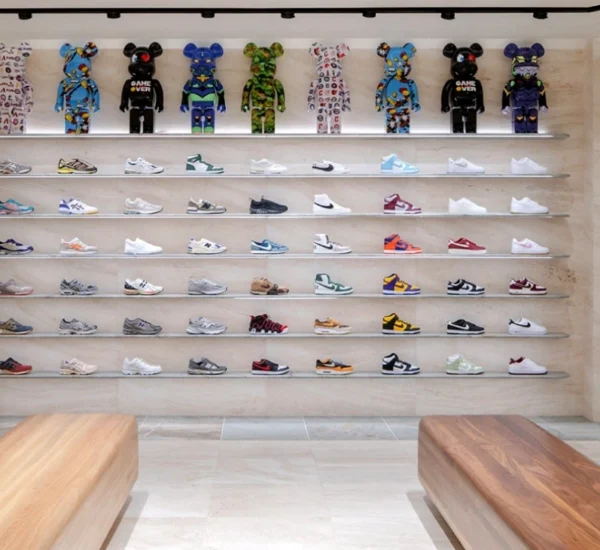
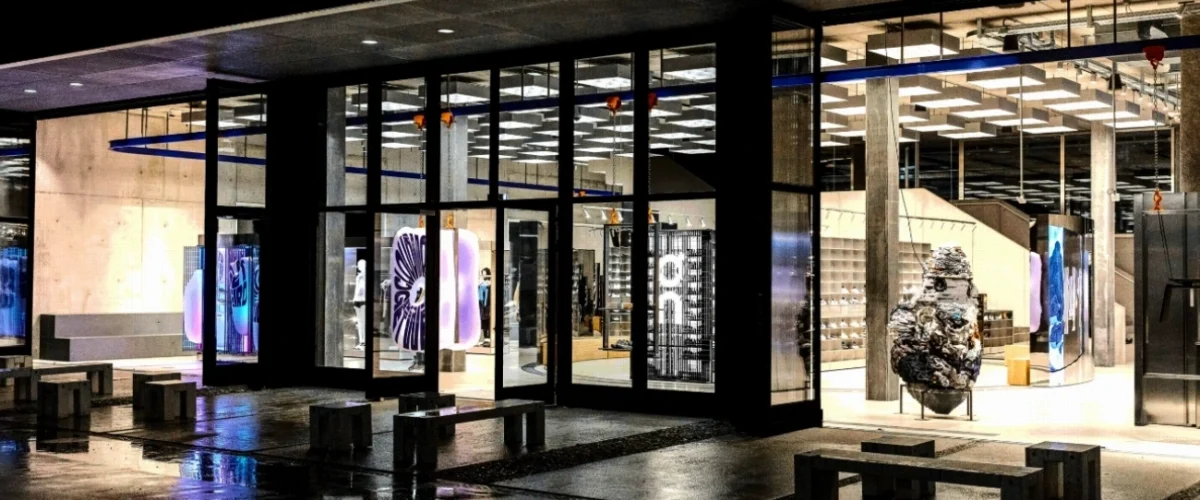
Waiting while someone fetches another size is such an ordinary part of buying shoes that it can disappear from discussions about design. At On’s first global flagship, that interval became a central concern. The project addressed a practical question: how could shoes stay close to the person trying them without making the entire sales floor feel like a stockroom? The answer was a wall that divided the interior while connecting customers with available pairs.
That concern is a useful starting point for the Swiss brand’s retail history. On’s stores translate a technical identity into familiar situations: trying, comparing, talking and getting outside. Their design choices range from a footwear archive to a reproduction of an Alpine boulder placed inside a Manhattan shop. Each attempts to give an abstract brand identity a physical form.
New York, December 2020
On opened its first global flagship on December 16, 2020, on Lafayette Street in NoHo. Its announcement introduced the Magic Wall, a structure approximately 62 feet long, with running analysis and scanning on one side and access to shoe models and sizes on the other. A boulder reproduced from a scan in Switzerland’s Engadin valley brought an Alpine reference into the interior.
The rock supplied a specific geographical connection. Rather than representing Switzerland only through a mountain photograph, the project introduced an object with volume and texture. It also provided a contrast with the wall: an irregular form associated with landscape beside a system built to organize choices.
A Retail TouchPoints interview explained that internal teams developed the concept with architect Andreas Bozarth Fornell before the pandemic. The wall was intended to reduce time spent waiting for boxes and leave more room for conversation with staff. Virtual appointments and a Manhattan delivery option for trying products were added during the public-health crisis.
Technology with an everyday assignment
The Magic Wall is interesting because it connected a visually striking installation with a small, recurring inconvenience. If the next size is accessible, a comparison can continue without another interruption. The design treated stock as part of the experience rather than something entirely concealed behind a door.
That does not make the person providing assistance less important. Some questions require discussion: what felt uncomfortable in the first pair, how a foot moves while walking and what the customer wants the shoe to do. A measurement can contribute information without accounting for the whole experience of wearing footwear.
Chronology matters here. Scanning, analysis and remote appointments were features presented around the 2020 opening. A launch records what a brand introduced at a particular moment. It does not establish that identical equipment, delivery times or services remain available years later. The historical significance of the experiment does not depend on treating every original feature as permanent.
Making room for the city
In October 2024, On announced new flagships in New York and Chicago. Flatiron occupied a historic 1930s property, retaining columns and moldings. The Rush Street project in Chicago incorporated references to the city’s bridges. The announcement also described running gatherings and local activities as part of the stores’ intended role.
These examples show how a brand’s design vocabulary can work with different buildings. Preserving existing elements at Flatiron lets the interior retain a history that predates the arrival of the shoes. Referencing bridges in Chicago establishes another connection, this time to infrastructure that shapes movement across a city.
This development need not be understood as a rejection of the original store. The task of trying footwear remains, but every address adds its own conditions: a facade, an entrance sequence, a neighborhood and people who already use those streets. Architecture can acknowledge those conditions without reproducing the same scene in every location.
The difference matters for a retail network. Recognition helps a visitor understand where they are, while local details give them a reason to notice the particular store in front of them. On’s projects provide concrete examples of that negotiation, from an imported Alpine reference to retained architectural features and a city’s bridge structures.
From the sales floor to the street
Running programs give an address another purpose. Gathering before a run creates time for conversations that do not fit neatly into choosing a size. For someone getting started, knowing where to meet can matter as much as understanding a product feature. For a regular runner, the store can become part of a shared routine.
The current Flatiron page identifies the store at 162 Fifth Avenue and describes events and movement sessions. It is a separate location from Lafayette. Anyone planning to attend a particular activity should consult the store’s own schedule rather than assume that an opening announcement supplies a permanent calendar.
On’s retail story becomes clearer when viewed across these different scales. The original wall addressed boxes, sizes and the distance between a customer and another pair. Later projects engaged with buildings and urban references. Between those dimensions sits the everyday experience of someone trying on shoes and imagining how they will fit into the route back outside.
Designing the Magic Wall
On: expansion in New York and Chicago
On NYC Flatiron: store information
Related store histories
Explore sneaker history and culture
Frequently asked questions
When and where did On open its first global flagship?
On opened its first global flagship on December 16, 2020, on Lafayette Street in NoHo, New York City.
Who helped develop On’s Magic Wall store concept?
A Retail TouchPoints interview explained that internal teams developed the concept with architect Andreas Bozarth Fornell before the pandemic. The wall was intended to reduce time spent waiting for boxes and leave more room for conversation with staff.
Where did the boulder in On’s NoHo flagship come from?
The NoHo flagship’s boulder was reproduced from a scan of a rock in Switzerland’s Engadin valley. It brought an Alpine reference into the Manhattan store.
What distinguished On’s 2024 Flatiron and Chicago flagships?
In October 2024, On announced new flagships in New York and Chicago. Flatiron occupied a historic 1930s property, retaining columns and moldings. The Rush Street project in Chicago incorporated references to the city’s bridges. The announcement also described running gatherings and local activities as part of the stores’ intended role.
Is On Flatiron the same store as the Lafayette Street flagship?
The current Flatiron page identifies the store at 162 Fifth Avenue and describes events and movement sessions. It is a separate location from Lafayette. Anyone planning to attend a particular activity should consult the store’s own schedule rather than assume that an opening announcement supplies a permanent calendar.