Before occupying a Fifth Avenue flagship, HOKA tested a simpler question: how could it present the whole brand inside a space of its own? Its footwear already reached customers through other retailers. A dedicated shop could bring shoes, apparel, service and activities together in an experience organized by the company itself.
The progression from American pop-ups in 2021 to the New York project in 2024 makes that story particularly clear. Physical expansion involved more than a change in size. HOKA began allocating space to explain products and receive people who might return for reasons beyond purchasing another pair.
2021: two coasts and a retail experiment
HOKA announced pop-ups in New York and Los Angeles in September 2021. Its release framed them as opportunities to show the breadth of its footwear and apparel, alongside events and programming. They were temporary locations, an important distinction when reconstructing this phase.
A pop-up can act as a rehearsal. The company learns how people move through the space, what questions they bring and which activities make sense there. Visitors encounter an assortment organized around a single brand, without that brand sharing a wall with competing manufacturers.
That does not diminish the role of specialist running shops. They offer a different retail experience. A multibrand store can compare manufacturers, while a HOKA store concentrates on choices within its own range. Both approaches can help a customer, but they produce different conversations during a fitting.
2024: Midtown joins the route
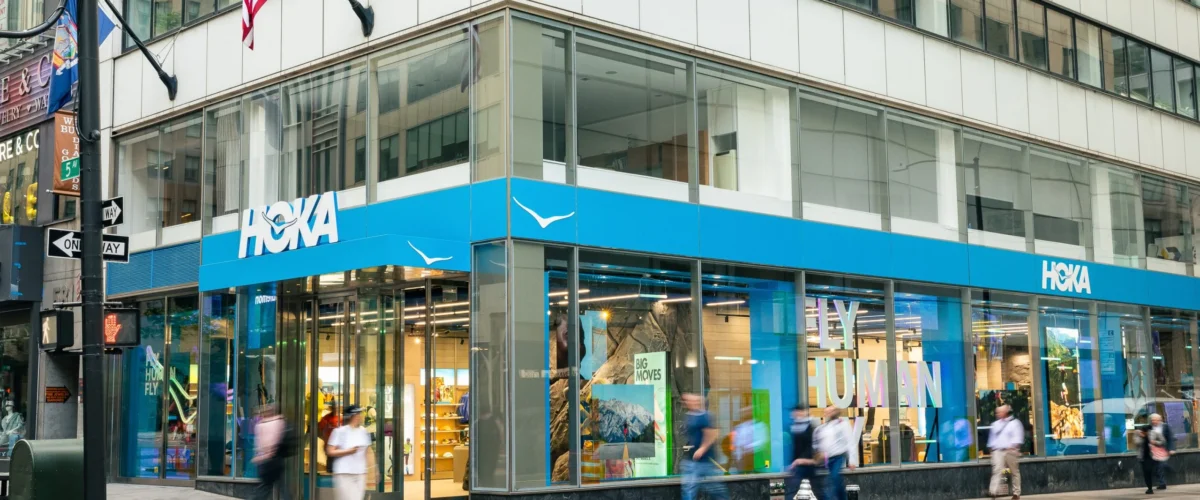
The flagship at 579 Fifth Avenue opened on June 7, 2024. Retail Dive’s coverage distinguished roughly 4,000 square feet of selling space from another 5,000 of back-of-house space. That separation prevents the 9,000-square-foot total from being mistaken for an entirely customer-facing sales floor.
The detail reveals how much a store depends on areas outside the promotional photograph. Stock, operations and support spaces help service work. A flagship may be conceived as a destination, but it still has to resolve the everyday tasks of selling footwear.
In an interview with Retail TouchPoints, executive Brooke Lord connected the Midtown choice with proximity to Central Park. The opening project included lower-level gatherings and features such as foot scanning and a treadmill. Its ambition to receive runners therefore appeared in both its location and its interior arrangements.
The city is part of the experience
The relationship with a park matters because it moves running beyond decoration. A store can display mountain imagery, but a Manhattan visitor is likely to experience movement in an urban setting. Connecting the shop with the city translates its sporting world into something practical.
The treadmill in the opening concept brought observation closer to sensation. Looking at a midsole’s volume is different from feeling a shoe while moving. Scanning added information to the fitting conversation without replacing a try-on or turning retail service into a clinical assessment.
These tools make the most sense as parts of a decision. The presence of a machine cannot guarantee perfect fit or a health benefit. Technology becomes useful when it supports better questions and staff listen to the needs described by the customer.
There is a cultural dimension to that everyday interaction. A technical-looking product can feel less intimidating when someone has time to explain it. The conversation can begin with a first pair or a familiar routine; it does not need to assume that every visitor is preparing for a major race.
A meeting point needs people to use it
By setting aside room for activities, the flagship expressed an ambition to bring people together. A group meeting before a run develops another relationship with a shop: recognizing faces, discussing routes and returning without necessarily planning an immediate purchase. Product remains present, but shares attention with practice.
That is the most interesting cultural aspect of the move from pop-up to flagship. HOKA sought to give an interest in movement a continuing physical base. Whether such a proposition succeeds cannot be inferred from an opening alone. It depends on programming, service and participation over time.
A current address with a recent history
The official directory retains the flagship at 579 Fifth Avenue and a separate Flatiron store on the same avenue. They are different addresses and should not be merged into one chronology. Current access to activities and equipment should be checked directly; the 2024 launch plan is not a permanent schedule.
HOKA’s store history shows a running brand building its own way of receiving people. The route passes through temporary experiments, a highly visible flagship and an attempt to connect the interior with movement outside. Footwear remains central, while the store tries to explain what people can do with it after leaving.
Retail Dive: the flagship opening
Retail TouchPoints: an interview about the project
Related store histories
On
Fleet Feet