An entrance tunnel, bleachers and fitting rooms conceived as locker rooms: adidas brought the language of the stadium to Fifth Avenue when its New York flagship opened in December 2016. The choice said something about the job the store was supposed to do. Visitors would enter a sporting environment before encountering a straightforward sequence of products.
It is a useful starting point for the brand’s retail history. Performance and Originals can be given different environments while sharing the familiar three stripes. Understanding that distinction helps explain why a sports flagship and a streetwear-focused store do not have to tell the same story.
2016: the stadium arrives on Fifth Avenue
The store at 565 Fifth Avenue opened on December 1, 2016. The opening announcement brought together professional athletes and almost a hundred high-school athletes from the region. American high-school stadiums were the stated inspiration, placing everyday sporting experience alongside the spectacle of professional competition.
The school reference is revealing. For many people, an early connection with sport involves watching friends, wearing team colors and recognizing a shared place. The store sought to activate that vocabulary. Footwear appeared within a setting that made sense even to someone who had never competed professionally.
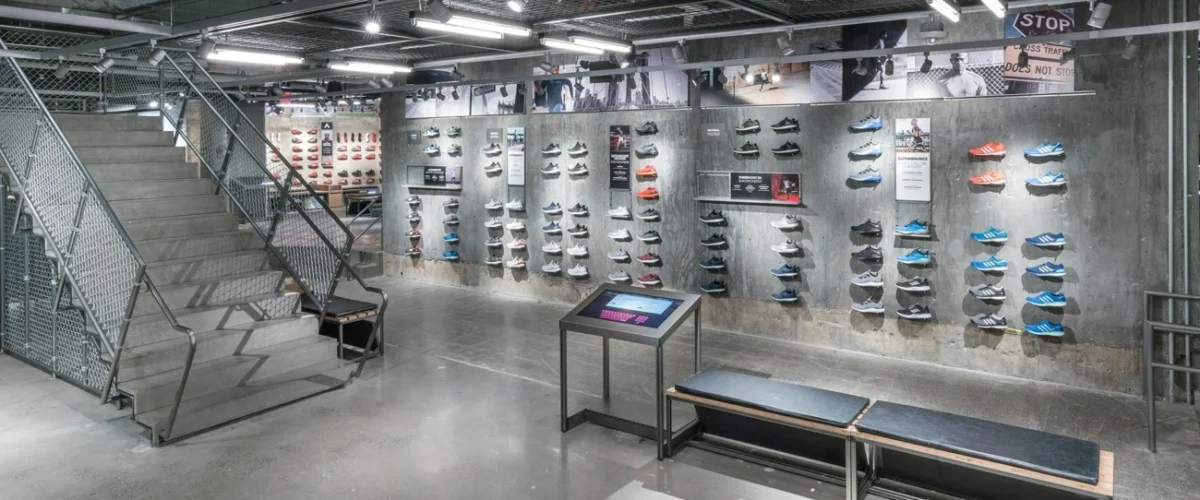
Designer Sean Brady’s portfolio, documenting work for Checkland Kindleysides, describes reclaimed bleachers, exposed materials and areas for testing products. Wood, metal and visible structure gave the concept substance. The sporting environment was communicated through the way the interior could be occupied, as well as through images on a wall.
Bleachers, for example, change a visitor’s posture. They make it possible to remain and watch rather than simply move past shelves. Within a store, that gesture borrows something from being a spectator. A commercial space adopts a familiar way of gathering around sport.
Originals found a different vocabulary in Chicago
In October 2017, adidas Originals opened its Wicker Park flagship. Contemporary Time Out coverage documented work by POSE and TUBSZ, an art wall curated by iPaintMyMind and a fitting room inspired by Chicago’s elevated trains. The references came from the city rather than a generalized sporting arena.
The contrast explains how the narratives differed. On Fifth Avenue, sport supplied the structure of the experience. In Wicker Park, the urban landscape and local creative work helped frame Originals. They were different ways of bringing footwear and context together, without requiring every adidas store to look identical.
The transit-inspired fitting room is especially telling. It brings a place of movement into retail, using a reference familiar to people who travel through the city. Sneakers enter a conversation about ordinary journeys: getting to work, meeting friends and crossing a neighborhood. That is an appropriate frame for footwear worn far beyond organized sport.
It also gives local recognition a practical form. Visitors do not need a long explanation to understand a bench or a familiar material. For someone who knows the city, such details can register immediately. For someone who does not, they invite a question about the place outside the store.
When the address becomes part of the identity
These projects show how much a store communicates through its choice of surroundings. A school stadium and an urban train are collective references, but they create different associations. One suggests games and spectatorship; the other movement and daily life. In both cases, the product acquires an environment that helps explain how it might be used.
Looking at specific elements keeps the discussion grounded. It is more revealing to ask why bleachers were installed or why a fitting room resembled a train than to call an interior immersive. Those decisions point toward the people and situations the designers imagined receiving.
They also make the stores useful documents of a moment in retail design. The details belong to their original projects, with the priorities and references of that time. Their cultural interest does not depend on every installation remaining untouched indefinitely.
One flagship cannot stand for the entire network
The official locator continues to list 565 Fifth Avenue. That confirms the store’s current presence, while features described at the 2016 opening should not automatically be treated as services available today. The same historical distinction applies to the Wicker Park installations discussed here.
Format and availability are separate questions too. An Originals store, a multicategory flagship and an outlet serve different commercial purposes. None of those labels alone guarantees a collaboration, size or particular price.
The contribution of these addresses to sneaker culture lies in how they place footwear inside a recognizable world. adidas incorporated sport, art and city life into its retail architecture. Understanding the stores means following the three stripes through the stadium, the street and the spaces people share in their everyday lives.
adidas: the New York flagship opening
Sean Brady: the interior design project
Time Out: adidas Originals in Wicker Park
adidas Fifth Avenue: official store
Related store histories
Explore sneaker history and culture
Frequently asked questions
When did the adidas Fifth Avenue flagship open?
The store at 565 Fifth Avenue opened on December 1, 2016. The opening announcement brought together professional athletes and almost a hundred high-school athletes from the region. American high-school stadiums were the stated inspiration, placing everyday sporting experience alongside the spectacle of professional competition.
What design features expressed the flagship’s stadium theme?
Designer Sean Brady’s portfolio, documenting work for Checkland Kindleysides, describes reclaimed bleachers, exposed materials and areas for testing products. Wood, metal and visible structure gave the concept substance. The sporting environment was communicated through the way the interior could be occupied, as well as through images on a wall.
When did adidas Originals open in Wicker Park?
In October 2017, adidas Originals opened its Wicker Park flagship. Contemporary Time Out coverage documented work by POSE and TUBSZ, an art wall curated by iPaintMyMind and a fitting room inspired by Chicago’s elevated trains. The references came from the city rather than a generalized sporting arena.
Where is the adidas Fifth Avenue flagship?
The official locator continues to list 565 Fifth Avenue. That confirms the store’s current presence, while features described at the 2016 opening should not automatically be treated as services available today. The same historical distinction applies to the Wicker Park installations discussed here.
Does an adidas flagship or outlet guarantee a particular collaboration or size?
Format and availability are separate questions too. An Originals store, a multicategory flagship and an outlet serve different commercial purposes. None of those labels alone guarantees a collaboration, size or particular price.