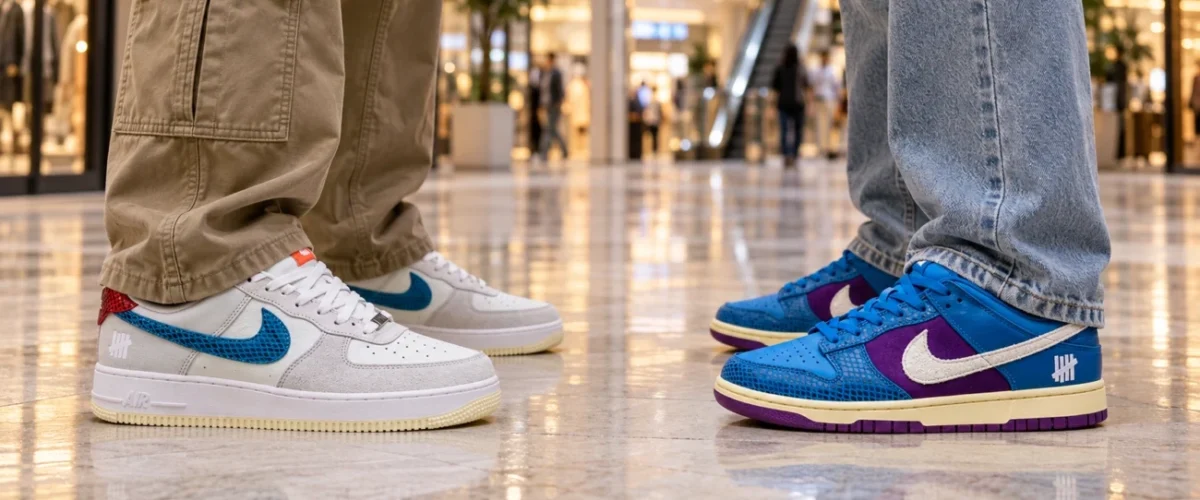
The Air Force 1 ’07 is the stronger starting point if you want a substantial-looking everyday sneaker, especially in a simple color. The Dunk Low makes more sense if the panel layout and contrast colors are what draw you in. The important difference underfoot is construction: the classic AF1 includes Nike Air cushioning, while the standard Dunk Low Retro specification lists a foam midsole. That is useful information, but it does not decide which will feel better on your feet.
This comparison uses two adult leather low-tops: the white Air Force 1 ’07, style CW2288-111, and the black-and-white Dunk Low Retro, DD1391-100. They give us a clear reference without pretending that every AF1 or Dunk is built the same way. The useful question is what those differences add to the way you dress and wear your shoes.
First, make sure you are comparing the right pairs
Start with the complete product name and style code, not the seller’s headline. “Dunk Low” can lead you to a standard Retro, an SB skate model or a release with a different material mix. “Air Force 1” also covers a much larger family than the ’07 leather low-top. A similar outline does not guarantee the same padding, upper or fit.
The official CW2288-111 listing identifies a leather upper, Nike Air, a foam midsole and a rubber outsole. The DD1391-100 Dunk Low Retro listing specifies leather, foam cushioning and a rubber outsole. Both have a padded low collar. Those are the baselines here.
If the pair in your cart says SB, has a platform, uses a textile upper or carries a different version name, reopen its own specifications. A comparison of these two references cannot settle that purchase. Even “premium” in a product description is not a standardized leather grade you can use to rank two shoes.
The visible difference: a substantial base or sharper color blocking
The AF1 presents a more substantial side profile. Its sole forms a strong horizontal band beneath the upper, which is a big part of the appeal of an all-white pair. The Dunk’s panel boundaries draw more attention, especially when the overlays contrast with the base. In black and white, those edges become the main design feature.
Think about what your outfits actually need. With loose denim or a wide straight-leg pant, the AF1’s visual presence can keep the shoe from disappearing beneath the hem. With shorts or cropped pants, a two-tone Dunk puts more emphasis on the shoe itself. These are styling options, not dress-code rules: either can work with both.
For a fair mirror comparison, try similar colors. Comparing a white AF1 with a bright multicolor Dunk tells you as much about color preference as it does about the models. If you keep choosing whichever pair is quieter, buy the quieter color rather than assuming you need a different silhouette.
Why the Dunk makes so much sense in two colors
The Nike archives connect the Dunk to College Colours and the Be True to Your School campaign, where university colors gave fans a way to show allegiance. That background explains why the division between a pale base and colored overlays feels so central to the shoe’s identity.
You do not have to follow a college team to enjoy the design. Look at where the second color travels: around the toe, along the lacing area and through the back of the shoe. It creates a rhythm that a single-color upper deliberately quiets. The white AF1 makes a different proposition: the eye picks up the shape and the shadows between panels before the colors.
If that side of sneakers is what draws you in, our Dunk history and Air Force 1 history explore the paths behind the two silhouettes. For buying, keep the visible design you enjoy separate from assumptions about comfort.
Air cushioning versus foam: what that really tells you
Nike Air is a genuine construction difference in this AF1. It does not mean the shoe will feel like a modern running model or automatically be the better choice for a long day. The complete package matters: the sole, insole, upper, collar and the space your foot has inside.
The Dunk’s listed foam cushioning is not “no cushioning.” It is a different specification. There is no reason to turn the absence of an Air label on this product sheet into a prediction that everyone will find the shoe uncomfortable. Equally, the name Air should not be treated as a comfort guarantee.
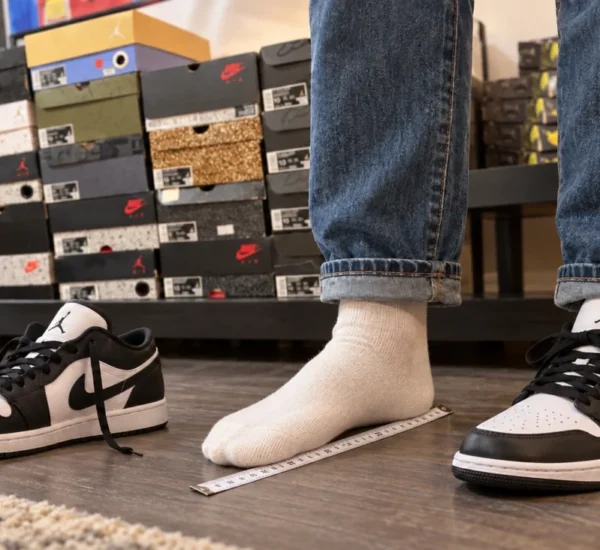
Separate three things when trying them on. First, does the footbed feel agreeable while standing? Second, does the shoe bend comfortably when you take a normal step? Third, do the upper and seams leave enough room around your toes and instep? A pleasant first impression under the heel does not cancel pressure elsewhere.
If your main purchase requirement is a full day of walking, compare the finalist with a shoe designed for that use. These are lifestyle classics with basketball roots. Their heritage alone is not a reason to choose them for current basketball training, running or a work setting that requires certified slip resistance.
Do Air Force 1 and Dunk Low fit the same?
Do not automatically carry one size across. Nike’s Air Force 1 sizing guidance discusses going half a size smaller for a more secure fit, while its Dunk guide starts from your usual Nike size. These are starting points for a fitting, not a formula that overrides the shape of your foot.
A familiar AF1 size may already reflect an earlier decision to size down. Using that number as your universal “Nike size” can muddy the next purchase. Instead, compare the size label on a pair that genuinely fits with the chart and fit note for the exact new shoe.
A useful try-on sequence
- With both shoes on, check that your toes lie naturally and the sides do not press uncomfortably.
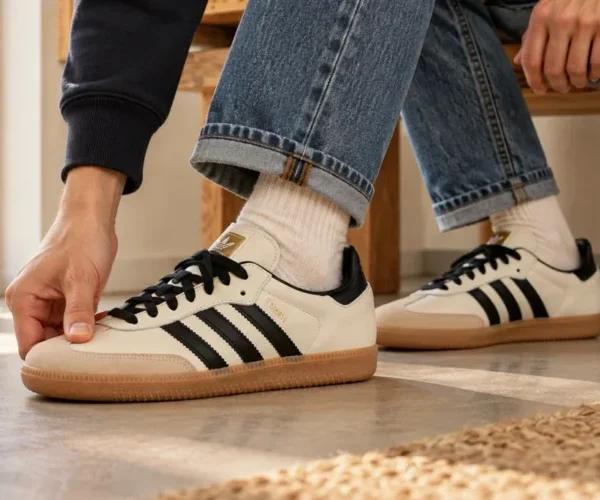
- Walk indoors and check for repeated heel lift or contact at the front.
- After any size change, repeat both checks. Extra toe room is not a fix if the heel becomes loose.
A wide-looking sole is not proof of a wide fit inside. Likewise, a small amount of unused space ahead of the toes does not automatically mean a shoe is too long. Foot shape, upper volume and heel hold need to work together. Our sneaker sizing and fit guide explains how to separate those checks before deciding to keep or exchange a pair.
Do not buy a painful size expecting leather to solve the problem later. Material can change with wear, but that is not a dependable way to create the length or width you need. Tightening the laces excessively to hold an oversized shoe is also a warning to reconsider the fit.
Leather, creases and everyday maintenance
The reference pairs have leather uppers, but that does not make their leather identical or make every colorway equally easy to maintain. Coatings, overlays, suede accents and textile panels change the care requirements. Read the materials for the color you are buying, particularly when a seller uses photographs of several versions in one listing.
Creases are a separate question from structural damage. Decide how much visible wear you are happy to live with before choosing a crisp all-white shoe. Buying too small to keep the toe box looking smooth is a bad trade: the shoe still has to move with your foot.
For routine care, remove loose dirt gently, clean according to the material instructions and let the shoes dry fully before the next wear. Nike advises against machine washing. A leather pair also should not inherit a soaking method intended for a washable textile item. Keep strong cleaners away from colored panels unless the product is approved for that material and has been tested discreetly.
Neither reference is a waterproof purchase. A leather upper, ventilation holes and a rubber outsole are not a waterproof system. If wet commutes are unavoidable, treat weather suitability as its own buying requirement rather than trying to infer it from which sneaker looks tougher.
What does spending more actually buy?
Compare the exact pairs available in your size. A higher asking price may reflect a particular color, collaboration, seller or limited supply. It does not necessarily add a better upper or more cushioning. A standard Dunk at a higher price has not become an SB, and an AF1 with a premium-looking finish has not automatically changed its underlying construction.
A useful way to compare value is to write down what you would miss if you bought the other pair. If the answer is “the white AF1 shape,” that is a real design preference. If it is “the Dunk’s black-and-white panels,” you have an equally clear reason. If the answer is only that one is currently more talked about, pause and look at the shoes with clothes you already own.
Include the seller’s exchange conditions, delivery cost and size availability in the decision. A modest saving loses its appeal when you cannot correct a poor fit. Do not pay a resale premium on the assumption that rarity makes an everyday leather sneaker more suitable for your routine.
Which one should you choose?
- Choose the Air Force 1 ’07 first if you want its substantial profile, prefer a simple white or tonal look and like how this specific Air-cushioned construction feels when tried on.
- Choose the Dunk Low Retro first if you want prominent panel contrast, already have outfits for the colorway and prefer the fit of the standard Dunk you have actually tried.
- Keep comparing if one squeezes your forefoot, the other slips at the heel, or your main need is specialized walking or sport performance. The better photograph cannot fix a mismatch.
If the Dunk appeals but you are also considering a Jordan-shaped low-top, move to the Dunk Low versus Air Jordan 1 Low comparison. It keeps the different Low versions separate instead of treating the names as interchangeable.
Before ordering, confirm the full model name, style code, materials, size system and return terms. Then choose the pair you want to wear and can wear comfortably. For the rest of the buying checks, use the 90sneakers buying guide.