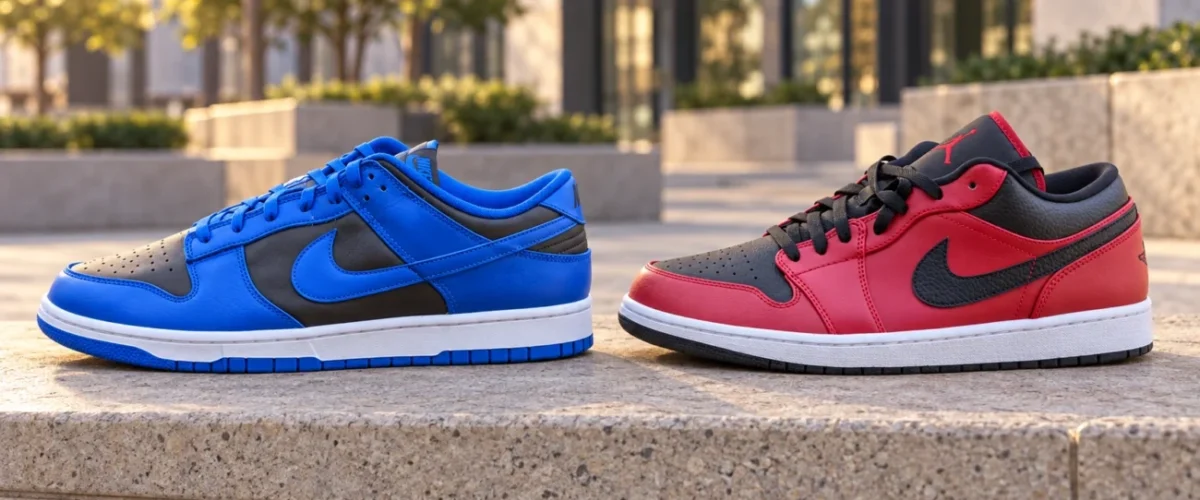
The Nike Dunk Low and Air Jordan 1 Low make a convincing shortlist: two low-cut, panelled sneakers with a strong basketball look and plenty of ways to wear them. The useful decision is less about declaring one the better shoe and more about choosing the right version, upper and fit.
Start with the Dunk if you like its straightforward color blocking and Nike branding. Start with the Jordan if the Wings logo and Air Jordan design are a big part of the appeal. The standard Jordan 1 Low has a documented encapsulated Air-Sole unit, while the Dunk Low Retro reference uses a foam midsole. That gives you a real construction difference, though it does not settle the comfort question for your feet.
The exact shoes being compared
This guide uses the adult Nike Dunk Low Retro DD1391-100 and adult Air Jordan 1 Low 553558-058 as its reference points. Nike lists leather, a foam midsole and a rubber outsole for the Dunk Low Retro. The Jordan 1 Low listing specifies leather, encapsulated Air-Sole cushioning and a solid rubber outsole.
The style codes keep the comparison honest. They are examples of the standard adult shoes, rather than a claim that every colorway has identical materials. Check the actual listing if you choose a different pair. Youth sizing, special editions and modified versions need their own inspection.
Jordan 1 Low is a family, not one fixed specification
The regular Low and Low OG should not disappear into a single bucket. In its Low OG Neutral Grey description, Nike specifically points to Nike Air branding replacing Jumpman and heritage details around the heel. Those are reasons an enthusiast might prefer that particular OG. They do not establish a universal leather-quality or comfort advantage.
Likewise, an SE label is a prompt to inspect the edition. Ask what changed: the surface finish, panels, trim or something more substantial? If the listing does not explain it, do not fill in the blanks with “better quality.” The same caution applies when transferring sizing advice from an OG review to the regular Low.
A standard Dunk comparison does not cover SB Dunk
The Dunk in this article is the casual Dunk Low Retro, not an SB Dunk. If an attractive listing includes SB, you are looking at a different reference with its own construction and fit considerations. A video about that shoe cannot reliably tell you how the DD1391 will feel.
This matters when shopping by photo. Similar colors and the same low-cut outline can hide a different product. Find the full name and style code before you compare prices, reviews or sizing advice.
Two routes through basketball sneaker culture
Nike’s Dunk history connects its beginnings with college team colors for the 1985–86 season and Be True to Your School. The Air Jordan 1 archive records the family’s 1985 debut, Peter Moore’s design and Michael Jordan at the center of its identity.
Those origins help explain two ways to fall for a shoe. With a Dunk, the first attraction might be the contrast between the base and overlays. With a Jordan, a Wings detail or connection to the wider family might carry as much weight as the color scheme. Both interests can belong in the same collection.
Try this with the colorways on your shortlist: follow the darker color around the shoe. Does it cover the toe overlay, the side panels or the back? Two black-and-white pairs can have quite different visual weight because of that distribution. Then see which details remain visible under the pants you actually wear. That is a more satisfying comparison than choosing solely by which model name gets the most attention.
The design differences you will notice every day
Both use a Swoosh, a perforated toe and overlapping panels, so a quick side view can make them seem nearly interchangeable. Look at the heel and tongue next. The reference Dunk gives the Nike wordmark a clear role at the back; the standard Jordan Low carries the Wings identity. The arrangement of the heel pieces changes the overall impression even when the colors are close.
A top-down view is equally useful. It shows what you will actually see when wearing them: the toe shape, the lace area and how much tongue remains visible above your pants. Compare equivalent camera angles. A close wide-angle product shot can make one shoe look dramatically bulkier than another without giving a fair sense of scale.
There is no need to invent a technical justification for liking one design more. Branding, the pattern of the panels and your connection to Jordan sneakers are legitimate buying factors. Just separate those preferences from claims about better construction.
Does Air-Sole make the Jordan more comfortable?
It gives the Jordan a different cushioning component. The reference Dunk has foam and no Air unit documented in its product description; the Jordan lists encapsulated Air-Sole. That is the factual distinction. It is not a controlled comparison of softness, pressure distribution or long-term comfort.
Underfoot cushioning is only part of the experience. A shoe can feel pleasant beneath the heel yet press on the side of your forefoot. Another can fit comfortably while its tongue bunches under tightly pulled laces. A technology name cannot account for either issue.
If you are buying mainly for a commute, a long sightseeing trip or extended standing, walk in both rather than judging them while seated. Notice pressure and heel movement as well as the initial step-in feel. If neither works, expand the shortlist instead of forcing the comparison to produce a winner. Our Air Force 1 vs Dunk Low comparison looks at another common choice among court-inspired sneakers.
Sizing: check the label system before the fit advice
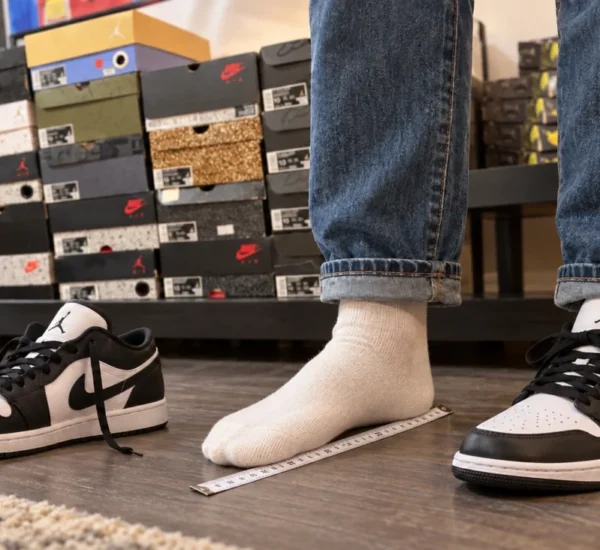
Use the appropriate chart for the actual listing. A US men’s size and the same number in US women’s sizing are different entries, and a youth pair is a different buying reference. Nike also distinguishes the CM label on the box from measured foot length in its official footwear size guide.
Your size in an existing Nike is useful as a starting point, particularly if you know which version it is. It still does not tell you how another shoe will accommodate your forefoot, instep or heel. “True to size” is a shorthand, not a description of your foot.
Try a complete pair of each model with your usual socks, then walk and turn. Check toe clearance, tongue pressure and heel hold. Do not pull the laces excessively tight to make an oversized shoe seem secure.
If going up a size fixes side pressure but creates substantial heel slip, the shape may be the issue. If the front is too short, buying with the hope that leather will stretch is a poor plan. The Air Jordan 1 section of our fit guide puts the variants in context and helps you distinguish width, length and volume problems.
Leather quality depends on the pair
The word leather does not tell you everything about the finish, thickness or feel of an upper. Two colorways within the same family may deserve a closer comparison than two model names on a list. Look at the actual panels, interior seams and edge finishing whenever you can.
For an online purchase, detailed photos of the exact style are more useful than a review of a different collaboration. Check whether the seller’s material description agrees with the product you intend to buy. Suede, glossy finishes and other treatments also change the care routine.
Creasing where the foot bends is a normal consideration when buying a smooth panelled sneaker. If visible wear bothers you, factor that into your choice of finish and color. Do not deliberately buy an uncomfortable size in an attempt to prevent creases. Fit matters more than keeping the toe looking untouched.
Three ways to make the final decision
For a versatile everyday rotation
Compare the colors you would actually buy, not the most famous version of each model. A quiet Jordan can be easier to repeat than a high-contrast Dunk, and the reverse can be true. Think about three outfits already in your closet. Straight-leg jeans, relaxed pants and shorts are useful reference points because they show different amounts of the shoe.
Check the heel and tongue with those outfits as well as the side profile. If one shoe only works with an outfit you do not own, it may be a less useful purchase even if its product photo is your favorite.
For someone drawn to Jordan specifically
Choose the Jordan if its identity is the reason you started shopping. Then narrow down regular Low versus OG before choosing a colorway. Paying for the wrong version because the title simply said “Jordan Low” is an avoidable disappointment.
There is no rule that says an enthusiast must buy OG. The relevant question is whether you value the details on that edition enough to pay the actual difference.
For the best deal
Compare your size, the final checkout total and the return conditions. A cheap final-sale pair with an uncertain fit can be a worse buy than a modest discount on a pair you can properly assess. A resale premium attached to another colorway is irrelevant to the construction of the shoe in your cart.
If both fit well and you like both equally, the lower total and easier returns are sensible tiebreakers. You do not have to manufacture a comfort hierarchy to make that choice.
Care and use: keep expectations realistic
Nike’s cleaning guidance starts with gently removing loose dirt, followed by suitable hand cleaning and air drying. Match the treatment to the upper: suede and smooth leather need different care. Avoid using heat as a drying shortcut.
Before buying, decide how much upkeep suits your routine. Light panels and pale soles make cleaning part of ownership whichever model you choose. Basketball heritage also does not automatically make a casual retro the right shoe for playing basketball; choose sports footwear around the activity’s demands.
The simplest conclusion: buy the design you genuinely want, then let fit and the real price decide. For more buying comparisons and practical checks, visit the 90sneakers buying guide.