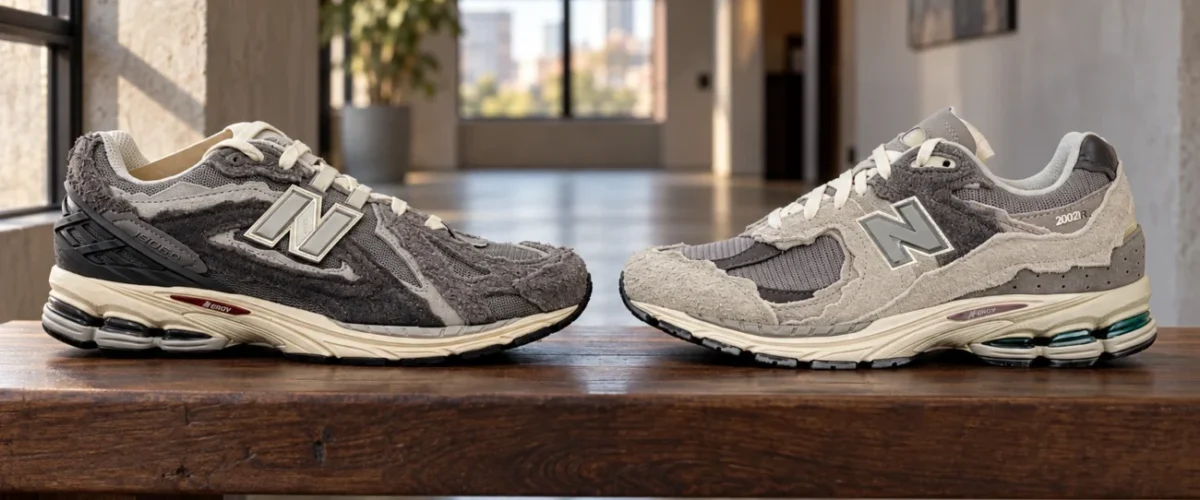
The New Balance 2002R and 1906R can look like two answers to the same question: how much retro-running detail do you want in an everyday sneaker? In their characteristic versions, the 2002R puts suede texture front and center, while the 1906R gives mesh, curved overlays and heel structure a more technical role.
The interesting part is underneath. New Balance itself groups them into a closely related sole family. That makes this a better conversation about uppers, fit and personal taste than a contest to count cushioning acronyms. If you already own one, it also helps explain what the other would actually add to your rotation.
The quick choice
- Try the 2002R first if you like suede, tonal colors and a runner-shaped shoe that sits comfortably alongside denim, twill and textured clothing.
- Try the 1906R first if exposed mesh, metallic-looking panels and the visual engineering of 2000s running shoes are the attraction.
- If you like them equally, let the exact fit, upper material and final price decide. The technology list does not establish a universal comfort winner.
These are style-led starting points. A particular colorway can change the whole comparison, and both families include treatments beyond the familiar suede-versus-mesh shorthand.
The reference versions and their limits
Our examples are the suede-and-mesh 2002R U20026PU and the 1906R M1906RER, which lists mesh, synthetic overlays and a TPU heel cage. Both are conventional lace-up lifestyle versions.
GORE-TEX versions, mules and extensively reworked uppers require separate consideration. So do the 1906A, 1906U and 1906L. When shopping, keep the letter attached to the model name. “1906” alone is not specific enough to transfer every review or feature description.
Original 2002 versus today’s 2002R
New Balance’s official history identifies the original 2002 as a 2010 Made in USA flagship and the 2002R as a 2020 Asian-made reinterpretation. Its 2002R collection description also identifies the 860v2-derived sole. The familiar upper and the modern R construction therefore deserve separate attention.
That distinction makes the 2002R interesting in its own right. You are choosing a particular reinterpretation of an archive design, not assuming that every component or manufacturing detail has returned unchanged. It also keeps the original model’s manufacturing story from being casually applied to a different shoe.
The shared sole family changes the comparison
New Balance’s 1906R description links it with the 2002R and 860v2 through ACTEVA LITE, N-ergy and segmented ABZORB SBS heel cushioning. The U20026PU listing names ABZORB, ABZORB SBS, N-ergy and Stability Web. Product descriptions use different terminology, so read the specific listing rather than scoring one shoe by the number of names printed on the page.
The practical takeaway is that the 1906R’s visibly technical upper does not automatically buy you an entirely higher cushioning category. Similarly, the 2002R does not lose its running-derived underfoot construction because its suede looks quieter.
A related platform still does not mean an identical experience. The upper influences where your foot sits, how firmly the midfoot is held and whether a panel presses on a sensitive spot. You can genuinely prefer one shoe without inventing a completely different sole beneath it.
Nor should a feature such as Stability Web become a promise to correct a foot issue. Here it is a construction detail to understand, not an individual clinical recommendation.
Why the 2002R works so well as a texture-led shoe
A tonal 2002R can have plenty going on without relying on sharp color contrast. The suede surface and mesh sections give neighboring grays, browns or greens different visual depth. That is a good reason to choose it if you enjoy details that become more noticeable up close.
As a styling suggestion, try it with straight denim or twill and leave enough of the upper visible to appreciate the panels. A very long hem can hide the texture that made the shoe appealing in the first place. A cleaner break above the shoe changes the impression without requiring an entirely different outfit.
If the edition you are considering has deliberately irregular edges, decide whether that treatment fits your taste. An intended raw-looking panel is different from loose stitching or poor adhesion. Use photos of the exact reference to distinguish the design from a potential condition issue, especially when buying a used pair.
“Premium” is also worth unpacking. You may prefer suede because of its appearance and touch. That is a clear preference. It does not, by itself, establish that a synthetic-panel shoe is badly made or that one pair will outlast the other.
For a closer look at what suede, mesh and synthetic materials contribute to a shoe, see the sneaker materials guide. It helps connect the finish you enjoy with the care you are willing to give it.
The 1906R’s N lock is worth a closer look
Look at how the laces meet the side of the 1906R. In an official New Balance Japan announcement, the brand describes N lock as connecting the N and laces to support the saddle area. It is one of those small functional details that gives the shoe’s technical appearance some substance.
During a try-on, notice what changes when you tighten that section. Does the midfoot feel comfortably held, or do you feel concentrated pressure? More structure is not automatically better for every foot. You do not need to pull the laces aggressively to make the system “work.”
On metallic-looking versions, curved overlays add light-catching lines even against simple clothing. You can emphasize that with nylon pants or use the contrast with plain jeans and a relaxed jacket. The shoe does not require a complete technical outfit to make sense.
More visible mesh is a reasonable reason to investigate the upper if you prefer an open-looking construction. It is not enough to quantify breathability or guarantee that every 1906R will feel cooler than every 2002R. Lining, panel placement, socks and the conditions of use still matter.
Fit: check more than your usual New Balance size
A size that works in your 574 or 990 is useful context, but not a universal answer. Start with the chart for the actual product and check which width is offered. A brand having multiple widths in its range does not mean your chosen colorway comes in all of them.
Use the same socks for both try-ons. Adjust each lacing system comfortably rather than trying to reproduce exactly the same tension. Different uppers can need different adjustments on the same foot.
- On the 1906R, ease the N lock area before assuming a different size is necessary.
- On the 2002R, notice whether an overlay meets your foot at an uncomfortable point.
- In both, check that going up to relieve forefoot pressure does not introduce heel slip while walking.
If the shoe only works after major compromises, try a different shape. Our sizing and fit guide explains the difference between length, width and volume. A pair that looks right in a collection still needs to work when you put it on.
What would each one add to your rotation?
You own a 2002R and are considering a 1906R
Decide whether you want a new underfoot experience or a new visual language. The 1906R can add a more overtly technical upper, a different approach to color and a different lacing feel. If you expect a dramatic cushioning transformation, the shared sole family is a reason to moderate that expectation.
Trying a pair is particularly useful here: it lets you discover whether the upper makes enough difference for your needs. Owning both can make sense, but the reason does not have to be that one is an upgrade.
Your collection already has several silver mesh runners
A suede-led 2002R in a tonal color might add more variety than another similar-looking technical sneaker. Look at the pairs you actually wear, not just those on your wish list. Does the purchase fill a specific gap, or repeat a look you already have several ways to achieve?
You want one pair for everyday use
Fit and upkeep should carry more weight. If brushing suede is a chore you will avoid, consider that before buying. If its texture is the whole attraction, the extra care may be a perfectly reasonable tradeoff. Choose based on the relationship you want with the shoe, not somebody else’s material ranking.
Price, cleaning and weather
Compare the total for your size, including shipping and any applicable import costs, alongside returns. A collaboration or scarce color can cost more for reasons unrelated to the cushioning. That may be acceptable to a collector, provided the reason for the premium is clear.
New Balance’s care guidance recommends material-appropriate cleaning, a discreet spot test and air drying, with specialist cleaners for leather or suede. It advises against a washer or dryer. Synthetic panels on a 1906R still sit alongside mesh and finishes that deserve gentle treatment.
If machine washing sounds like the easy option, read how to decide whether sneakers can go in the washer. The care routine belongs in the buying decision before the shoe needs a major clean.
A technical appearance is not a waterproof claim. If wet weather is central to your plans, look for an explicit specification on the exact version. Do not transfer a GORE-TEX feature to a regular 2002R or treat a substantial-looking outsole as certification for slippery surfaces.
If you like retro-running design, the ASICS GEL-KAYANO 14 vs GEL-1130 comparison explores another pair with distinct uppers and archive connections.
The best reason to choose between these New Balances is often above the sole: suede texture and a quieter treatment, or mesh and more visible technical detail. Pick the personality your rotation needs, then confirm that your feet agree. Find more comparisons in the 90sneakers buying guide.