Terrace culture describes a world of style associated with British football stands, particularly the development of football casuals in the late 1970s and 1980s. Within that setting, sports shoes could communicate taste, knowledge, and belonging. A pair’s significance might have less to do with displaying a club crest than with recognizing a silhouette, a color, or a version that was difficult to find locally.
The term does not mean everything people wear to a match. Nor does owning adidas shoes automatically make someone part of a subculture. Understanding this history requires following people, travel, stores, and objects as well as brands. It is one route through sneaker history and culture, operating differently from athlete endorsements or fashion spread primarily through celebrity appearances.
What does terrace mean here?
Terrace refers to the sections of a stadium where spectators traditionally stood. The physical space became a cultural reference because repeatedly gathering for football also created opportunities to observe and discuss what other people wore. Match day included travel, meeting friends, conversation, and the journey home. Clothing circulated through that whole sequence, even when it did not display a team’s colors.
Casuals identifies a particular cultural formation associated with clothing and footwear choices. It does not simply mean casual dress in a shopping catalog. National Museums Liverpool situates the movement’s emergence on British football terraces in the late 1970s and documents links with fashion, music, and art. The category grew through specific practices and rivalries rather than a universal checklist of required products.
This distinction prevents a common anachronism. A contemporary photograph combining a football jersey and retro sneakers may reference the tradition without reproducing what a particular group wore in 1981. Aesthetic reference, community participation, and historical membership are different things. Clothes invite connections, but they cannot supply a complete biography of the person wearing them.
Liverpool, travel, and unfamiliar store shelves
Liverpool has an important place in accounts of the style’s development. Discussing the Art of the Terraces exhibition, participant and author Dave Hewitson described clothing and shoes circulating through supporters’ trips and the close attention people paid to new looks. His interview about terrace fashion captures the lived dimension of that process without requiring the claim that one city invented all casual sneaker consumption.
Before a global catalog could be opened on a phone, obtaining a product from another market might require travel, personal contacts, or a retailer with particular suppliers. Differences between what two places stocked could become culturally significant. A shoe that was ordinary in one country might be unusual in its new owner’s hometown. Rarity could reflect distribution and circulation rather than a numbered limited production run.
Meetings between supporters allowed styles to travel too. That does not mean everyone adopted the same brands at the same time. A visual distinction can change precisely because other people learn to recognize it. Once a look becomes familiar, a group may seek a different detail. A fixed list of “official casual sneakers” freezes a process built on comparison, changing preferences, and local differences.
Why did shoes from other sports reach football stands?
One of this history’s most interesting features is that footwear worn to watch football did not have to be designed for playing football. Training models, tennis shoes, and indoor-sport footwear could acquire another use. Original technical purpose and later cultural identity occupy different layers of the same object. Becoming a terrace classic does not retroactively turn a handball shoe into a soccer cleat. The adidas Stan Smith story offers another example of a tennis model developing an everyday identity far beyond its original sporting use.
Liverpool John Moores University’s My Mersey Paradise research gathers records and stories associated with models including Samba, Mamba, Bamba, Trimm Trab, and Forest Hills. This study of style and place demonstrates that local memory cannot be reduced to one silhouette. It also shifts attention from advertising toward photographs, magazine references, interviews, and objects retained by participants themselves.
Examining construction makes differences visible. Upper height, toe shape, suede texture, and sole design can vary substantially among shoes now grouped together as retro. The guide to sneaker anatomy provides a vocabulary for looking closely. Without it, the shared presence of three stripes can obscure distinct designs and original sporting purposes.
Samba: from cold pitches to street style
Adidas dates the first Samba to 1950 as football footwear for cold, icy, or snowy surfaces, and identifies an important transformation in 1972. The company archive makes clear that the earliest version looked different from the silhouette later familiar on streets. Its history involves adaptation rather than a design born fully formed as a fashion accessory.
That origin helps explain the range of shoes brought together on the terraces. Samba carried football references, while other favorites came from court sports or training. Terrace style connected objects a sports catalog separated by purpose. The supporter assembled the combination, choosing proportions, color, and visual presence for a different setting.
Gazelle, Handball Spezial, and the problem of similar names
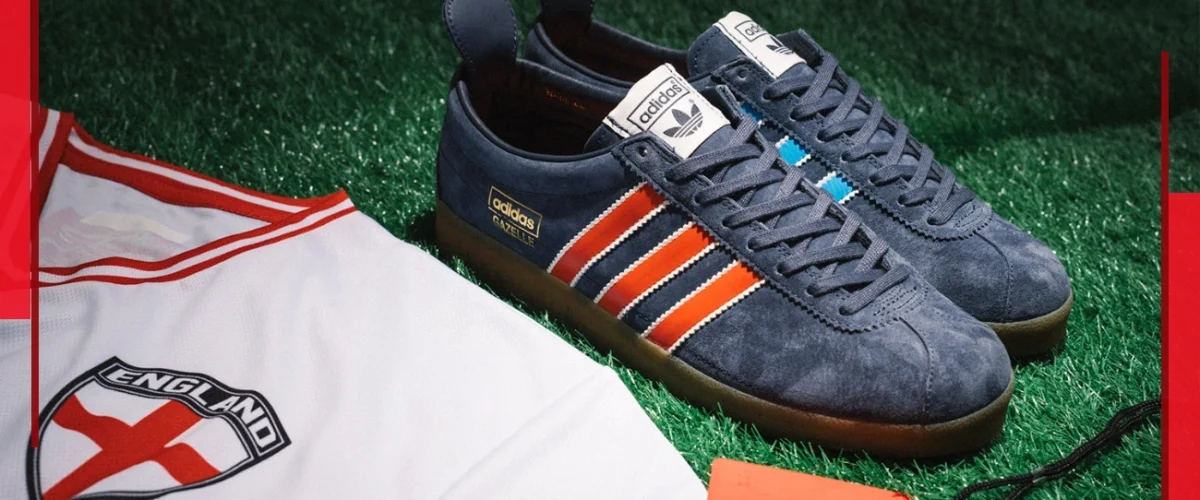
Adidas dates the Gazelle’s introduction to 1966 and describes subsequent changes to the model. Its long life helps explain how one footwear family can move through sport, music, and everyday dress. It does not establish that every Gazelle currently sold exactly reproduces the 1966 construction. The brand’s Gazelle history is a sequence of versions, not the story of an object that remained unchanged for decades.
The Handball Spezial, meanwhile, was introduced in 1979 for handball, according to the adidas Originals archive. Its name records that sporting purpose. When the shoe appears in discussions of terrace culture, the subject is its subsequent adoption, not a different origin sport. That matters when a product’s present-day fashion identity is more familiar than its earlier life as equipment.
Is Handball Spezial the same as adidas SPZL?
No. Handball Spezial is a shoe model. Adidas Spezial, often shortened to SPZL, also names the collection curated by Gary Aspden and launched in 2014. The official tenth-anniversary presentation confirms the line’s chronology and its approach to reworking the archive. Confusing the two leads to the incorrect claim that this contemporary collection started in 1979.
SPZL also offers a useful lesson in what revisiting an archive means. The Gazelle SPZL combines references to earlier versions with particular construction and finishing decisions. A thoughtful reinterpretation need not be an exact replica. Familiar names, similar materials, and historic colors do not remove the need to compare the actual shoes when assessing faithfulness to a specific original edition.
Knowledge, distinction, and the role of stores
Within terrace style, recognizing a product could function as an abbreviated conversation. Two pairs that looked nearly identical to an outsider could be meaningfully different to someone who knew their details. That does not mean every participant memorized a complete brand catalog. Knowledge could be local and practical: where a shoe appeared, who brought it home, which shop sold it, or what people wore with it.
The sneakerhead dictionary explains terms such as retro and colorway, but an edition’s social meaning extends beyond its commercial classification. A shoe may matter because it recalls a trip or friendship even when it commands no extraordinary resale price. A cultural archive should not be organized exclusively around the amount of money an object can generate decades later.
Liam Gallagher: a musical connection with a named product
In 2019, adidas introduced the LG SPZL in collaboration with Liam Gallagher. The project had appeared at a June show at London’s Round Chapel before its August announcement. The official adidas record connects the sneaker with the period of his album Why Me? Why Not?. It is a specific meeting of music, an archive-led collection, and everyday clothing.
The relationship continued with the LG2 SPZL, whose packaging referenced both the 2019 release and vintage adidas boxes, according to the second collaboration’s presentation. That detail reveals another mechanism of sneaker memory. A shoe’s shape is not the only thing telling a story: packaging and graphic identity can connect a new product with the habits of people who save and recognize older objects.
Can casual culture be reduced to hooliganism?
No. Violence belongs to parts of British football history and appears in accounts of some supporter groups, but a garment does not establish violent conduct. Automatically associating a sneaker with criminality, political beliefs, or a willingness to fight turns an object into a judgment about its wearer. It also diminishes the history by excluding design, friendship, humor, music, collecting, and artistic production.
The opposite approach, presenting the past as a conflict-free fashion show, is not especially helpful either. Tensions and exclusions can be acknowledged without generalizing about all supporters. This article’s focus is footwear circulation and cultural meaning. It does not use appearance to diagnose character or romanticize violence to make a silhouette seem more interesting.
From everyday use to museum collection and back to fashion
Art of the Terraces, held at the Walker Art Gallery from November 2022 to March 2023, brought clothing and art together to examine this legacy. Its significance lies in the framing: shoes and garments can record social relationships rather than function only as commodities. The museum project’s announcement sets out that perspective, making it possible to read a saved pair as evidence of an experience.
When the look returns to fashion, those memories remain without obliging new wearers to reproduce an old uniform. Someone may enjoy a shape or color before learning its history. Terrace culture matters to sneakers because it shows how use changes meaning: sports equipment travels, passes through supporters’ hands, and becomes a language of taste. A company supplies the object, while a collective history expands what it can represent.
Frequently asked questions
What does terrace culture mean?
Terrace culture is a style culture linked to British football stands, especially the football casuals of the late 1970s and 1980s. “Terrace” refers to stadium sections where spectators traditionally stood. Supporters used clothing and sneakers to express taste, knowledge and belonging.
Who were the football casuals, and when did the movement emerge?
Casuals identifies a particular cultural formation associated with clothing and footwear choices. It does not simply mean casual dress in a shopping catalog. National Museums Liverpool situates the movement’s emergence on British football terraces in the late 1970s and documents links with fashion, music, and art. The category grew through specific practices and rivalries rather than a universal checklist of required products.
Was the adidas Samba originally a fashion sneaker?
Adidas dates the first Samba to 1950 as football footwear for cold, icy, or snowy surfaces, and identifies an important transformation in 1972. The company archive makes clear that the earliest version looked different from the silhouette later familiar on streets. Its history involves adaptation rather than a design born fully formed as a fashion accessory.
Are Handball Spezial and adidas SPZL the same thing?
No. Handball Spezial is a shoe model. Adidas Spezial, often shortened to SPZL, also names the collection curated by Gary Aspden and launched in 2014. The official tenth-anniversary presentation confirms the line’s chronology and its approach to reworking the archive. Confusing the two leads to the incorrect claim that this contemporary collection started in 1979.
Does wearing terrace-style sneakers make someone a hooligan?
No. Violence belongs to parts of British football history and appears in accounts of some supporter groups, but a garment does not establish violent conduct. Automatically associating a sneaker with criminality, political beliefs, or a willingness to fight turns an object into a judgment about its wearer. It also diminishes the history by excluding design, friendship, humor, music, collecting, and artistic production.