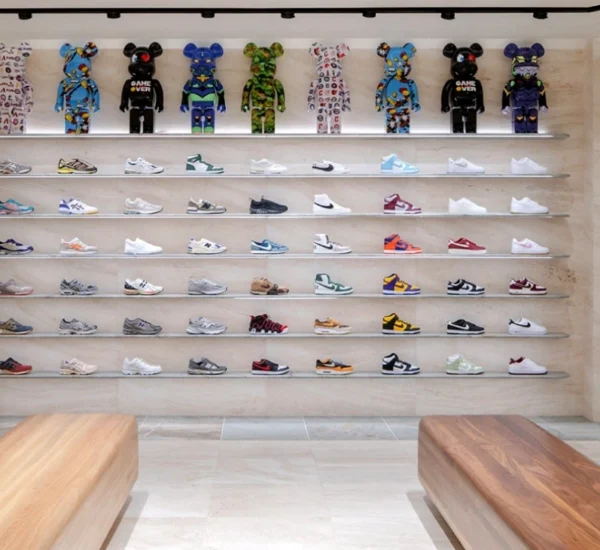

A sneaker in a movie can do much more than complete an outfit. It can locate a character socially, trigger a conflict, preserve the memory of a gift, or announce an imagined future. When a scene stays with viewers, the shoe acquires a second biography. Alongside its release date and original sport, it carries the story of the person who wore it onscreen.
That relationship requires care. A filmed shoe, a replica sold decades later, and an edition inspired by a character are not necessarily the same object. A visible logo also does not establish a paid product-placement agreement. This route through sneaker history and culture identifies models and movies while separating what happens in a film from the commercial products that eventually surround it.
Fast Times at Ridgemont High: Jeff Spicoli’s Slip-Ons
In 1982’s Fast Times at Ridgemont High, Sean Penn’s Jeff Spicoli wears checkerboard Vans Slip-Ons. Vans’ archive records the shoes’ presence in the film and associated promotional imagery. The history of the checkerboard pattern confirms that connection. The company’s timeline dates Style 98, later known as the Classic Slip-On, to 1977. The sneaker existed before the character.
Identification is only the beginning. The laceless construction, instantly recognizable pattern, and Spicoli’s relaxed manner form a coherent image. That is an interpretation of the costume’s effect, not a claim that every viewer understood it identically. The shoes help make the character legible without requiring the screenplay to stop and explain his relationship to fashion.
It would also be inaccurate to say that the movie invented checkerboard or introduced Vans to California youth for the first time. It widened the circulation of an image with an existing history. Separating origin from amplification matters: an object can already mean something within a community before becoming familiar to a much larger movie audience. Screen exposure builds on that earlier life rather than replacing it.
Aliens: the Alien Stomper in Ellen Ripley’s world
The Alien Stomper belongs to Reebok’s connection with James Cameron’s 1986 film Aliens. The Reebok Japan historical archive identifies the footwear worn by Ellen Ripley, played by Sigourney Weaver. The relevant movie is the second installment, not 1979’s Alien. That straightforward distinction prevents a common error when the shoe’s name and the franchise title are blended together.
Visually, the footwear participates in a future that feels functional and inhabited. It appears in a world of work, movement, and danger rather than as a party accessory. The straps and substantial shape can be read as part of that equipment-oriented visual language. This does not establish that the shoe contains technology capable of meeting fictional demands, or make a later reissue suitable technical footwear for any activity.
The connection to Ripley also broadens the subject beyond a list of male characters wearing sneakers. She does not need to become an athlete or discuss fashion for footwear to contribute to her image. It belongs to an action costume. For collectors, however, a later shoe carrying the same name still requires its own identification, including the version, construction, size range, and release date.
Do the Right Thing: an Air Jordan 4 becomes a conflict
In Spike Lee’s 1989 Do the Right Thing, Buggin’ Out, played by Giancarlo Esposito, reacts when someone steps on and marks his Air Jordan 4. Nike confirms the model’s connection with the film in its Jordan 4 archive. The sneaker is no longer a quiet background detail: the action draws attention to the value the character places on his pair.
The scene can be read through care, respect, and contested space. A mark matters because someone has invested attention in an object and interprets the incident within already tense relationships. That reading does not reduce the movie to a sneaker advertisement. The encounter belongs to a larger work about neighborhood life and racial relationships, whose complexity extends well beyond any individual product.
The episode also demonstrates that a shoe need not be futuristic or exceptionally rare to work dramatically. The scene makes a recognizable concern visible: something a person values has been treated carelessly. The Air Jordan 1 history provides earlier context for the franchise, while the Jordan 4 illustrates how that world acquired further meanings away from the basketball court.
Back to the Future Part II: three dates behind the Nike Mag
Back to the Future Part II opened in 1989 and places Marty McFly in an imagined 2015. The automatically tightening Nike Mag is part of that future. Nike’s archive history of the Mag documents the concept and the later effort to bring a screen object closer to a real product. An effect shown in a movie should not be treated as proof of a fully functional commercial system in 1989.
The first version made available to the public arrived in 2011 through a program supporting Parkinson’s research. It reproduced the appearance and lighting but did not have the later version’s automatic lacing. In 2016, the program included a self-lacing Mag, as recorded in the Michael J. Fox Foundation annual report. The 1989 movie, 2011 product, and 2016 product are separate milestones.
This resolves a recurring confusion: 2015 is the year the characters visit, not the film’s release year or the first public Mag release. Popular memory can compress everything into “the shoe from 2015.” Historically, the question needs greater precision. Is the subject the fictional setting, an object used during filming, or a later commercial realization of the design?
The Mag also shows how cinema can create a design expectation. Viewers may want not only the appearance but the action a fictional object promises. The fantasy poses a problem for designers and engineers: how can a shoe perform something a movie can achieve through effects? The history of Nike adds company context, but the Mag retains its particular relationship between fiction, development, and emotional memory.
Forrest Gump: the Cortez as a gift and traveling companion
In 1994’s Forrest Gump, a white Nike Cortez with red and blue details is associated with Jenny’s gift to Tom Hanks’ title character. The model-film connection is documented in Sneaker News’ Cortez identification, while Paramount’s official film page identifies the movie. Calling that color arrangement “Forrest Gump” does not mean the Cortez was originally created for the production.
The sneaker operates differently from the Mag. It does not require impossible technology to matter. Its meaning comes from a relationship between people and the journey a character undertakes. The object can be read as a material reminder of care and companionship. That is a narrative function: an ordinary pair gains emotional weight because the story establishes who gave it and who received it.
Space Jam: Michael Jordan between basketball and fiction
The Air Jordan 11 existed before its appearance in 1996’s Space Jam. Nike’s Air Jordan 11 archive dates the original model to 1995 and records its later connection with the movie. That chronology prevents cinematic success from being mistaken for the birth of the entire silhouette. The film added an identity to a product that already had a direct basketball history.
This case is distinctive because Michael Jordan plays a version of himself rather than simply lending his footwear to an unrelated character. Sport, celebrity, and fiction overlap. One young viewer may remember the sneaker first through a game alongside animated characters; another through real basketball. Neither entry point exhausts the product’s meaning, and both can coexist within a single person’s collection.
Miles Morales: sneakers build animated characters too
The relationship extends to animation through Miles Morales and the Air Jordan 1. In Nike’s Next Chapter behind-the-scenes series, Patrick O’Keefe, production designer on Spider-Man: Across the Spider-Verse, discusses what the character should wear. O’Keefe’s account brings together classic Jordan and Spider-Man references; the next interview segment connects the discussion with comic-book and animation traditions.
This changes the nature of costume. An actor can wear a physical pair, while an animated character requires decisions about how to represent volume, color, and movement. Sneaker identity remains recognizable even when the object is drawn. Miles shows how footwear can maintain an everyday scale within a fantastic story: a hero has extraordinary powers but also makes clothing choices that connect him with other people.
The Air Jordan 1 history establishes the model’s life before the character. A colorway means a color combination, as explained in the sneakerhead dictionary; in a film, that combination can also become part of its wearer’s visual identity. The interesting element is the overlap between a recognizable product design and a new narrative.
Why do these scenes still matter?
Price is not the common thread. Spicoli communicates an attitude, Ripley inhabits an action-oriented world, Buggin’ Out makes care for an object part of a confrontation, Marty experiences a technological promise, Forrest receives a gift, and Jordan crosses between sport and fantasy. These are distinct narrative functions. Together, they show why sneakers in cinema cannot be reduced to a ranking of rare shoes.
Revisiting the scenes allows viewers to recognize what footwear contributes without treating every appearance as a commercial campaign. It also makes collecting, shopping, or simply enjoying the design more precise. A movie memory may make a pair special, but the history becomes more interesting when character, screen-used object, original release, and later tribute are kept in focus as different parts of the story.
Frequently asked questions
Which Vans did Spicoli wear in Fast Times at Ridgemont High?
In 1982’s Fast Times at Ridgemont High, Sean Penn’s Jeff Spicoli wears checkerboard Vans Slip-Ons. Vans’ archive records the shoes’ presence in the film and associated promotional imagery. The history of the checkerboard pattern confirms that connection. The company’s timeline dates Style 98, later known as the Classic Slip-On, to 1977. The sneaker existed before the character.
Which sneakers does Ripley wear in Aliens?
The Alien Stomper belongs to Reebok’s connection with James Cameron’s 1986 film Aliens. The Reebok Japan historical archive identifies the footwear worn by Ellen Ripley, played by Sigourney Weaver. The relevant movie is the second installment, not 1979’s Alien. That straightforward distinction prevents a common error when the shoe’s name and the franchise title are blended together.
Which Air Jordan appears in the sneaker scene in Do the Right Thing?
In Spike Lee’s 1989 Do the Right Thing, Buggin’ Out, played by Giancarlo Esposito, reacts when someone steps on and marks his Air Jordan 4. Nike confirms the model’s connection with the film in its Jordan 4 archive. The sneaker is no longer a quiet background detail: the action draws attention to the value the character places on his pair.
Were the first Nike Mag released to the public self-lacing?
The first version made available to the public arrived in 2011 through a program supporting Parkinson’s research. It reproduced the appearance and lighting but did not have the later version’s automatic lacing. In 2016, the program included a self-lacing Mag, as recorded in the Michael J. Fox Foundation annual report. The 1989 movie, 2011 product, and 2016 product are separate milestones.
Which Nike sneakers does Forrest Gump wear?
In 1994’s Forrest Gump, a white Nike Cortez with red and blue details is associated with Jenny’s gift to Tom Hanks’ title character. The model-film connection is documented in Sneaker News’ Cortez identification, while Paramount’s official film page identifies the movie. Calling that color arrangement “Forrest Gump” does not mean the Cortez was originally created for the production.