LS is associated with Lifestyle on certain Nike and Jordan sneakers, especially Air Jordan retros from the 2000s. It is a historical designation for specific versions, rather than a classification for every Nike worn casually.
Context matters: in apparel, LS can also stand for Long Sleeve. Before interpreting the letters, check the full name, category, and product code.
What does LS mean on Nike and Jordan sneakers?
In the historical context of certain Nike and Jordan sneakers, LS is associated with Lifestyle.
The most useful official evidence comes from Nike’s own archive on the Air Jordan 4 “Cool Grey”. In recounting the colorway’s history, the brand describes the 2004 Air Jordan IV as a “lifestyle take” on the silhouette and explicitly mentions the 2007 Air Jordan III LS in the same timeline.
That provides much stronger historical context than simply memorizing “LS = Lifestyle.” It points to an era when Jordan Brand was experimenting with new versions of classic models, drawing shoes deeply rooted in basketball further into fashion and everyday wear.
For other abbreviations from this world, the Sneakerhead Dictionary is worth exploring afterward. Here, the focus is on why LS needs context.
Air Jordan LS: when retros found a new life in the 2000s
The most interesting part of LS is not simply saying “it was casual.” It is recognizing the shift in context.
The Air Jordan 4, for example, began as a basketball shoe. Nike’s official Air Jordan 4 history records its original release in 1989, Tinker Hatfield’s design, and its direct connection to Michael Jordan on the court.
SNKRS also recalls that Michael wore the Air Jordan IV when he hit “The Shot” against Cleveland in 1989. This is a silhouette whose story began at the heart of basketball performance.
When that same design receives a lifestyle treatment years later, the original story is not erased. That overlap is exactly what makes retros so interesting.
Air Jordan 4 LS
The Air Jordan 4 Retro LS “Tour Yellow” is one of the best-known historical examples. Specialist release archives record the White/Tour Yellow/Dark Blue Grey/Black version, style 314254-171, in 2006.
That story returned to the spotlight in 2026 when Nike reissued the Air Jordan 4 “Tour Yellow” after roughly two decades.
The returning version uses style IO2463-102, white leather, Tour Yellow accents, and visible Nike Air cushioning. Nike describes the colorway as part of the experimental spirit of early-2000s Air Jordans.
There is a particularly useful nuance here: the 2026 version does not carry LS in its current official name. That shows why a historical designation should not be treated as a permanent label for a silhouette or colorway.
The historical release may belong to the LS context. Its reissue may return under a different name.
Air Jordan 3 LS
The Air Jordan III LS has an important documentary advantage: Nike itself mentions it directly in its historical archive.
While tracing the evolution of gray shades in the Jordan line, the official page records the 2007 Air Jordan III LS. This is primary evidence that LS really was part of the historical naming of certain Jordan retros.
It also avoids a common glossary mistake: using only contemporary models that happen to be “casual” to explain a code that became known in a much more specific historical setting.
Other Air Jordan LS releases from the 2000s
Historical market archives also document other releases with LS in their names, such as the Air Jordan 8 Retro LS in 2007.
What changed on an Air Jordan LS?
There is no universal “Air Jordan LS” specification sheet.
One release might feature a particular combination of materials, colors, and details; another might take a different approach.
Nike describes the 2004 Air Jordan 4 Cool Grey, for example, as a lifestyle interpretation with premium nubuck and chrome details. That information belongs to that product.
It does not allow us to conclude that every LS must have:
- Nubuck;
- Premium leather;
- Chrome finishes;
- Greater comfort;
- Greater durability;
- Better quality.
LS helps explain the historical context of a particular version. To discover what actually changed, consult that release’s specifications.
Does LS mean less technology?
No.
A lifestyle version of a silhouette originally designed for sports may preserve much of the original model’s technology and construction.
The Air Jordan 4 is again a good example. The 2026 Tour Yellow version uses Nike Air, a foam midsole, a rubber outsole, and the recognizable AJ4 structure.
There is another important distinction, though: retaining historical technology does not automatically make a retro the contemporary shoe Jordan would choose for an athlete playing professional basketball today.
Performance origins, retained technology, and current positioning are different questions.
Are Air Force 1s, Dunks, and Air Max shoes LS?
They should not be classified as LS simply because they are widely worn as lifestyle shoes today.
The Air Force 1, Dunk, and many Air Max silhouettes are good examples of sneakers that began or developed in sports before becoming streetwear staples. They help illustrate the historical shift from performance to lifestyle.
But “lifestyle” as a current use is not the same as “LS” as a documented release designation.
To call a particular product an LS, look for LS in that release’s documented name rather than inferring the classification from how people wear the shoe.
Lifestyle is not the same as Nike Sportswear
Another common confusion is treating LS and NSW as synonyms.
NSW stands for Nike Sportswear. It is a current designation connected to a broad area of Nike’s offerings, including sneakers, apparel, and lifestyle products.
LS, in the context discussed here, appears as a historical designation on specific releases.
In other words:
- Lifestyle is a broad concept describing use and positioning;
- LS was used in certain historical product names associated with Lifestyle;
- NSW means Nike Sportswear and represents a different concept within Nike’s product organization.
For a closer look at that difference, see what Nike NSW means.
LS is not the same as PRM, QS, or SP
There is no reason to arrange LS, PRM, QS, and SP on a universal ladder of quality, price, or exclusivity.
Each designation needs to be understood in its own context.
LS does not mean Premium. It should therefore not automatically be confused with PRM. See what Nike PRM means.
LS does not specify distribution. It should therefore not be used as an equivalent of QS.
LS does not mean Special Project. It is therefore not a synonym for SP, either.
The more useful question is not “Which abbreviation is better?” It is: what does it communicate about this particular release?
Can LS mean something else on Nike products?
Yes, and this is one of the biggest reasons not to decode the letters in isolation.
In apparel, LS can refer to Long Sleeve
Within Nike’s systems and internal image or product names, LS appears on pieces publicly described as Long-Sleeve.
One example is a Nike Pro product internally identified as M NP DF TIGHT TOP LS and presented to consumers as “Men’s Dri-FIT Tight Long-Sleeve Fitness Top.” Another appears as B NP DF LS TOP and is described as “Dri-FIT Long-Sleeve Top.”
In this context, interpreting LS as Lifestyle would be a mistake.
The same letters do not guarantee the same meaning in every category.
Jordan LS Slide is another context that calls for care
Nike also has an official product page for Jordan LS Slides, style CZ0791-201.
The product has a Solarsoft footbed, an adjustable strap, a removable heel strap, and a removable pocket. Its official name does indeed include LS.
But the page does not spell out the letters as “Lifestyle.” Their presence alone should therefore not be used to automatically transfer the historical meaning of Air Jordan Retro LS to this slide.
It is a good example of a simple rule: identify the product first, then interpret the abbreviation.
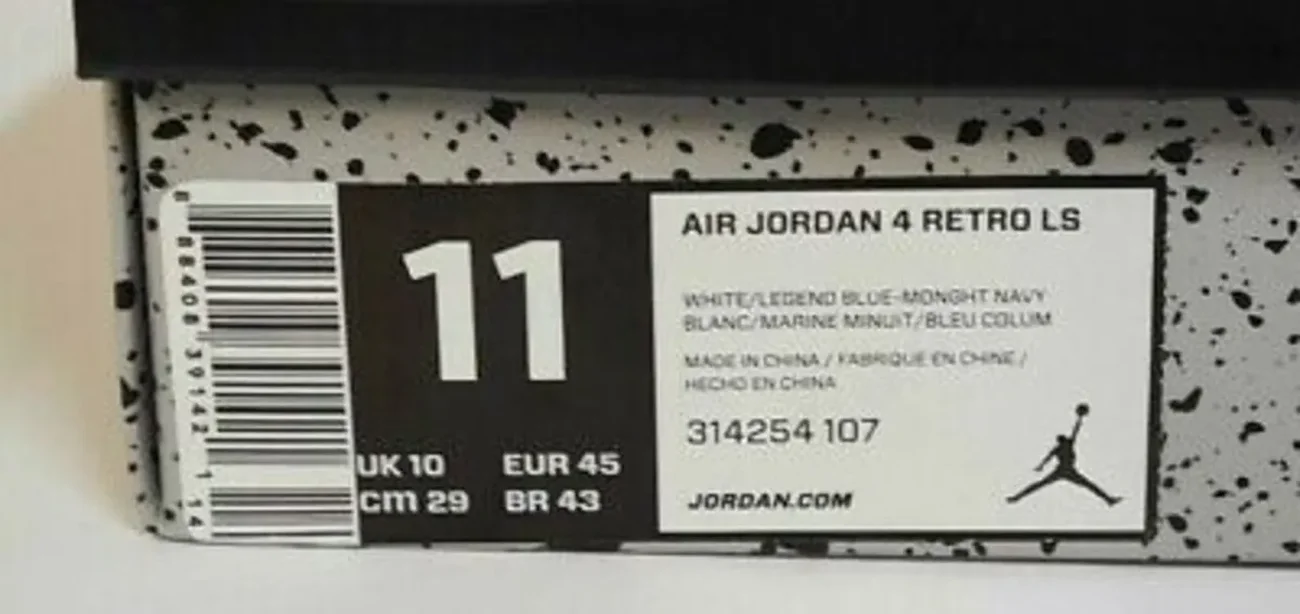
Does LS appear on the tag or box?
Depending on the period, it may appear alongside the names of particular releases in product records, box labels, catalogs, or retail systems.
What is not safe to claim is that every Nike LS must have LS in a specific position on its internal tag.
A Nike internal tag may show the size, style code, country of manufacture, and other production information, but there is no universal “LS” field that applies to every release.
How do you correctly identify an LS release?
For a historical sneaker, the best approach is to cross-reference information:
- Documented release name: look for an actual association between LS and that product.
- Style code: confirm the specific version.
- Date and colorway: distinguish similar releases from different periods.
- Nike/Jordan archive: prioritize a primary source when one exists.
- Specialist historical archive: use it to supplement older Nike pages that are no longer available.
Do not try to identify LS from appearance alone.
A sneaker does not become an LS because it has leather, an unusual colorway, or looks good with casual clothing.
Can I wear an Air Jordan LS for sports?
The answer should not be determined by the abbreviation alone.
An Air Jordan retro may preserve technology and construction that originated in basketball, but a model created decades ago should not automatically be considered equivalent to the modern footwear Jordan develops for competitive performance today.
For training or sports, check the specific product’s intended use and construction rather than using LS as the sole criterion.
Does LS prove that a Nike or Jordan is authentic?
No.
A counterfeit can copy the name, LS, style code, box, tag, and colorway of a real release.
Finding LS in the description or on the packaging therefore does not authenticate the pair.
If authenticity is the question, see what a Legit Check (LC) is.
Is a Nike or Jordan LS worth buying?
It can be, but not because LS is automatically better.
When evaluating a historical release, consider:
- The exact model;
- The colorway and year;
- The materials used in that version;
- The fit;
- The pair’s condition;
- How you intend to wear it;
- Whether the price makes sense for you.
With older pairs, age and condition can matter much more than LS at the end of the name.
To keep understanding these designations without falling for invented rules, consult the Sneakerhead Dictionary. To explore how performance sneakers also became objects of style and culture, visit Sneaker History and Culture.