The mural above Foot Locker’s Washington Heights entrance gives the neighborhood a place in the picture. Street signs, a subway car and figures carrying shopping bags share the facade beneath the retailer’s familiar name. Documented when the store opened in 2019, it offers a useful starting point for understanding a company whose history stretches back to a California shopping mall. A business built on recognition across many locations was asking what could make one location belong to its surroundings.
That question runs through Foot Locker’s development. Its cultural role has depended on distribution, the shop floor and the people who connect products to customers. The company did not have to manufacture the shoes to influence how they were encountered. A store could bring several brands together, give a particular release visibility or build a space around a sport. Over time, the format itself became part of the story.
A specialist inside the mall
The first Foot Locker opened in 1974 at Puente Hills Mall in City of Industry, California, within the Kinney shoe business. The starting point matters: an athletic-footwear specialist operating inside the familiar structure of an American mall. Its identity developed around a clear category, with staff uniforms resembling referees’ shirts making the sporting association visible before a customer examined a shoe.
As the business expanded, it introduced Lady Foot Locker in 1982 and Kids Foot Locker in 1986. Those separate formats show how the company divided its audience and built retail environments around different customers. They also complicate the shorthand image of the sneaker shop as a space concerned only with men’s basketball footwear. Foot Locker’s expansion involved several ways of shopping for and participating in sport.
The chain’s later cultural markers included Slam Fest, staged between 1988 and 1996, and the exclusive 1998 launch of Nike’s Air Max Plus. These examples sit at different points in the retail relationship: an event makes the retailer a producer of spectacle; an exclusive release makes it a destination for a particular product. Both give the name on the storefront a role beyond identifying the company processing the sale.
Basketball gets its own room
In November 2007, Nike and Foot Locker opened House of Hoops on Harlem’s 125th Street. Nike, Jordan Brand and Converse shared a basketball-focused retail concept. The collaboration concentrated a specific sporting culture inside the larger retailer’s network, giving it a setting with its own identity.
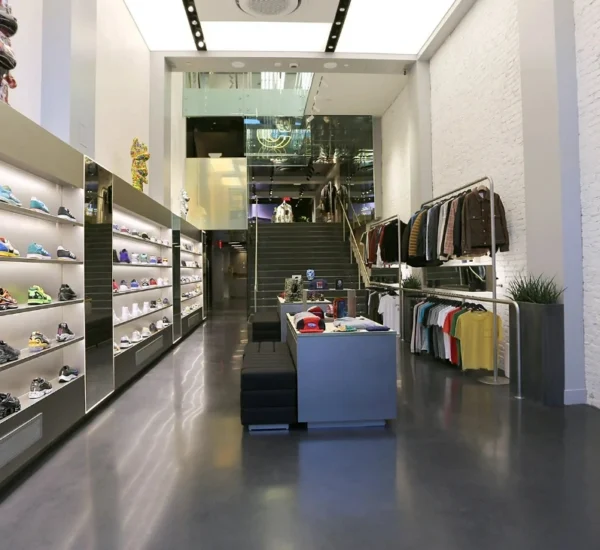
House of Hoops helps explain the next stage of Foot Locker’s store experiments. A national chain could organize a space around a shared interest, then connect that interest to a particular place. The challenge was how much local character could survive a repeatable format. A recognizable sign might bring people through the door; the selection, design and programming would determine what made that door different.
Putting the neighborhood into the format
The first North American Power Store opened in Eastpointe, near Detroit, in January 2019. Its launch paired full-family shopping with an event area and work by Detroit artist Désirée Kelly. The company described local art, music and sport as ingredients of the format. That gave the subsequent Washington Heights opening a context: it belonged to a broader experiment in making large stores more locally specific.
At 605 West 181st Street, the Washington Heights branch opened on August 10, 2019. Its roughly 9,000-square-foot layout included a second-floor activation space. The Home Grown program brought in local labels including Perico Limited and Lyfestyle NYC, placing neighborhood businesses within a retailer better known for national and international sports brands.
Local publication Uptown Collective credited Danny Peguero with the artwork and described neighborhood businesses, artists and influencers participating in the store’s development. That detail gives the mural substance. Local identity entered through named contributors and products, allowing the neighborhood to appear as a source of creative work.
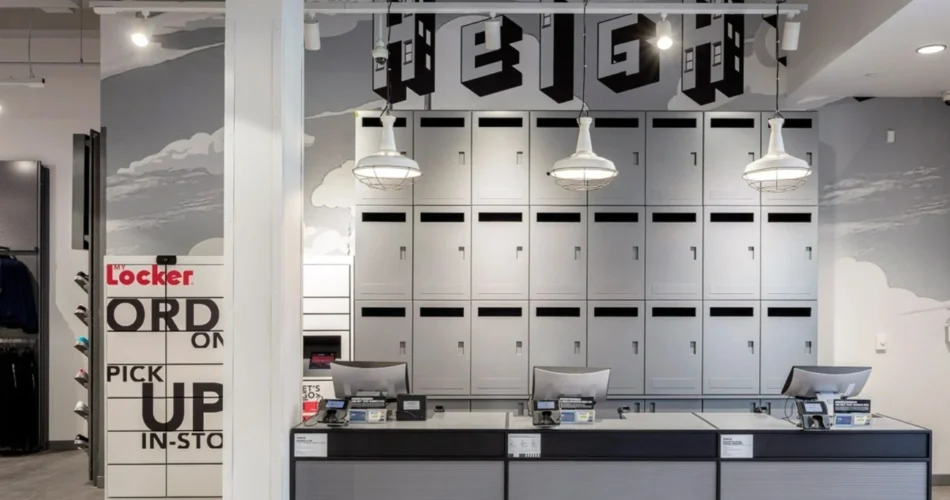
Technology was part of the opening, too. Nike’s app connected product information, inventory checking and reservations to the physical store. These were launch-era services, but their significance was broader: the phone and the shop floor were being designed as connected parts of a purchase. The community space and the digital tools addressed different reasons for keeping a physical store relevant.
The store remains a work in progress
Foot Locker’s experiments continued with its reinvented concept at Willowbrook Mall in Wayne, New Jersey, in April 2024. The company emphasized digital fixtures, a revised environment and better tools for its staff, known as Stripers. Reporting on the opening also described a communal try-on area and a sneaker hub for assistance and personalization. The mall remained part of the story, even as the company explored neighborhood formats.
Washington Heights remains the clearest example of the cultural question behind these changes. A chain’s identity can travel widely; the people and histories surrounding a particular storefront cannot be reduced to the same template. Foot Locker’s most revealing retail moments are those in which the two meet: a basketball space on 125th Street, a local artist’s work in Eastpointe, a neighborhood label on 181st Street. Together they show how selling sneakers can also shape the setting in which sneaker culture is recognized.
Foot Locker origins
The Washington Heights opening
A neighborhood account of the Power Store
Related store histories
Explore sneaker history and culture
Frequently asked questions
When and where did the first Foot Locker open?
The first Foot Locker opened in 1974 at Puente Hills Mall in City of Industry, California, within the Kinney shoe business. The starting point matters: an athletic-footwear specialist operating inside the familiar structure of an American mall. Its identity developed around a clear category, with staff uniforms resembling referees’ shirts making the sporting association visible before a customer examined a shoe.
When did Lady Foot Locker and Kids Foot Locker begin?
As the business expanded, it introduced Lady Foot Locker in 1982 and Kids Foot Locker in 1986. Those separate formats show how the company divided its audience and built retail environments around different customers.
What is Foot Locker’s connection with the Air Max Plus?
The chain’s later cultural markers included Slam Fest, staged between 1988 and 1996, and the exclusive 1998 launch of Nike’s Air Max Plus. These examples sit at different points in the retail relationship: an event makes the retailer a producer of spectacle; an exclusive release makes it a destination for a particular product. Both give the name on the storefront a role beyond identifying the company processing the sale.
What was the original House of Hoops?
In November 2007, Nike and Foot Locker opened House of Hoops on Harlem’s 125th Street. Nike, Jordan Brand and Converse shared a basketball-focused retail concept.
When did the Washington Heights Power Store open?
At 605 West 181st Street, the Washington Heights branch opened on August 10, 2019. Its roughly 9,000-square-foot layout included a second-floor activation space.