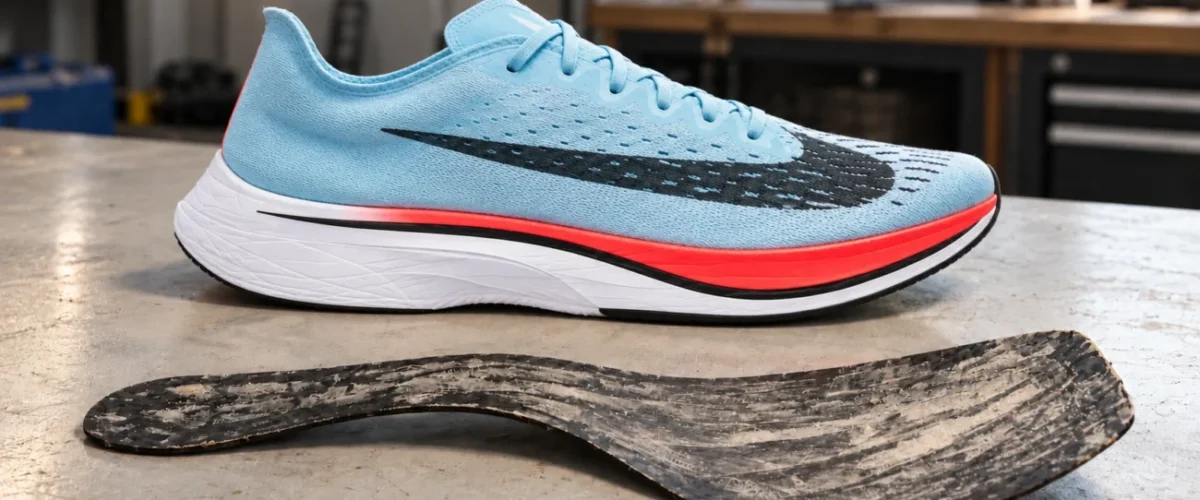
A carbon plate changes a running shoe’s stiffness and how the shoe deforms. The result depends on the whole design: foam, plate shape and position, sole geometry, weight, and the runner using it. Some combinations improve running economy in studies. Carbon alone does not guarantee a faster, more comfortable, or more suitable shoe for you.
For anyone interested in sneakers, that is the fascinating part. Two pairs carrying the same “carbon-plated” description can offer very different experiences. Understanding what surrounds the plate is more useful than chasing the stiffest material or the biggest propulsion claim.
What the plate actually does
In the running constructions discussed here, the plate is integrated into the midsole. It can change how much the shoe resists bending along its length, from heel to toe. Its curve, width, thickness, and position also matter. Knowing that the material is carbon fiber leaves much of the design unexplained.
It helps to separate four parts of the picture:
- Foam: it compresses under load and recovers part of that deformation. Softness and energy-return behavior are different characteristics.
- Plate: it contributes to bending behavior and the mechanical interaction between the foot and the rest of the midsole.
- Geometry: stack height, base width, sole curvature, and the distribution of material shape the complete platform. A rocker is the curved profile involved in the sole’s rolling transition.
- Mass: weight belongs in the performance discussion. Adding components is not a cost-free design choice.
In Nike’s NEXT% system description, the Alphafly plate works alongside ZoomX foam and Air Zoom units. ASICS’ technical description of METASPEED SKY PARIS and EDGE PARIS illustrates different plate configurations. These are engineering examples, not a ranking of the best shoes.
Our sneaker anatomy guide explains the difference between the midsole, outsole, and insole. An integrated plate should not be confused with an aftermarket rigid insert placed inside the shoe.
Does a propulsive feeling prove a performance benefit?
A shoe can feel lively, soft, or eager to roll forward. Those impressions matter when deciding whether you enjoy it. The trouble starts when a sensation becomes a claimed percentage advantage. A pair that feels exciting during a try-on may not be the best match for your pace or route.
Separate three questions when reading a performance claim:
- Energy return: how much of the mechanical energy put into a material or shoe comes back under the test conditions?
- Running economy: what is the metabolic cost of maintaining a speed under controlled conditions?
- Performance: how long does the runner take to complete a task, such as a race or time trial?
These measures are related, but they are not interchangeable. Foam does not create energy, and a benchtop number cannot be transferred directly to your watch. The useful shopping question becomes what was compared, with whom, and under which conditions.
What the primary studies actually show
Where the 4% reference came from
A Nike-funded study by Hoogkamer and colleagues tested 18 high-caliber runners at 14, 16, and 18 km/h. A prototype reduced average energetic cost by about 4% against two comparison shoes with mass matched. That was a whole-shoe comparison, not a promise of a 4% faster race time.
The experiment that cut the plate
Healey and Hoogkamer tested runners at 14 km/h in intact and plate-cut Vaporfly 4% shoes. Running economy did not differ significantly. The plate was cut, not removed: the result challenges a stiffness-only explanation without establishing that every plate is unnecessary.
For shopping, the implication is straightforward. Greater stiffness is not a universal quality scale. You are choosing a complete construction. Bending two shoes by hand will not reveal which will require less energy during your run.
Carbon-plated models are not equivalent
In Joubert and Jones’ comparison, 12 male runners tested seven plated models and a comparison shoe at 16 km/h. Results varied; two plated models did not differ significantly from the comparison shoe. These historical models illustrate category differences, rather than establish a current shopping ranking.
Do carbon plates work at slower running speeds?
There is no universal pace at which the plate switches on. Nor is there evidence here for promising the same benefit to everybody above or below one pace.
Joubert and colleagues compared two shoes in 16 runners. Average oxygen consumption was 1.4% lower at 12 km/h and 0.9% lower at 10 km/h; the latter did not reach statistical significance. Those speeds are approximately 8:03 and 9:39 per mile, respectively, not universal eligibility cutoffs.
In a different design, Bolliger and colleagues tested 14 participants at 7.5–12 km/h across three days. The advanced-footwear model improved average economy against a traditional shoe, with no detectable speed dependence. The lab disclosed an unrelated On contribution. Different samples and shoes help explain why one universal pace rule would be unreliable.
Importantly, these were running tests. Using a slow-running result to promise the same advantage during an everyday walk would go beyond the evidence presented.
The group’s best result may not be yours
In a study of 18 recreational male runners, 11 ran their fastest treadmill 3-km time trial in the Vaporfly 4%; the others were fastest in another shoe. Individual responses existed alongside average benefits. That treadmill test cannot identify a winner for every person or route.
Three decisions therefore remain personal: the fit your foot accepts, the ride you enjoy, and the value you place on a possible advantage. An impressive specification cannot make up for squeezed toes, heel slippage, or a platform you dislike through corners.
When is a carbon-plated shoe worth considering?
You want a pair for racing or particular workouts
There is a concrete question to investigate: does this model work well for the pace, surface, and duration you intend to use it for? Compare the plate as part of the design, alongside fit, traction, cornering behavior, and budget. Get familiar with the pair before relying on it for an important occasion, within the retailer’s testing and return conditions.
You are starting out and need one versatile pair
Start with the jobs the shoes need to do. If they will handle easy runs, errands, and several hours away from home, assess each of those uses. Carbon makes a shoe neither compulsory nor automatically unsuitable. There is simply little reason to pay for a race-oriented promise that does not address your main need.
You mainly walk or wear sneakers casually
Judge the shoe while walking, standing, using stairs, and changing direction. You might enjoy a plated shoe for those activities, but the running studies cited here do not establish more efficient everyday walking. Compare non-plated alternatives, too, rather than assuming the most technical category will feel best all day.
You enjoy exploring different constructions
Curiosity is a perfectly valid reason to like a shoe. The experience of a design can make a purchase worthwhile without turning it into a personal-record claim. Identify what interests you: a more noticeable rolling transition, a different midsole shape, or a particular material combination. That makes for a more rewarding comparison than checking the carbon box.
How to try a pair without treating impressions as science
- Define the job. Road running, walking, mixed daily use, and collecting call for different questions.
- Check fit at rest and in motion. Wear the intended socks, try both feet, and notice heel hold, toe space, and localized pressure.
- Assess the transition at your own pace. If the retailer permits it, compare walking and running. A few entertaining steps may not predict your preference over a complete outing.
- Notice control as well as softness. Pay attention to cornering and confidence on the surface where testing is allowed.
- Compare with a familiar pair. During later use permitted by the purchase conditions, note the route, perceived effort, and feel. One faster day may reflect weather, training, motivation, or rest.
This process organizes preferences; it does not measure running economy as a lab does. Heart rate and GPS from one run cannot certify a small shoe-related improvement, either. If a pair bothers you, do not interpret discomfort as evidence that the technology is working.
Price, wear, and the remaining questions
Before paying extra, consider how often the pair will perform the job you selected it for. There is no universal mileage at which every carbon plate expires or every foam stops working. Inspect outsole wear, visible damage, asymmetry, and changes during your use. Foam creasing alone cannot quantify performance loss.
Will a carbon insole turn my regular shoe into a super shoe?
That equivalence has not been established. Adding an insert does not reproduce an integrated plate’s position, the foam, or the geometry of a complete design. It also changes the shoe’s internal space and fit.
Do carbon plates prevent injuries?
The performance studies discussed here do not establish injury prevention. A change in movement during a test is also insufficient to predict an individual’s injury risk. This guide explains footwear choices; it does not recommend a shoe to treat pain or a clinical condition.
How can I confirm there is a plate without opening the shoe?
Read the official specification for the exact model and version. Resistance to hand bending, an outsole opening, or a foam’s trade name does not independently establish the plate’s composition.
A good plated shoe is interesting because of what the complete design offers in the use you value. Knowing its components makes the purchase more informed and the sneaker conversation more rewarding. Explore the Sneaker Lab for more on materials, cushioning, and construction.