
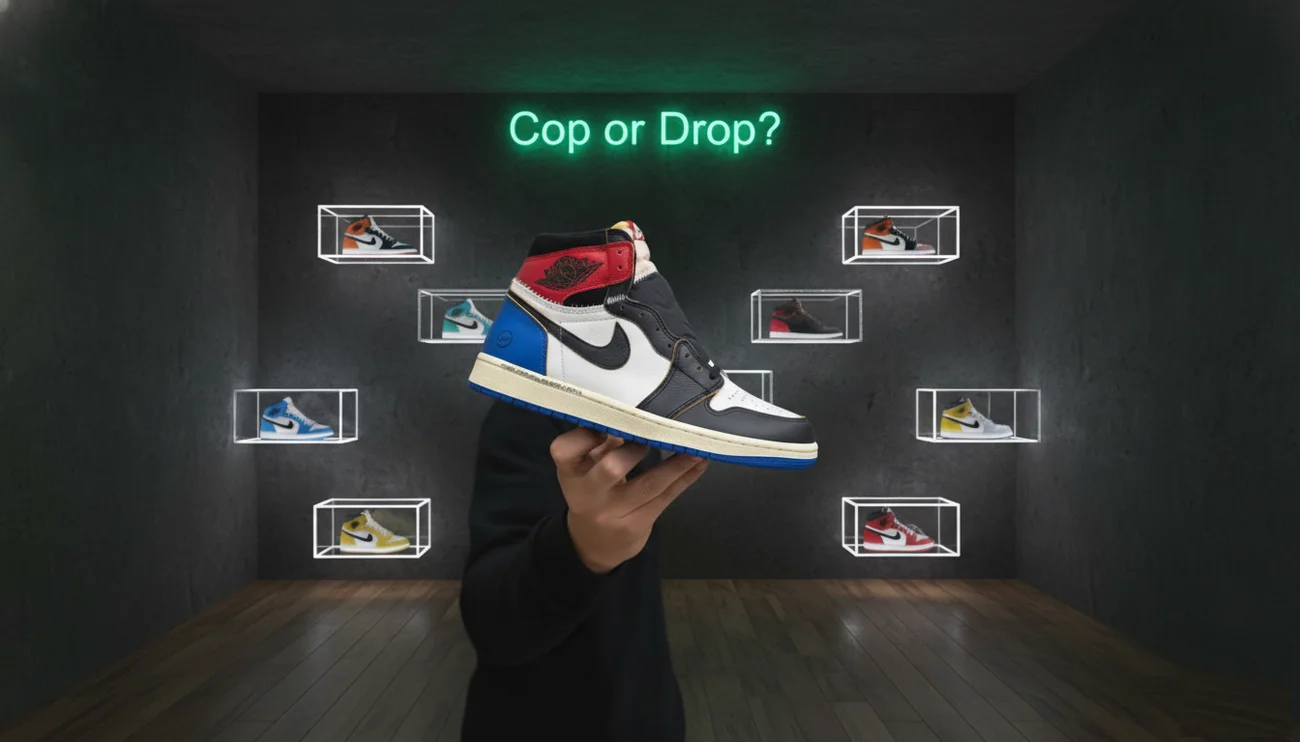
Cop or Drop is a simple sneaker-culture question: would you buy this pair, or would you pass on it?
In U.S. sneaker slang, cop means to get, obtain, or buy something. Drop in this phrase means to leave it alone or pass, although drop also has another sneaker meaning: a product release.
That double meaning is why context matters. “The drop is Friday” means the release happens Friday. “Cop or Drop?” means “Would you buy it or skip it?”
The phrase became popular because it compresses an opinion into two words. It can be used seriously, jokingly, in polls, reviews, social posts, release discussions, or conversations between friends.
What Does Cop or Drop Mean?
Cop or Drop means “buy it or pass on it?” It asks whether a sneaker is worth pursuing from your point of view.
The phrase does not require the shoe to be limited, expensive, or hyped. You can ask Cop or Drop about a general release, a retro, a collaboration, a running shoe, or a pair sitting on sale.
The answer is personal: design, fit, price, use, budget, nostalgia, and availability can all matter.
- Cop: I would buy or try to get it.
- Drop: I would pass.
- Maybe: often means “cop at a lower price” or “depends on fit.”
What Does “Cop” Mean in Sneakers?
In sneaker culture, cop means to acquire a pair—usually by buying it, although the broader slang sense is simply to obtain something.
The verb was not invented by sneakerheads. Dictionary.com traces cop as slang connected with grabbing, seizing, or obtaining, with roots much older than modern sneaker culture.
Sneaker communities adopted an existing English slang verb because it fits the act of securing a release: “I copped the pair,” “Did you cop?” or “Easy cop.”
In U.S. conversation, “cop” can describe intention before launch or a completed purchase afterward, depending on the sentence.
- “I’m going to cop these.”
- “I copped them this morning.”
- “That’s an easy cop for me.”
Did Sneaker Culture Invent the Word “Cop”?
No. The slang verb cop existed long before sneaker collecting became a modern subculture.
English dictionaries document senses related to obtaining, grabbing, or acquiring. Sneaker culture gave the word a highly visible new setting rather than creating it from scratch.
That distinction matters because sneaker slang often borrows from wider Black American, hip-hop, sports, streetwear, skate, gaming, and internet language.
Understanding the broader language keeps sneaker history from being falsely presented as if every popular term began inside a shoe forum.
Does “Cop” Only Mean Buying a Limited Sneaker?
No. A sneaker does not need to be limited for someone to call it a cop.
You can cop an Air Force 1 general release, a discounted running shoe, a vintage pair, or a collaboration.
Hype changes urgency, not the basic meaning of the word.
Sometimes the best cop is the pair you will actually wear instead of the one everyone else is discussing.
Cop Can Mean Intention or a Completed Purchase
Before release, “cop” often means intention: “I’m copping these.”
After release, copped usually means the purchase or acquisition already happened.
The same person can say “cop” on Monday, take an L on Friday, and never actually complete the purchase.
That is why Cop or Drop is mainly an opinion format rather than proof of a transaction.
Context usually makes the timing clear.
- Before launch: “Cop.”
- After purchase: “Copped.”
- After missing out: “Wanted to cop, but took an L.”
- After changing your mind: “It was a cop until I saw the price.”
- After a discount: “Now it’s a cop.”
What Does “Drop” Mean in Cop or Drop?
In Cop or Drop, drop means pass: you would leave the shoe behind rather than buy it.
It is close to saying “skip,” “pass,” or “not for me.”
That does not mean the sneaker is objectively bad.
A Drop for one person can be an Instacop for someone else.
Price can turn a Cop into a Drop, and a discount can reverse the decision.
Fit, intended use, color, materials, and what you already own can matter more than public hype.
Why Does “Drop” Also Mean a Sneaker Release?
In fashion and sneaker culture, a drop also means a product release or availability event.
People say “the drop,” “drop date,” “this week’s drops,” or “the shoe drops Friday.”
That usage became common across streetwear, music, gaming, fashion, and product culture.
A release can be scheduled, first-come-first-served, raffle-based, draw-based, or distributed through another mechanism.
So “drop” has two different jobs in sneaker conversation.
In “What time does the drop start?” it means the release event.
In “Cop or Drop?” it means pass.
The grammar normally resolves the ambiguity.
If you are researching launch terminology, see what a sneaker drop means.
The fact that one word carries two sneaker meanings is normal slang evolution, not a contradiction.
Cop, Copped, Instacop, and Pass: How the Terms Work
Cop
Cop means you would get the pair or try to buy it.
Copped
Copped is the completed form: you already secured or bought the item.
Instacop
Instacop means an immediate yes—something you want with little hesitation.
It expresses enthusiasm, not guaranteed availability or a completed purchase.
Cop or Pass
Cop or Pass is essentially the same opinion format as Cop or Drop, without the second meaning that drop has in release language.
Are Cop or Drop and W/L the Same Thing?
No. Cop or Drop is usually an opinion or intention. W/L describes the result of an attempt.
You can vote Cop before release and still take an L in the raffle.
You can also vote Drop and later change your mind after seeing the shoe in person.
The phrases answer different questions.
One is “Do I want it?” The other is “Did I get it?”
- Cop: I want it.
- Drop: I would pass.
- W: my attempt succeeded.
- L: my attempt did not succeed.
Cop Is Not the Same Thing as a W
A Cop can happen before the release, while a W can only describe a successful outcome.
Saying “Cop” in a poll does not mean you already own the sneaker.
If you enter a SNKRS Draw and are selected, that is a W.
If the pair was also something you wanted, it was both a Cop and a W—but the terms still describe different things.
See our guide to sneaker terminology for related slang.
Drop Is Not the Same Thing as an L
A Drop is a decision or opinion: you do not want to buy the pair.
An L is an unsuccessful attempt to get something you did want.
If you never enter the raffle because the shoe is a Drop for you, there is no L.
That distinction keeps the language surprisingly logical once the slang is decoded.
Is Cop or Drop the Same as a Raffle or Draw?
No. Cop or Drop is an opinion format.
A raffle or draw is a release mechanism used to allocate the chance to purchase a product.
You can answer Cop for a sneaker and then enter a raffle.
You can answer Drop and ignore the raffle completely.
You can also Cop a shoe sold first-come-first-served, by reservation, or from normal retail inventory.
The sales mechanism does not define whether something is a Cop.
It only changes how you might try to get it.
Does Cop or Drop Only Make Sense for Limited Releases?
No. The format works for any sneaker people have an opinion about.
A mass-market running shoe can be Cop or Drop.
A retro sitting on shelves can be Cop or Drop.
A collaboration that sold out in seconds can be Cop or Drop.
Limitation increases discussion, but it is not part of the definition.
How Did Cop or Drop Become a Content Format?
The phrase is ideal for social media because it creates an immediate binary choice.
Sneaker pages use it in polls, short videos, carousels, live streams, reviews, and release previews.
It also encourages comments because people naturally explain why they voted one way.
Brands and retailers can use similar “would you buy?” engagement formats, although Cop or Drop belongs to broader community language rather than one company.
The strongest versions go beyond hype and explain fit, materials, retail price, use, and design.
Do More “Cop” Votes Mean the Sneaker Will Increase in Value?
No. Social-media enthusiasm is not a resale model.
A poll measures the opinions of the people who saw and answered it.
Resale value depends on supply, demand, size, timing, release quantity, restocks, condition, and market behavior.
A shoe can receive overwhelmingly positive reactions and still trade below retail if supply is large.
Another pair can divide opinions but become scarce later.
- Poll votes are not purchase orders.
- Hype does not reveal actual supply.
- A current price check should use comparable completed sales.
How Should You Decide Whether a Sneaker Is a Cop or Drop for You?
The best answer combines taste with practical questions instead of outsourcing the decision to the loudest comment section.
Do You Actually Like the Design?
If you would still want the shoe without the collaboration name, celebrity, or resale chart, that is strong evidence it is a real Cop for you.
Does the Model Fit Your Intended Use?
A basketball shoe, retro lifestyle sneaker, running model, skate shoe, and trail sneaker solve different problems. Buy for how you plan to wear it.
Does the Fit Work for You?
A great colorway in the wrong last can become an expensive box decoration. Check model-specific sizing and your own foot shape.
Does the Price Fit Your Budget?
A Cop at retail can become a Drop at an inflated resale price. Your budget is part of the opinion.
Are You Choosing the Pair or Reacting to the Release?
FOMO can make urgency feel like preference. Ask whether you still want the shoe if the countdown clock disappears.
There is no penalty for changing your mind after seeing better photos, learning the fit, or discovering that another pair suits you more.
Examples of Cop or Drop in Conversation
The phrase works naturally in U.S. sneaker conversation because it can be short or expanded with reasons.
Here are common forms:
- “Cop or Drop on the new colorway?”
- “Cop at retail, Drop at resale.”
- “Instacop for me.”
- “I was going to Cop, but the materials changed my mind.”
- “Drop—I already own something too similar.”
- “Cop if it fits TTS.”
- “Easy Cop once it hits sale.”
Cop or Drop FAQ
What Does Cop or Drop Mean?
It means “Would you buy this sneaker or pass on it?”
What Does Cop Mean in Sneakers?
Cop means to get, obtain, or buy a pair.
Does Cop Mean Buy?
Usually, yes in sneaker conversation, although the broader slang sense is “obtain.”
Did Sneakerheads Invent the Word Cop?
No. The slang verb existed long before sneaker culture adopted it.
What Does Copped Mean?
Copped means the person already secured or bought the item.
What Does Drop Mean in Cop or Drop?
It means pass or skip the purchase.
Why Does Drop Also Mean a Release?
Because drop developed a separate fashion and product meaning for a launch or release event. Context tells you which meaning applies.
Is Cop or Drop the Same as Cop or Pass?
Yes in practical use. Both ask whether you would buy or pass.
What Does Instacop Mean?
Instacop means an immediate yes—something you want with very little hesitation.
Is Cop the Same as a W?
No. Cop describes desire or purchase intent; W describes a successful release attempt.
Is Drop the Same as an L?
No. Drop means you chose to pass; L means you tried and did not succeed.
Is Cop or Drop a Raffle?
No. A raffle is a release mechanism; Cop or Drop is an opinion.
Is Cop or Drop Only Used for Limited Sneakers?
No. It can be used for any sneaker.
Do You Have to Actually Buy the Shoe to Say Cop?
No. Before release, Cop commonly communicates intention. After purchase, people often say Copped.
Do More Cop Votes Mean Higher Resale Value?
No. Polls measure opinion, not guaranteed demand, supply, or completed sales.
How Do I Decide Cop or Drop?
Consider design, fit, intended use, price, what you already own, and whether you would still want the pair without the hype.
Conclusion: Two Words That Summarize an Opinion
Cop or Drop survived because it is simple enough for a poll and flexible enough for a real buying decision.
Cop means you want to get the pair. Drop means you would pass.
Neither word predicts resale value, rarity, authenticity, or whether you will win a raffle.
The most useful Cop is the one that fits your taste, feet, use, and budget.
If you want to keep decoding the language around releases and collecting, continue with the Sneakerhead Dictionary.