Long before contemporary sneakers arrived at Lapstone & Hammer, its address had housed other kinds of retail. Those overlapping eras provide a useful introduction to the Philadelphia boutique. Its identity has developed through attention to both the product and the materials and memories surrounding its presentation.
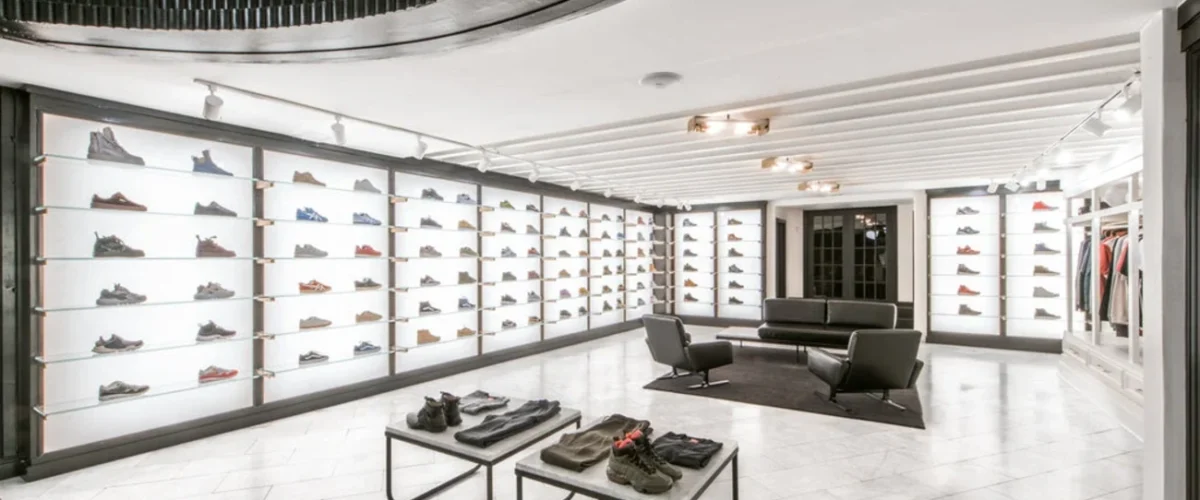
Brian Nadav’s shop opened in 2015 at 1106 Chestnut Street. The story is not simply about which labels reached its shelves. It also concerns the decision to make the physical setting part of a conversation about making things, noticing details and getting dressed.
An address becomes part of the identity
In its 2015 account of the building, Lapstone described former occupants including an Evans drugstore, a Dr. Scholl’s shop and Pauline’s Bridal Shoppe. It also explained that old shoe-display stands discovered on the premises would be reused.
That connection is particularly meaningful in sneaker retail. A stand from an earlier period of footwear selling brings objects from different generations into contact. Shoe technology changes, but familiar actions remain: looking closely, touching materials, comparing pairs and trying them on.
Such continuity gives the space a personality beyond the latest release. The building becomes another layer of the presentation, supplying references that remain alongside changing selections of apparel and footwear.
The 2017 expansion
For its second anniversary, the boutique unveiled a designer-focused annex and introduced house labels with names recalling the building’s past, including Pauline’s Bridal Shoppe and Evans Apothecary. Its event report credits Kate Rohrer of ROHE Creative with the design and records a musical appearance by DJ Clark Kent.
This chapter brings architecture, music and product into the same frame. The additional space was not presented merely as room for more inventory. It made the references behind the store more explicit.
For sneaker enthusiasts, that context changes how a boutique can be read. The selection gains a relationship with furnishings, materials and other parts of a wardrobe. Footwear remains central without having to carry the entire identity of the place on its own.
Indigo as a process
The 2024 Lapstone Indigo project combined Standard Issue apparel with ASICS models hand-dyed in Philadelphia. The GEL-NYC and GEL-1130 underwent a dip-dye process that produced tonal variation between pairs.
The distinction matters: the retailer described a dye intervention on existing models, which should not automatically be confused with developing a new silhouette. The interest lies in what the process adds to the surface and appearance of a familiar object.
It also offers another way to think about uniqueness. Difference is not simply a matter of how few pairs exist; it can be visible in the material result of the work. Color absorption, layered panels and transitions between shades of blue become things to examine.
That is an approachable entry point even for someone unfamiliar with sneaker release calendars. The question is less about recognizing a code immediately and more about understanding what happened to the object in front of you.
A story told through materials
The connections between these chapters are tangible: old display stands, commercial memory, architecture and dye. Together they explain Lapstone & Hammer more clearly than a list of stocked labels or launches could.
Its trajectory invites sneaker enthusiasts to pay attention to how things are made and presented. A building and a hand-dyed shoe operate at different scales, but both reward the same habit: taking a closer look before moving on to the next new release.
Sources and further reading
1106 Chestnut Street: a house full of history
Brian Nadav and the opening of Lapstone & Hammer
Related store histories
Notre
A Ma Maniére
For the wider context, explore Sneaker History and Culture: From Rubber Soles to a Global Movement.