Packer’s long history becomes more interesting when its different eras are kept visible. A neighborhood shoe business and a modern sneaker boutique answer different needs, yet knowledge can pass between them. The resulting story is about how a retailer uses inherited experience: as material to reinterpret, as a relationship to maintain and sometimes as an old product worth looking at again.
From Yonkers to New Jersey
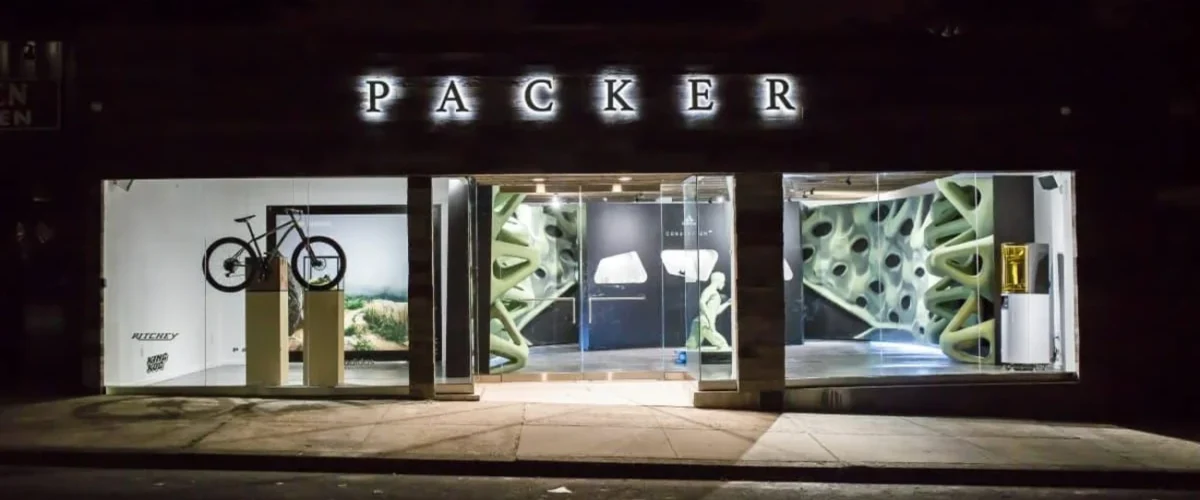
The original Packer store opened on Ashburton Avenue in Yonkers, New York, in 1907 and served the neighborhood for more than ninety years. The next-generation store opened in Teaneck, New Jersey, in 2003. Packer’s official history connects the two as stages of a family business, with the New Jersey boutique developing a new expression of that inheritance.
The family sequence gives the dates a human scale. Reporting based on an interview with Mike Packer traces the business to his grandfather and great-uncle, followed by his father Marty and then Mike’s generation. That continuity is about people passing on a trade, including an understanding of customers and footwear accumulated through ordinary shop work.
Mike’s own route was indirect. In a 2021 interview, he recalled law school, venture capital and travel to Asia, while continuing to help his father with brand meetings. The eventual return joined an inherited business with experiences gathered elsewhere. His account emphasizes continuity in supplier relationships alongside a desire to approach the shop in a different way.
Working with the footwear archive
Basketball offered one route into collaborative design. Packer participated in Reebok’s twentieth-anniversary Pump project in 2009, with an in-store event announced for November 19. The project connected the boutique with a performance-shoe archive and gave that history a local setting, where a familiar sporting technology could be reconsidered through a retailer’s particular interests.
Material could be a starting point too. Discussing the 2013 Saucony Hangtime Woodland Snake, Mike Packer described finding a compelling combination in the supplier’s material books. He was wary of attaching a story to every design decision. That comment is an important counterweight: the shop’s creative approach also leaves room for texture, color and the pleasure of making something work.
The 2015 ASICS GEL-LYTE III Dirty Buck drew on the appearance of a traditional dress shoe, using suede and leather above a brick-red sole. Its March 7 release made a different footwear vocabulary available through a running silhouette. The design offers a particularly clear connection between a general shoe retailer’s heritage and the materials of sneaker collaboration.
The idea grew into the 2017 J.Crew, Packer and ASICS Tiger 1907 Collection, marking the business’s 110th anniversary. Four GEL-LYTE III designs interpreted dress-shoe references, with staged previews before the full September 30 release. The anniversary worked as a design brief: the earlier business supplied ways of thinking about color and materials for a contemporary collection.
The 1907 Collection and its dress-shoe references
Music and the memory of objects
Hip-hop supplied another kind of archive. Packer, Raekwon and Diadora’s 2015 N.9000 Purple Tape marked twenty years of Only Built 4 Cuban Linx. The cassette-associated palette and album details linked a shoe to a physical music format. Recognition depended on shared memory, giving the collaboration a subject beyond the footwear model itself.
Packer returned to that relationship in its 2020 Tales from the Chef feature, recalling the original Purple Tape project and presenting Raekwon’s recollections around the album’s twenty-fifth anniversary. The shop’s platform became a place to preserve a participant’s voice. The footwear collaboration could thus lead into a longer conversation about the work that inspired it.
An Air Force 1 event recap shows a similar interest in objects already owned. Packer temporarily turned its Teaneck store into a display of pairs drawn from customers’ collections, including a tribute to Clark Kent. The shop became an exhibition space, allowing the knowledge held by collectors to become part of what other visitors could see.
On October 13, 2026, Packer’s official contact page listed Teaneck at 941 Teaneck Road and a second New Jersey location at 382 Marin Boulevard, Jersey City. These are the present physical references for the profile. The Yonkers origin explains the inheritance, while the New Jersey addresses locate the later boutique chapter.
Packer’s official contact and locations
The strongest thread is an ability to change the use of an archive. A dress-shoe material can shape a runner, a cassette can suggest a palette, and a customer’s collection can become a display. Packer’s history gives those acts of selection a family and regional context, while leaving room for new interpretations rather than requiring the shop to remain unchanged.
Related store histories
Sneaker Politics
Shoe Gallery
For the wider context, explore Sneaker History and Culture: From Rubber Soles to a Global Movement.