A casino chip might seem an unlikely starting point for a sneaker. In FEATURE’s history, it helps explain what a boutique contributes to a collaboration: a point of view. The shoe still comes from a manufacturer’s archive, but its colors and details begin to tell a story about the people presenting it.
That intersection makes FEATURE worth examining. Its trajectory offers a way to look beyond Las Vegas as a tourist destination and consider how a shop can turn local references into a visual vocabulary that sneaker enthusiasts recognize.
The Chinatown beginning
FEATURE opened in Las Vegas Chinatown in 2010. In its tenth-anniversary retrospective, the company describes four friends wanting a place where music, art, fashion and sneakers could coexist. All Things Good became the phrase connecting that selection.
This beginning matters because it places the shop before its more luxurious retail settings. The idea was about combinations. A sneaker could sit within the same conversation as a garment, a musical reference or a visual concept, rather than being treated as an isolated collectible.
On the original High Roller, black and salmon accents referred to a $100 chip. The tongue label echoed a chip’s shape, while the insoles repeated the graphic motif. The concept was not confined to the release name: it appeared in details that became visible when someone examined the pair.
High Roller gives a local idea physical form
FEATURE’s first sneaker collaboration arrived with Saucony in 2014. The High Roller project used casino chips as its starting point. Las Vegas was therefore more than a name on the packaging: its visual codes became part of the shoes themselves.
It is also a reason to consider a collaboration beyond scarcity. A palette can act as a clue, while a graphic detail can connect an object to a place. Appreciating that relationship does not require owning the shoe or tracking resale prices. It requires understanding the reference behind the design.
The series continued, reaching the Shadow 6000 Chocolate Chip in 2022. FEATURE presented that release as the High Roller Pack’s conclusion, drawing on vintage Las Vegas chips and returning to the visual memory that had shaped the original concept.
A different setting at Wynn
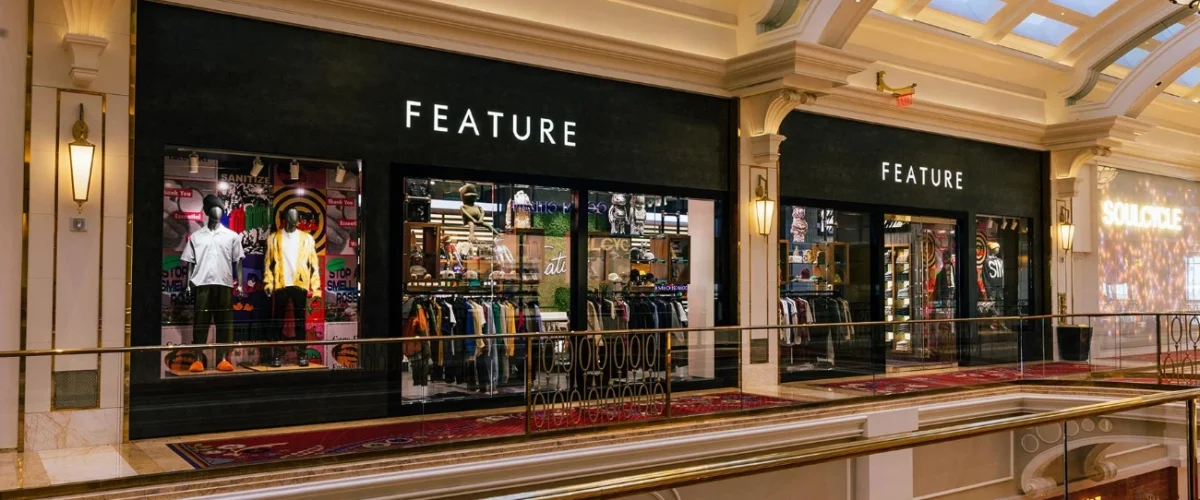
The 2018 opening at Wynn Plaza Shops introduced another setting for the retailer. FEATURE later explained that this location addressed travelers and customers interested in premium fashion. Its sneaker tunnel made footwear presentation part of the store’s architectural experience.
This chapter is more useful than a simple branch count. A different retail environment changes how a selection is encountered. The same identity must make sense to someone following a specific collaboration and to someone discovering the shop while traveling.
It also raises a productive question for anyone interested in sneaker retail: how does a specialist perspective remain legible when its audience broadens? FEATURE’s history offers concrete places and projects through which to think about that question, without assuming that expansion automatically proves cultural importance.
Reading the store through its references
FEATURE provides a tangible example of a boutique acting as an editor of references. Its place in sneaker culture is better understood through those choices than through a best-store ranking. Following the story reveals how a local idea can take shape in products, spaces and ways of looking at footwear.
Sources and further reading
FEATURE: 10 Years in Retrospect
FEATURE x Saucony: The History of the High Roller Pack
Related store histories
Extra Butter
Kith
For the wider context, explore Sneaker History and Culture: From Rubber Soles to a Global Movement.