The Nike Zoom Kobe I belongs to two beginnings: Kobe Bryant’s numbered Nike signature series and, twelve years later, the Protro program. Its importance is easiest to understand by separating those stories. The original was a mid-cut leather basketball shoe; the later version used that familiar shape as a platform for updated performance.
Nike unveiled the model in December 2005, and Bryant wore it professionally on Christmas Day. Retail histories generally place the original launch in 2006. These dates describe different events, so a shoe labeled ‘2005’ in a retrospective and ‘2006’ in a marketplace is not necessarily a different model. Nike Kobe Vault: Kobe I Nike Zoom Kobe I: original shoe review
Ken Link’s place in the story
Ken Link designed the Kobe I. Contemporary reporting from Nike’s 2006 media summit identifies him directly, an important correction to the assumption that Eric Avar designed every numbered Kobe. Avar’s wider relationship with Bryant should not erase Link’s work on the first two signatures. Ken Link at Nike’s 2006 media summit
Look at the I beside the later IV or VI and its proportions tell a different story. The substantial collar, broad forefoot and layered panels belong to an earlier basketball design vocabulary. The line’s identity was still being developed; a low collar was not yet its defining visual rule.
What the original actually used
The original combines a leather upper with Zoom Air at the heel and forefoot, supported by a Phylon midsole. Its collar and heel structure are part of the shoe’s containment system. Those components should be described as a complete construction rather than reduced to an ‘Air’ logo.
The layered leather makes the construction easy to read: the forefoot panels, collar and heel look like distinct pieces assembled around the foot. That visible architecture is part of the I’s character. Later knitted Kobes would pursue a more continuous surface, making the first model a useful starting point for following how the line’s visual language changed.
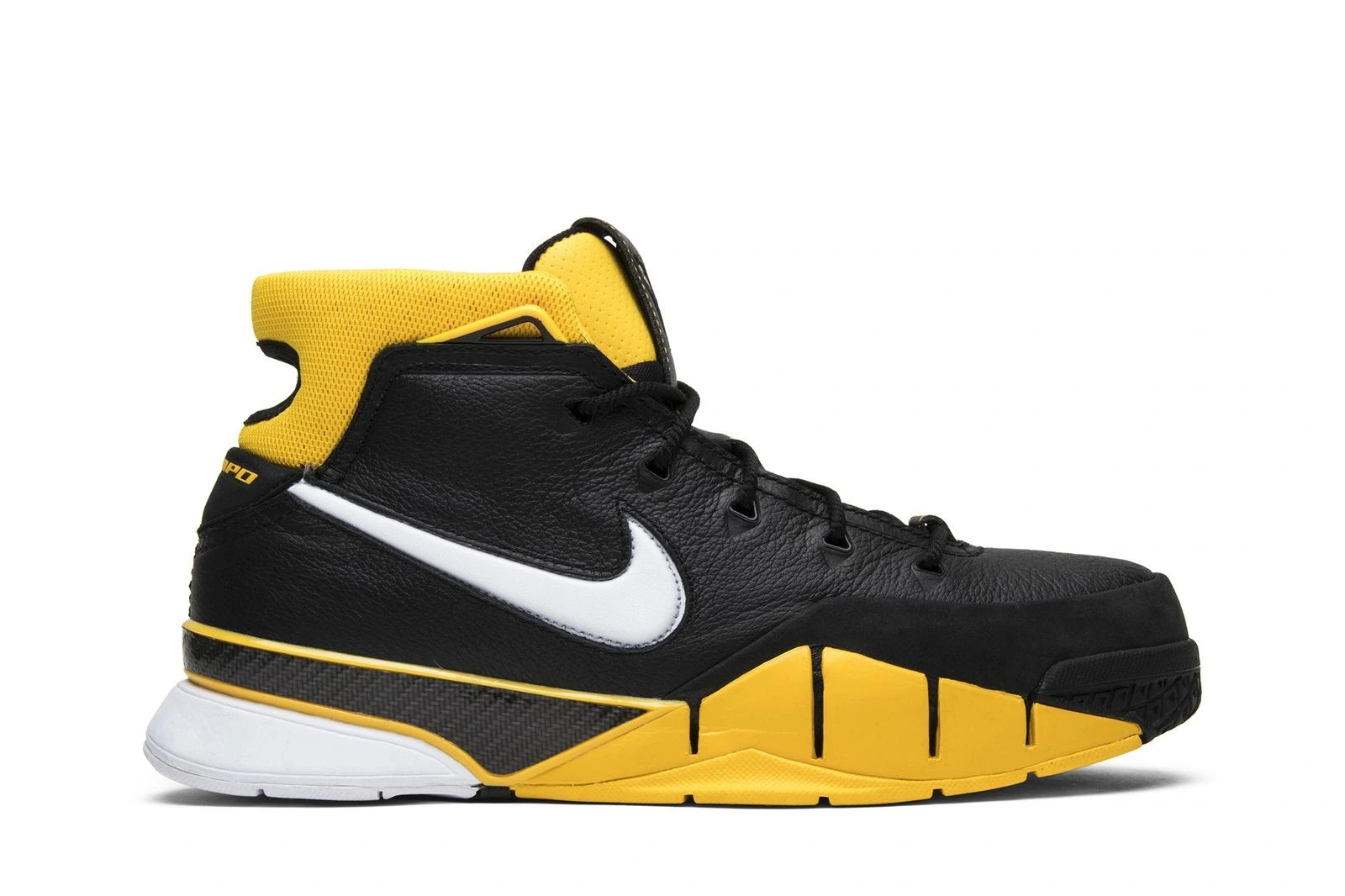
Three original retail colors
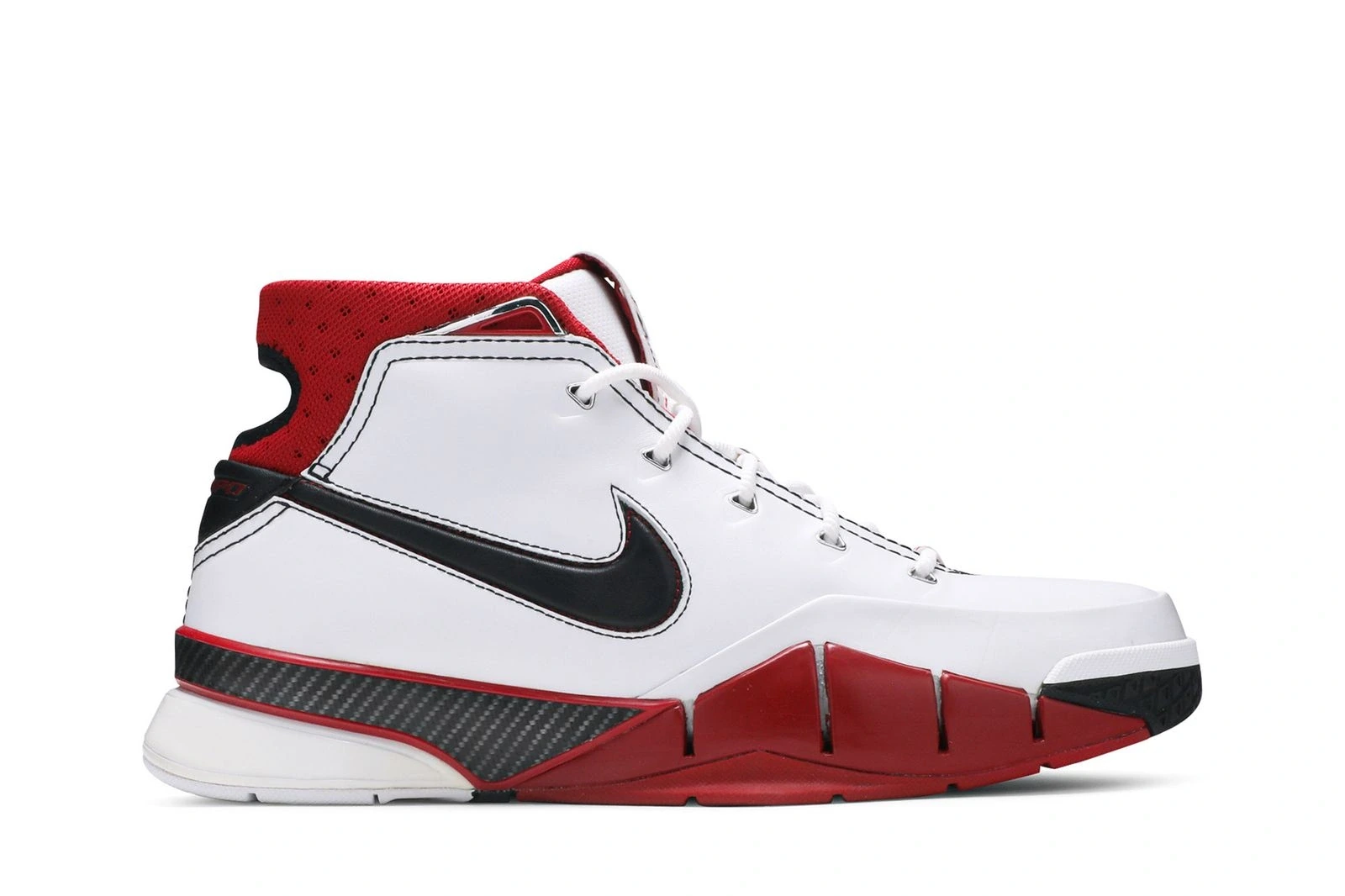
All-Star, 2006: White/Black/Varsity Red, SKU 313143-101, is a documented original retail edition. Original Kobe 1 All-Star 2006: 313143-101 The white base and red accents place the layered design in a different visual register from the Lakers-linked palettes. This is separate from the white/purple player exclusive used in the 81-point game.
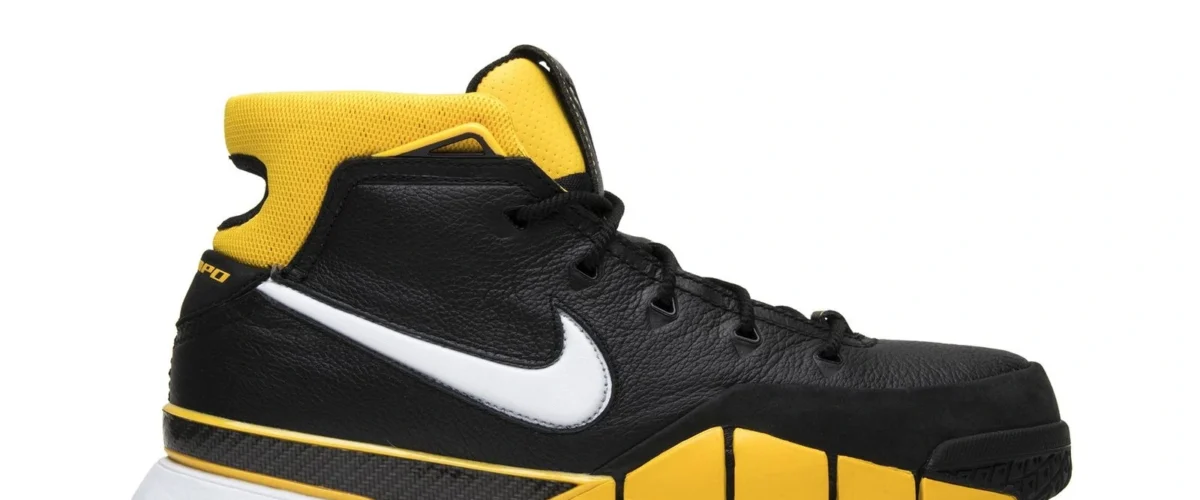
Black/White/Varsity Maize: the darker original-era scheme makes the white Swoosh and yellow accents stand out against the upper. It gives the same layered construction a denser appearance than the white All-Star retail edition. Compared with All-Star, Black/Maize shows how the original range could move between team-linked colors and another basketball occasion without changing its construction. Kobe Archive: Kobe I colorway catalog
MPLS: Flint Grey, white and University Blue shift the model toward a cooler palette. Nike Kobe 1 MPLS: original product archive The grey body softens the contrast between panels, while blue becomes the visual accent. Beside the white/red All-Star and black/maize pairs, MPLS demonstrates the range of the original design before later commemorative editions expanded its story.
All-Star, Black/Maize and MPLS show how varied the original retail palette already was. The separate white/purple game pair adds another kind of history: a player exclusive whose cultural importance exceeded its original availability.
The game that transformed its meaning
White/Black/Varsity Purple: Bryant’s 81-point game pair was a player exclusive. The Story Behind Kobe Bryant’s First Nike Signature Sneaker The bright base and dark accents produce a clearly divided silhouette; purple gives the restrained scheme its Lakers association. Its historical importance comes from the specific pair on court, while later commemorative versions turn that memory into another product chapter. Our Nike PE guide explains the player-exclusive designation.
On January 22, 2006, Bryant scored 81 points against Toronto. The date and total are documented by the NBA. NBA Communications: Kobe Bryant by the numbers For the shoe, that performance created a durable visual association: a particular pair became a way to remember an entire evening.
The timing made the association especially powerful: the performance came early in the first numbered Nike model’s life. The silhouette did not need years of accumulated history to become recognizable. The 81-point night supplied an immediate visual reference, and later editions could return to that image whenever they revisited the beginning of the line.
Protro begins in 2018
The Kobe I Protro arrived in February 2018. Contemporary launch coverage documented revised Zoom cushioning and a lighter build while preserving the familiar exterior. Kobe I Protro contemporary February 2018 announcement The project established a new role for the silhouette: a recognizable part of Bryant’s history could return as equipment for contemporary basketball.
The 2018 launch also brought an Undefeated collaboration into the Protro story, connecting the return to Los Angeles’s sneaker culture. Nike: Makers of the Game, All-Star 2018 This broadened what a return could mean: the familiar design could support updated construction and a fresh collaboration at the same time. The I therefore anchors both the original numbered sequence and the later conversation between basketball history and contemporary product design.
Frequently asked questions
Was the Kobe 1 Kobe’s first Nike shoe?
It was his first numbered Nike signature. Shoes he wore before it, including Huarache models, are a separate part of the chronology.
Did the Protro debut in 2006?
No. The original retail era is 2006; the first Kobe I Protro arrived in 2018.
Is every 81 Points pair an original?
No. The nickname also appears on later commemorative versions. Identify the edition and production year.
Editorial research checked on October 16, 2026.